Results by title
3 books match the query 'Novelists, French'
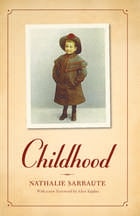
Childhood
Nathalie Sarraute
University of Chicago Press, 2013
As one of the leading proponents of the nouveau roman, Nathalie Sarraute is often remembered for her novels, including The Golden Fruits, which earned her the Prix international de litterature in 1964. But her carefully crafted and evocative memoir Childhood may in fact be Sarraute’s most accessible and emotionally open work. Written when the author was eighty-three years old, but dealing with only the first twelve years of her life, Childhood is constructed as a dialogue between Sarraute and her memory. Sarraute gently interrogates her interlocutor in search of her own intentions, more precise accuracy, and indeed, the truth. Her relationships with her mother in Russia and her stepmother in Paris are especially heartbreaking: long-gone actions are prodded and poked at by Sarraute until they yield some semblance of fact, imbuing these maternalistic interactions with new, deeper meaning. Each vignette is bristling with detail and shows the power of memory through prose by turns funny, sad, and poetic. Capturing the ambience of Paris and Russia in the earliest part of the twentieth century, while never giving up the lyrical style of Sarraute’s novels, this book has much to offer both memoir enthusiasts and fiction lovers.
[more]
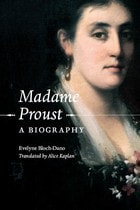
Madame Proust
A BiographyEvelyne E. Bloch-Dano
University of Chicago Press, 2007
Marcel Proust’s In Search of Lost Time opens with one of the most famous scenes in literature, as young Marcel, unable to fall asleep, waits anxiously for his mother to come to his bedroom and kiss him good night. Proust's own mother is central to the meaning of his masterpiece, and she has always held a special role in literary history, both as a character and as a decisive influence on the great writer’s career. Without knowing much about her, we think of her as the quintessential writer's mother.
Now Evelyne Bloch-Dano’s touching biography acquaints Proust fans with the real Jeanne Weil Proust. Written with the imaginative force of a novel, but firmly grounded in Jeanne and Marcel Proust’s writings, Madame Proust skillfully captures the life and times of Proust’s mother, from her German-Jewish background and her marriage to a Catholic grocer’s son to her lifelong worries about her son’s sexuality, health problems, and talent. As well as offering intimate glimpses of the Prousts’ daily life, Madame Proust also uses the family as a way to explore the larger culture of fin-de-siècle France, including high society, spa culture, Jewish assimilation, and the Dreyfus affair. Throughout, Bloch-Dano offers sensitive readings of Proust’s work, drawing out the countless interconnections between his mother, his life, and his magnum opus.
Those coming to In Search of Lost Time for the first time will find in Madame Proust a delightful primer on Marcel Proust’s life and times. For those already steeped in the pleasures of Proust, this gem of a biography will give them a fresh understanding of the rich, fascinating background of the writer and his art.
[more]
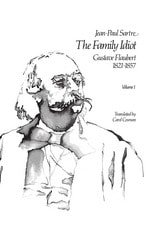
The Family Idiot
Gustave Flaubert, 1821-1857, Volume 1Jean-Paul Sartre
University of Chicago Press, 1981
That Sartre's study of Flaubert, The Family Idiot, is a towering achievement in intellectual history has never been disputed. Yet critics have argued about the precise nature of this novel, or biography, or "criticism-fiction" which is the summation of Sartre's philosophical, social, and literary thought. Sartre writes, simply, in the preface to the book: "The Family Idiot is the sequel to The Question of Method. The subject: what, at this point in time, can we know about a man? It seemed to me that this question could only be answered by studying a specific case."
"A man is never an individual," Sartre writes, "it would be more fitting to call him a universal singular. Summed up and for this reason universalized by his epoch, he in turn resumes it by reproducing himself in it as singularity. Universal by the singular universality of human history, singular by the universalizing singularity of his projects, he requires simultaneous examination from both ends." This is the method by which Sartre examines Flaubert and the society in which he existed.
Now this masterpiece is being made available in an inspired English translation that captures all the variations of Sartre's style—from the jaunty to the ponderous—and all the nuances of even the most difficult ideas. Volume 1 consists of Part One of the original French work, La Constitution, and is primarily concerned with Flaubert's childhood and adolescence.
[more]