Results by title

9 books match the query 'Nuclear power plants'

cover of Bureaucrats, Clients, and Geography: The Bailly Nuclear Power Plant Battle in Northern Indiana

Bureaucrats, Clients, and Geography

The Bailly Nuclear Power Plant Battle in Northern Indiana

Nancy J. Obermeyer

University of Chicago Press, 1989
[more]
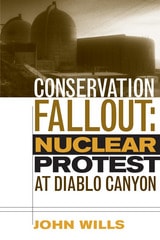
cover of Conservation Fallout: Nuclear Protest At Diablo Canyon

Conservation Fallout

Nuclear Protest At Diablo Canyon

John Wills

University of Nevada Press, 2012

An unprecedented look at nuclear politics in California Vehement, widespread opposition accompanied the rise of the U.S. nuclear industry during the 1960s and 1970s. In Conservation Fallout, John Wills examines one of the most controversial atomic projects of the period: Pacific Gas and Electric Company’s decision to build its premier nuclear power plant at Diablo Canyon, a relatively unsettled, biologically rich, and especially scenic part of the central California coastline. Two competing visions of California emerged while the plant underwent construction. Environmentalists used Diablo as a symbol of impending ecological doomsday, while PG&E envisioned it as the model that would usher in a new age of energy production. The Sierra Club almost disbanded over whether to condone or protest the reactor project. Divisions also emerged in the local community as residents and politicians, enticed by the promise of cheap electricity and lucrative tax revenues, found themselves pitted against others who feared the dangers of radiation in their own backyards. The controversy intensified when a fault line was discovered within three miles of the plant. Grassroots groups The Mothers for Peace, a local women’s group, and The Abalone Alliance, a statewide nonviolent direct-action organization, did their utmost to stop the plant from going on-line. In 1979, an Alliance rally in San Francisco attracted 25,000 people, while 40,000 others gathered in San Luis Obispo. During a two-week-long blockade of the Diablo plant in 1981, over 1,900 activists were jailed, the largest arrest in the history of American antinuclear protest. Despite its significance in the history of twentieth-century environmental issues and the continuing debate over the safety of nuclear power, the full story of Diablo Canyon has not been told until now. Wills bases his account on extensive interviews with the individuals involved, as well as on the archives of the Sierra Club, several protest organizations, public agencies, PG&E, and others. The result is an engaging, balanced examination of nuclear politics in California. By focusing on one of the last wild places in the state and its transformation into a major technological center, and on the evolution and strategies of the little-studied grassroots protest groups determined to protect California and resist the spread of nuclear technology, Wills has made a major contribution to our understanding of America’s nuclear age.
[more]
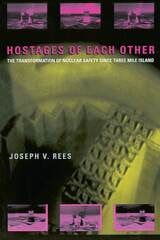
cover of Hostages of Each Other: The Transformation of Nuclear Safety since Three Mile Island

Hostages of Each Other

The Transformation of Nuclear Safety since Three Mile Island

Joseph V. Rees

University of Chicago Press, 1996

Rees offers the first in-depth account of the extraordinary transformation in the safety standards, operations, and management of the nation's nuclear facilities spurred by the accident at Three Mile Island. Detailing the surprising success of self-regulation within the nuclear industry, his book reveals the possibilities for effective communitarian action.
[more]
cover of Mothers and the Mexican Antinuclear Power Movement

Mothers and the Mexican Antinuclear Power Movement

Velma García-Gorena

University of Arizona Press, 1999

In the early 1970s construction began on a nuclear power plant at Laguna Verde in the Mexican state of Veracruz. Initially, most local citizens were largely unconcerned with the prospect of having the nuclear plant in their community. With the accidents at Three Mile Island and Chernobyl, however, residents' complacency toward the power plant soon turned to opposition. Protest groups such as the Madres Veracruzanas emerged to join existing environmental groups in a fight to close down the facility.

In Mothers and the Mexican Antinuclear Power Movement, Velma García-Gorena traces the protest movement against the Mexican government's Laguna Verde nuclear plant, outlining the movement's formation, development, and decline. Documenting the movement's key players and turning points in superb detail, she interweaves important historical narrative with a deft examination of the events, framing her analysis in terms of social movement literature. In a departure from the more conventional New Social Movements approach to analyzing antinuclear movements, García-Gorena demonstrates how, in many ways, movements of this kind are not so new and how a modified "political process" approach fits much better. With a sophisticated application of various social movements' paradigms, García-Gorena incorporates perspectives such as resource mobilization, political process paradigms, and feminist theory.

Timely, well written, and thoroughly researched, Mothers and the Mexican Antinuclear Power Movement fills a major gap in the literature on grassroots environmental movements in Latin America. Both rich in empirical detail and convincing in its conclusions, this study provides a broader understanding of Mexican social movements and the quest for democracy in developing countries.
[more]
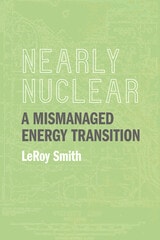
cover of Nearly Nuclear: A Mismanaged Energy Transition

Nearly Nuclear

A Mismanaged Energy Transition

leroy smith

Michigan State University Press, 2021
When Consumers Power’s plan to build a nuclear power plant in Midland, Michigan, was announced in 1967, it promised to free Michigan residents from expensive, dirty, coal-fired electricity and to keep Dow Chemical operating in the state. But before the plan could be completed, the facility was called an engineering nightmare, a financial disaster, a construction boondoggle, a political headache, and a regulatory muddle. Most locals had welcomed nuclear power eagerly. Why, after almost twenty years and billions of dollars, did this promise of a high-tech, coal-free, prosperous future fail? And what lessons does its failure offer today as Americans try to develop a clean energy  economy based on renewable power? To answer these questions, energy consultant and author LeRoy Smith carefully traces the design and construction decisions made by Consumers Power, including its choice of reactor and its hiring of the Bechtel Corporation to manage the project. He also details the rapidly changing regulatory requirements and growing public concern about the environmental risks of nuclear power generation. An examination of both the challenges and importance of renewable energy, this book will be of value to anyone interested in grappling with the complexities of our ongoing efforts to eliminate fossil fuels in favor of clean renewable energy.
[more]
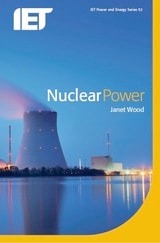
cover of Nuclear Power

Nuclear Power

Janet Wood

The Institution of Engineering and Technology, 2007
This title is the first of four 'new-look' books in the Power and Energy series that are aimed at industry professionals rather than academics. Nuclear Power explains in detail how nuclear power works, its costs, its benefits as part of the electricity supply system, and also examines its record.
[more]
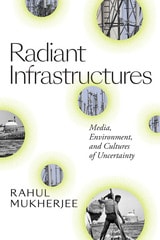
cover of Radiant Infrastructures: Media, Environment, and Cultures of Uncertainty

Radiant Infrastructures

Media, Environment, and Cultures of Uncertainty

Rahul Mukherjee

Duke University Press, 2020
In Radiant Infrastructures Rahul Mukherjee explores how the media coverage of nuclear power plants and cellular phone antennas in India—what he calls radiant infrastructures—creates environmental publics: groups of activists, scientists, and policy makers who use media to influence public opinion. In documentaries, lifestyle television shows, newspapers, and Bollywood films, and through other forms of media (including radiation-sensing technologies), these publics articulate contesting views about the relationships between modernity, wireless signals, and nuclear power. From testimonies of cancer patients who live close to cell towers to power plant operators working to contain information about radiation leaks and health risks, discussions in the media show how radiant infrastructures are at once harbingers of optimism about India's development and emitters of potentially carcinogenic radiation. In tracing these dynamics, Mukherjee expands understandings of the relationship between media and infrastructure and how people make sense of their everyday encounters with technology and the environment.
[more]
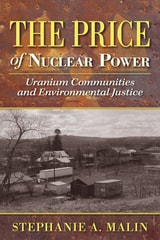
cover of The Price of Nuclear Power: Uranium Communities and Environmental Justice

The Price of Nuclear Power

Uranium Communities and Environmental Justice

Malin, Stephanie A.

Rutgers University Press, 2015

Rising fossil fuel prices and concerns about greenhouse gas emissions are fostering a nuclear power renaissance and a revitalized uranium mining industry across the American West. In The Price of Nuclear Power, environmental sociologist Stephanie Malin offers an on-the-ground portrait of several uranium communities caught between the harmful legacy of previous mining booms and the potential promise of new economic development. Using this context, she examines how shifting notions of environmental justice inspire divergent views about nuclear power’s sustainability and equally divisive forms of social activism. 
 
Drawing on extensive fieldwork conducted in rural isolated towns such as Monticello, Utah, and Nucla and Naturita, Colorado, as well as in upscale communities like Telluride, Colorado, and incorporating interviews with community leaders, environmental activists, radiation regulators, and mining executives, Malin uncovers a fundamental paradox of the nuclear renaissance: the communities most hurt by uranium’s legacy—such as high rates of cancers, respiratory ailments, and reproductive disorders—were actually quick to support industry renewal. She shows that many impoverished communities support mining not only because of the employment opportunities, but also out of a personal identification with uranium, a sense of patriotism, and new notions of environmentalism. But other communities, such as Telluride, have become sites of resistance, skeptical of industry and government promises of safe mining, fearing that regulatory enforcement won’t be strong enough. Indeed, Malin shows that the nuclear renaissance has exacerbated social divisions across the Colorado Plateau, threatening social cohesion. Malin further illustrates ways in which renewed uranium production is not a socially sustainable form of energy development for rural communities, as it is utterly dependent on unstable global markets. 
 
The Price of Nuclear Power is an insightful portrait of the local impact of the nuclear renaissance and the social and environmental tensions inherent in the rebirth of uranium mining.
 
 
[more]
cover of Wind Power and Other Energy Options

Wind Power and Other Energy Options

David Rittenhouse Inglis

University of Michigan Press, 1978

Discusses the potential of wind power as an alternative energy source
[more]