Results by title
4 books match the query 'Nuevo León (State)'

Delirio—The Fantastic, the Demonic, and the Réel
The Buried History of Nuevo LeónBy Marie Theresa Hernández
University of Texas Press, 2002
Striking, inexplicable stories circulate among the people of Nuevo León in northern Mexico. Stories of conversos (converted Jews) who fled the Inquisition in Spain and became fabulously wealthy in Mexico. Stories of women and children buried in walls and under houses. Stories of an entire, secret city hidden under modern-day Monterrey. All these stories have no place or corroboration in the official histories of Nuevo León.
In this pioneering ethnography, Marie Theresa Hernández explores how the folktales of Nuevo León encode aspects of Nuevolenese identity that have been lost, repressed, or fetishized in "legitimate" histories of the region. She focuses particularly on stories regarding three groups: the Sephardic Jews said to be the "original" settlers of the region, the "disappeared" indigenous population, and the supposed "barbaric" society that persists in modern Nuevo León. Hernández's explorations into these stories uncover the region's complicated history, as well as the problematic and often fascinating relationship between history and folklore, between officially accepted "facts" and "fictions" that many Nuevoleneses believe as truth.
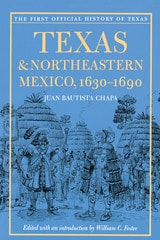
Texas and Northeastern Mexico, 1630-1690
By Juan Bautista Chapa
University of Texas Press, 1997
An English translation of Chapa's Historia de Nuevo León, the first history of the region that eventually became Texas and northeastern Mexico.
Winner, Presidio La Bahía Award, Sons of the Republic of Texas
In the seventeenth century, South Texas and Northeastern Mexico formed El Nuevo Reino de León, a frontier province of New Spain. In 1690, Juan Bautista Chapa penned a richly detailed history of Nuevo León for the years 1630 to 1690. Although his Historia de Nuevo León was not published until 1909, it has since been acclaimed as the key contemporary document for any historical study of Spanish colonial Texas.
This book offers the only accurate and annotated English translation of Chapa's Historia. In addition to the translation, William C. Foster also summarizes the Discourses of Alonso de León (the elder), which cover the years 1580 to 1649. In the appendix, Foster includes a translation of Alonso (the younger) de León's previously unpublished revised diary of the 1690 expedition to East Texas and an alphabetical listing of over 80 Indian tribes identified in this book.
Chapa was also an authority on the local Indians, and his Historia lists the names and locations of over 300 Indian tribes. This information, together with descriptions of the vegetation, wildlife, and climate in seventeenth-century Texas, make this book essential reading for ethnographers, anthropologists, and biogeographers, as well as students and scholars of Spanish borderlands history.
The Archaeology of La Calsada
A Rockshelter in the Sierra Madre Oriental, MexicoBy C. Roger Nance
University of Texas Press, 1992
On a remote mountainside 2,000 meters above sea level in the northern Sierra Madre Oriental, the rockshelter at La Calsada has yielded basic archaeological data for one of the least understood regions of prehistoric North America, the state of Nuevo León in northern Mexico. This comprehensive site report, with detailed information on artifacts and stratigraphy, provides baseline data for further explorations in the region and comparisons with other North American hunter-gatherer groups.
Radiocarbon dating traces the earliest component at the site to 8600-7500 B.C., giving La Calsada arguably the earliest well-dated lithic complex in Mexico. Nance describes some 1,140 recovered stone tools, with comparisons to the archaeology of southern and southwestern Texas, as well as reported sites in Tamaulipas, Coahuila, and Nuevo León, Mexico.
From the lithic and stratigraphic analysis, Nance deduces occupational patterns at the site, beginning with Paleo-Indian cultures that lived in the area until about 7500 B.C. Through changes in tool technology, he follows the rise of the Abasolo tradition around 3000 B.C. and the appearance of a new culture with a radically different lithic industry around 1000 A.D.
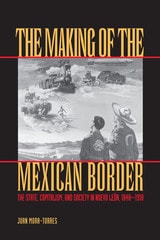
The Making of the Mexican Border
The State, Capitalism, and Society in Nuevo León, 1848-1910By Juan Mora-Torres
University of Texas Press, 2001
The issues that dominate U.S.-Mexico border relations today—integration of economies, policing of boundaries, and the flow of workers from south to north and of capital from north to south—are not recent developments. In this insightful history of the state of Nuevo León, Juan Mora-Torres explores how these processes transformed northern Mexico into a region with distinct economic, political, social, and cultural features that set it apart from the interior of Mexico.
Mora-Torres argues that the years between the establishment of the U.S.-Mexico boundary in 1848 and the outbreak of the Mexican Revolution in 1910 constitute a critical period in Mexican history. The processes of state-building, emergent capitalism, and growing linkages to the United States transformed localities and identities and shaped class formations and struggles in Nuevo León. Monterrey emerged as the leading industrial center and home of the most powerful business elite, while the countryside deteriorated economically, politically, and demographically. By 1910, Mora-Torres concludes, the border states had already assumed much of their modern character: an advanced capitalist economy, some of Mexico's most powerful business groups, and a labor market dependent on massive migrations from central Mexico.