Results by title

5 books match the query 'Nuttall, Sarah'
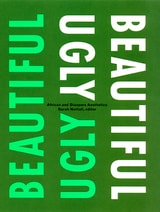
cover of Beautiful/Ugly: African and Diaspora Aesthetics

Beautiful/Ugly

African and Diaspora Aesthetics

Sarah Nuttall, ed.

Duke University Press, 2006

In Cameroon, a monumental “statue of liberty” is made from scrap metal. In Congo, a thriving popular music incorporates piercing screams and carnal dances. When these and other instantiations of the aesthetics of Africa and its diasporas are taken into account, how are ideas of beauty reconfigured? Scholars and artists take up that question in this invigorating, lavishly illustrated collection, which includes more than one hundred color images. Exploring sculpture, music, fiction, food, photography, fashion, and urban design, the contributors engage with and depart from canonical aesthetic theories as they demonstrate that beauty cannot be understood apart from ugliness.

Highlighting how ideas of beauty are manifest and how they mutate, travel, and combine across time and distance, continental and diasporic writers examine the work of a Senegalese sculptor inspired by Leni Riefenstahl’s photographs of Nuba warriors; a rich Afro-Brazilian aesthetic incorporating aspects of African, Jamaican, and American cultures; and African Americans’ Africanization of the Santería movement in the United States. They consider the fraught, intricate spaces of the urban landscape in postcolonial South Africa; the intense pleasures of eating on Réunion; and the shockingly graphic images on painted plywood boards advertising “morality” plays along the streets of Ghana. And they analyze the increasingly ritualized wedding feasts in Cameroon as well as the limits of an explicitly “African” aesthetics. Two short stories by the Mozambican writer Mia Couto gesture toward what beauty might be in the context of political failure and postcolonial disillusionment. Together the essays suggest that beauty is in some sense future-oriented and that taking beauty in Africa and its diasporas seriously is a way of rekindling hope.

Contributors. Rita Barnard, Kamari Maxine Clarke, Mia Couto, Mark Gevisser, Simon Gikandi, Michelle Gilbert, Isabel Hofmeyr, William Kentridge, Dominique Malaquais, Achille Mbembe, Cheryl-Ann Michael, Celestin Monga, Sarah Nuttall, Patricia Pinho, Rodney Place, Els van der Plas, Pippa Stein, Françoise Vergès
[more]
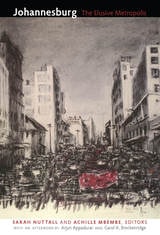
cover of Johannesburg: The Elusive Metropolis

Johannesburg

The Elusive Metropolis

Sarah Nuttall and Achille Mbembe, eds.

Duke University Press, 2008

Johannesburg: The Elusive Metropolis is a pioneering effort to insert South Africa’s largest city into urban theory, on its own terms. Johannesburg is Africa’s premier metropolis. Yet theories of urbanization have cast it as an emblem of irresolvable crisis, the spatial embodiment of unequal economic relations and segregationist policies, and a city that responds to but does not contribute to modernity on the global scale. Complicating and contesting such characterizations, the contributors to this collection reassess classic theories of metropolitan modernity as they explore the experience of “city-ness” and urban life in post-apartheid South Africa. They portray Johannesburg as a polycentric and international city with a hybrid history that continually permeates the present. Turning its back on rigid rationalities of planning and racial separation, Johannesburg has become a place of intermingling and improvisation, a city that is fast developing its own brand of cosmopolitan culture.

The volume’s essays include an investigation of representation and self-stylization in the city, an ethnographic examination of friction zones and practices of social reproduction in inner-city Johannesburg, and a discussion of the economic and literary relationship between Johannesburg and Maputo, Mozambique’s capital. One contributor considers how Johannesburg’s cosmopolitan sociability enabled the anticolonial projects of Mohandas Ghandi and Nelson Mandela. Journalists, artists, architects, writers, and scholars bring contemporary Johannesburg to life in ten short pieces, including reflections on music and megamalls, nightlife, built spaces, and life for foreigners in the city.

Contributors: Arjun Appadurai, Carol A. Breckenridge, Lindsay Bremner, David Bunn, Fred de Vries, Nsizwa Dlamini, Mark Gevisser, Stefan Helgesson, Julia Hornberger, Jonathan Hyslop, Grace Khunou, Frédéric Le Marcis, Xavier Livermon, John Matshikiza, Achille Mbembe, Robert Muponde, Sarah Nuttall, Tom Odhiambo, Achal Prabhala, AbdouMaliq Simone
[more]
cover of Johannesburg: The Elusive Metropolis, Volume 16

Johannesburg

The Elusive Metropolis, Volume 16

Sarah Nuttall and Achille Mbembe, eds.

Duke University Press, 0

This issue of Public Culture attempts to overturn perceptions that frame Africa as an object apart from the rest of the world. By placing the city of Johannesburg—the preeminent metropolis of the African continent and a city facing a complicated legacy of racial strife and wealth accumulation—at the heart of new critical urban theory, Johannesburg: The Elusive Metropolis broadens discussions of modernity, cosmopolitanism, and urban renewal to include Africa. The issue brings Johannesburg into direct dialogue with other world cities, creating a space for the interrogation and investigation of the metropolis in a properly global sense.

Contributors to this issue—a mix of scholars, urban planners, and artists, many of whom hail from South Africa—reveal Johannesburg to be a polycentric and international city that has developed its own cosmopolitan culture. In a detailed study of three streets in the modern precinct of Melrose Arch, one essay shows how the thoroughly commodified and marketed Johannesburg cityscape has shaped the cultural sensitivities, aesthetics, and urban subjectivities of its inhabitants, at times even overriding the historical memory of apartheid. Another essay, focusing on the emergence of a new urban culture, examines how the city itself becomes a crucial site for the remixing and reassembling of racial identities. By tracking the movement of people with AIDS to various locations in the city to seek relief and treatment, another essay reveals an urban geography very different from what is seen from the highways. Finally, through interviews and commentaries, journalists, artists, and architects of Johannesburg offer reflections on the geography and shifting culture of the city and its townships, on the complicated relationship between Johannesburg and other African cities, and on the search for an architectural style that adequately expresses the complexity of this cosmopolitan city.

Contributors. Lindsay Bremner, Nsizwa Dlamini, Mark Gevisser, Grace Khunou, Frédéric Le Marcis, John Matshikiza, Achille Mbembe, Sarah Nuttall, Rodney Place, AbdouMaliq Simone, Michael Watts
[more]
cover of Postcolonial Air and Atmospheres: Elemental life and environmental crisis

Postcolonial Air and Atmospheres

Elemental life and environmental crisis

Edited by Sarah Nuttall and Isabel Hofmeyr

University College London, 2026

This study expands the traditional scope of air and atmosphere studies to explore atmospheres and aesthetics in postcolonial contexts. 
 
This volume puts two traditions of scholarship into conversation: Euro-American work on air and atmospheres, and emergent postcolonial debates on these themes. Drawing on the strengths of the first, this collection probes its limits, while mapping an emergent field of postcolonial research on air and atmospheres.
 
Postcolonial Air and Atmospheres recontextualizes debates on atmospheres and aesthetics, exploring these themes in relation to the uneven hemispheric terrains of material decay and toxicity. It extends the narrow spatial purview of the Euro-American scholarship by taking an empire-wide perspective, considering historical questions of air and enslavement alongside South Asian histories of air conditioning and the toxic atmospheres of extractive industries. It develops a phenomenology of breathing in a range of postcolonial settings to revisit the theorizations of air and breath in Western critical theoretical scholarship. The collection comprises three sections. “Affective Atmospheres” explores the materialities of air while foregrounding atmospheres as sites of affect, politics, and power in the postcolony. “Unfree and Impure Airs” foregrounds clean and toxic air and who breathes them, along with the politics and technologies of how these unequal forms of air were and are produced. “Breathing In” centers practices of breath as a means of analyzing air and atmospheres.
[more]
cover of Your History with Me: The Films of Penny Siopis

Your History with Me

The Films of Penny Siopis

Sarah Nuttall, editor

Duke University Press, 2024

Penny Siopis is internationally acclaimed for her pathbreaking paintings and installations. Your History with Me is a comprehensive study of her short films, which have put her at the front ranks of contemporary artist-filmmakers. Siopis uses found footage to create short video essays that function as densely encrypted accounts of historical time and memory that touch on the cryptic and visceral elements of gender and power. The critics, scholars, curators, artists, and filmmakers in this volume examine her films in relation to subjects ranging from the history of Greeks in South Africa, trauma and cultural memory, and her relationship with the French New Wave to her feminist-inflected articulations of form and content and how her films comment on apartheid. They also highlight her global South perspective to articulate a mode of filmmaking highly responsive to histories of violence, displacement, and migration as well as pleasure, joy, and renewal. The essays, which are paired with vivid stills from Siopis’s films throughout, collectively widen the understanding of Siopis’s oeuvre. Opening new vocabularies of thought for engaging with her films, this volume outlines how her work remakes the possibilities of film as a mode of experimentation and intervention.

Contributors. John Akomfrah, Sinazo Chiya, Mark Gevisser, Pumla Dineo Gqola, Katerina Gregos, Brenda Hollweg, William Kentridge, Achille Mbembe, Sarah Nuttall, Griselda Pollock, Laura Rascaroli, Zineb Sedira, Penny Siopis, Hedley Twidle, Zoé Whitley
[more]