Results by title
5 books match the query 'Nyong'o, Tavia'

Problem Solved!
The Music and Theater of The Negro ProblemStew Stewart and Heidi Rodewald, Edited and with an Introduction by Brandon Woolf
University of Michigan Press, 2027
Problem Solved! invites readers into the exhilarating, unpredictable artistic world of The Negro Problem, the genre-defying music and theater collective behind the Tony and Obie Award–winning Passing Strange. Blending previously unpublished song lyrics, playscripts, critical essays, intimate interviews, and performance texts, the collection charts more than three decades of daring experimentation across rock music, musical theater, avant-garde performance, and other interdisciplinary forms of social and artistic critique.
Equal parts archive, mixtape, and critical meditation, the book captures The Negro Problem’s unique ability to move between seriousness and satire, activism and irony, intellectual rigor and irresistible melody. In addition to theatrical texts written and composed by Stew Stewart and Heidi Rodewald, the volume features a contextual essay by historian Scott Kurashige, close readings of The Total Bent by performance studies scholar Tavia Nyong’o, dramaturgical analyses of Passing Strange by volume editor Brandon Woolf, and a long-form interview about the band’s origins from co-leader Heidi Rodewald. The volume explores how the band challenges conventional ideas about race, identity, authenticity, activism, and musical theater through humor, contradiction, experimentation, and joyful disruption. Problem Solved! invites general readers, music enthusiasts, scholars, and theater lovers alike to explore how song can boldly and beautifully rise to meet our fractious cultural moment.
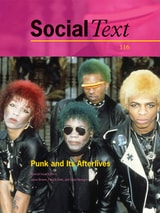
Punk and Its Afterlives, Volume 31
Jayna Brown, Patrick Deer, and Tavia Nyong'o, special issue editors
Duke University Press, 0
Jayna Brown is Associate Professor of Ethnic Studies at the University of California, Riverside. Patrick Deer is Associate Professor of English at New York University. Tavia Nyong’o is Associate Professor of Performance Studies at the Tisch School of the Arts at New York University.
Theatre History Studies 2008, Vol. 28
Edited by Rhona Justice-Malloy
University of Alabama Press, 2008
Theatre History Studies is a peer-reviewed journal of theatre history and scholarship published annually since 1981 by the Mid-American Theatre Conference (MATC), a regional body devoted to theatre scholarship and practice. The conference encompasses the states of Illinois, Iowa, Nebraska, Kansas, Missouri, Minnesota, North Dakota, South Dakota, Wisconsin, Indiana, Michigan, and Ohio. The purpose of the conference is to unite persons and organizations within the region with an interest in theatre and to promote the growth and development of all forms of theatre.
Theatre History Studies 2015, Vol. 34
Elizabeth Reitz Mullenix
University of Alabama Press, 2015
The five essays are arranged chronologically, starting with Alan Sikes’s discussion of the Abydos Passion Play. Sikes challenges the long-held interpretation of that ritualized annual reenactment of the death, dismemberment, and return to life of Egyptian god-king Osiris as the world’s first recorded dramatic production. In analyzing the “Passion Play”—Sikes argues the term is not apt—he applies semiotic theory using "sign and referent" to revise general concepts of mimesis, and in so doing clarifies the fundamental answer to the question, “What is theatre?”
In a pair of essays, Andrew Gibb and Nicole Berkin both explore theatre during America’s antebellum period. Gibb examines minstrelsy in antebellum California, exploding narrow definitions of minstrelsy as a primarily Eastern phenomenon and one reflecting a stark interaction of two races. Following the story of Jewish African Caribbean immigrant William Alexander Leidesdorff, Gibb demonstrates that national forms are always affected by their local productions and audiences. Berkin’s essay focuses on the struggles over cultural power that took place between popular entertainers and theatre managers. She examines how both parties used touring strategically to engage with antebellum notions of deception and fraud.
The last two essays, by Megan Geigner and Heide Nees, present findings from performance studies which, by examining a wide array of dramatic and performative texts, expands the interdisciplinary foundations of theatre history studies. This fascinating collection is rounded out by an expanded selection of insightful reviews of recent literature in the area.

Wildness
Jack Halberstam and Tavia Nyong'o, special issue editors
Duke University Press, 2018
Contributors: Vanessa Agard-Jones, Jayna Brown, Jodi A. Byrd, Mel Y. Chen, Jack Halberstam, Saidiya Hartman, Lamonda Horton-Stallings, Zakkiyyah Jackson, Martin F. Manalansan IV, Fred Moten, José E. Muñoz, Tavia Nyong’o, Julietta Singh, Riley Snorton, Wu Tsang, Dinesh Wadiwei