Results by title
3 books match the query 'O'Brassill-Kulfan, Kristin'
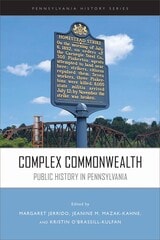
Complex Commonwealth
Public History in PennsylvaniaEdited by Margaret Jerrido, Jeanine M. Mazak-Kahne, and Kristin O'Brassill-Kulfan
Temple University Press, 2027
There are thousands of historic sites across Pennsylvania. The question of whose memories, what histories, and what local heritage deserve preservation has animated historians and communities for centuries. The editors and contributors to Complex Commonwealth provide a collection of accessible essays about public history in Pennsylvania that show how we have commemorated and preserved the state’s material culture, museums, monuments and memorials, parks, archives, libraries, and historic sites over centuries.
Chapters examine the Homestead Steel Strike, the Carlisle Indian School’s Digital Resource Center, and African American cemeteries and burial grounds, among other case studies. The methodologies these public historians use are as diverse as the various histories of labor, gender, religion, and race. It is by shedding light on these underseen histories that Complex Commonwealth affirms the importance of state and regional history to everyday Pennsylvanians.
Complex Commonwealth emphasizes the importance of place and space in shaping how we know what we know about the past and how that collectively shapes our future.
Contributors: Barbara Barksdale, Zachary L. Brodt, Steven Burg, Mary Catherine Foltz, Kelly C. George, James Gerencser, Alexandra Acri Godfrey, Kris Lowrey, Devin C. Manzullo-Thomas, Carol W. Smith, Frank Vitale IV, and the editors
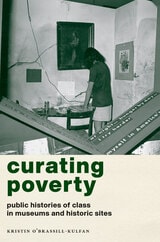
Curating Poverty
Public Histories of Class in Museums and Historic SitesKristin O'Brassill-Kulfan
University of Massachusetts Press, 2027
Asking how Americans’ fraught relationship with class has played out in public history
In 1966, a Smithsonian curator proposed recreating a “slum” dwelling inside the Museum of History and Technology, complete with rats in the walls, synthesized smells, and heat in summer and cold in winter. The public was not pleased. One editorialist called it “preserving a very insignificant aspect of civilization.” A Life magazine reporter worried that schoolchildren on field trips might find the exhibit’s horrors “pretty tame compared to their own homes.” The proposal was shelved. But the debate it ignited over whether poverty could or should be presented in museums cast a long shadow in US public history.
In Curating Poverty, Kristin O’Brassill-Kulfan examines how public historians have curated, preserved, and interpreted the experiences of people living in poverty—and how different publics have responded to these efforts. Poverty and economic inequality have shaped the lives of millions of Americans since the colonial period. For most of the nation’s history, welfare institutions such as almshouses and poor farms could be found in nearly every county in the United States. Yet explicit interpretation of poverty, welfare, and inequality remains an outlier in public history.
Documenting attempts to incorporate histories of poverty and class into exhibitions from the 1930s to the present, O’Brassill-Kulfan interrogates institutions of varying sizes and missions, paying particular attention to museums within the Smithsonian network. She traces how communities and public historians have remembered, neglected, erased, and sometimes reclaimed the surviving landscapes of poverty relief—from preserved almshouses and poor farm cemeteries to tenement museums and public housing sites. By placing poverty at the center of public history, Curating Poverty reveals how Americans have constructed, contested, and obscured histories of class and inequality and what it might look like to finally tell those stories honestly.
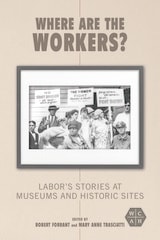
Where Are the Workers?
Labor's Stories at Museums and Historic SitesEdited by Robert Forrant and Mary Anne Trasciatti
University of Illinois Press, 2022
A wide-ranging blueprint for change, Where Are the Workers? shows how working-class perspectives can expand our historical memory and inform and inspire contemporary activism.
Contributors: Jim Beauchesne, Rebekah Bryer, Rebecca Bush, Conor Casey, Rachel Donaldson, Kathleen Flynn, Elijah Gaddis, Susan Grabski, Amanda Kay Gustin, Karen Lane, Rob Linné, Erik Loomis, Tom MacMillan, Lou Martin, Scott McLaughlin, Kristin O’Brassill-Kulfan, Karen Sieber, and Katrina Windon