Results by title
5 books match the query 'Obeah'
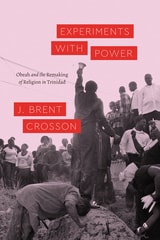
Experiments with Power
Obeah and the Remaking of Religion in TrinidadJ. Brent Crosson
University of Chicago Press, 2020
In 2011, Trinidad declared a state of emergency. This massive state intervention lasted for 108 days and led to the rounding up of over 7,000 people in areas the state deemed “crime hot spots.” The government justified this action and subsequent police violence on the grounds that these measures were restoring “the rule of law.” In this milieu of expanded policing powers, protests occasioned by police violence against lower-class black people have often garnered little sympathy. But in an improbable turn of events, six officers involved in the shooting of three young people were charged with murder at the height of the state of emergency. To explain this, the host of Crime Watch, the nation’s most popular television show, alleged that there must be a special power at work: obeah.
From eighteenth-century slave rebellions to contemporary responses to police brutality, Caribbean methods of problem-solving “spiritual work” have been criminalized under the label of “obeah.” Connected to a justice-making force, obeah remains a crime in many parts of the anglophone Caribbean. In Experiments with Power, J. Brent Crosson addresses the complex question of what obeah is. Redescribing obeah as “science” and “experiments,” Caribbean spiritual workers unsettle the moral and racial foundations of Western categories of religion. Based on more than a decade of conversations with spiritual workers during and after the state of emergency, this book shows how the reframing of religious practice as an experiment with power transforms conceptions of religion and law in modern nation-states.
From eighteenth-century slave rebellions to contemporary responses to police brutality, Caribbean methods of problem-solving “spiritual work” have been criminalized under the label of “obeah.” Connected to a justice-making force, obeah remains a crime in many parts of the anglophone Caribbean. In Experiments with Power, J. Brent Crosson addresses the complex question of what obeah is. Redescribing obeah as “science” and “experiments,” Caribbean spiritual workers unsettle the moral and racial foundations of Western categories of religion. Based on more than a decade of conversations with spiritual workers during and after the state of emergency, this book shows how the reframing of religious practice as an experiment with power transforms conceptions of religion and law in modern nation-states.
[more]
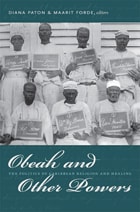
Obeah and Other Powers
The Politics of Caribbean Religion and HealingDiana Paton and Maarit Forde, eds.
Duke University Press, 2012
In Obeah and Other Powers, historians and anthropologists consider how marginalized spiritual traditions—such as obeah, Vodou, and Santería—have been understood and represented across the Caribbean since the seventeenth century. In essays focused on Cuba, Haiti, Jamaica, Martinique, Puerto Rico, Trinidad and Tobago, and the wider Anglophone Caribbean, the contributors explore the fields of power within which Caribbean religions have been produced, modified, appropriated, and policed. The "other powers" of the book's title have helped to shape, or attempted to curtail, Caribbean religions and healing practices. These powers include those of capital and colonialism; of states that criminalize some practices and legitimize others; of occupying armies that rewrite constitutions and reorient economies; of writers, filmmakers, and scholars who represent Caribbean practices both to those with little knowledge of the region and to those who live there; and, not least, of the millions of people in the Caribbean whose relationships with one another, as well as with capital and the state, have long been mediated and experienced through religious formations and discourses.
Contributors. Kenneth Bilby, Erna Brodber, Alejandra Bronfman, Elizabeth Cooper, Maarit Forde, Stephan Palmié, Diana Paton, Alasdair Pettinger, Lara Putnam, Karen Richman, Raquel Romberg, John Savage, Katherine Smith
Contributors. Kenneth Bilby, Erna Brodber, Alejandra Bronfman, Elizabeth Cooper, Maarit Forde, Stephan Palmié, Diana Paton, Alasdair Pettinger, Lara Putnam, Karen Richman, Raquel Romberg, John Savage, Katherine Smith
[more]
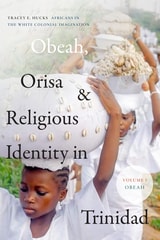
Obeah, Orisa, and Religious Identity in Trinidad, Volume I, Obeah
Africans in the White Colonial Imagination, Volume 1Tracey E. Hucks
Duke University Press, 2022
Obeah, Orisa, and Religious Identity in Trinidad is an expansive two-volume examination of social imaginaries concerning Obeah and Yoruba-Orisa from colonialism to the present. Analyzing their entangled histories and systems of devotion, Tracey E. Hucks and Dianne M. Stewart articulate how these religions were criminalized during slavery and colonialism yet still demonstrated autonomous modes of expression and self-defense. In Volume I, Obeah, Hucks traces the history of African religious repression in colonial Trinidad through the late nineteenth century. Drawing on sources ranging from colonial records, laws, and legal transcripts to travel diaries, literary fiction, and written correspondence, she documents the persecution and violent penalization of African religious practices encoded under the legal classification of “obeah.” A cult of antiblack fixation emerged as white settlers defined themselves in opposition to Obeah, which they imagined as terrifying African witchcraft. These preoccupations revealed the fears that bound whites to one another. At the same time, persons accused of obeah sought legal vindication and marshaled their own spiritual and medicinal technologies to fortify the cultural heritages, religious identities, and life systems of African-diasporic communities in Trinidad.
[more]
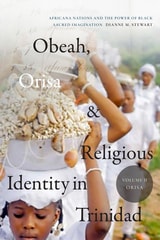
Obeah, Orisa, and Religious Identity in Trinidad, Volume II, Orisa
Africana Nations and the Power of Black Sacred Imagination, Volume 2Dianne M. Stewart
Duke University Press, 2022
Obeah, Orisa, and Religious Identity in Trinidad is an expansive two-volume examination of social imaginaries concerning Obeah and Yoruba-Orisa from colonialism to the present. Analyzing their entangled histories and systems of devotion, Tracey E. Hucks and Dianne M. Stewart articulate how these religions were criminalized during slavery and colonialism yet still demonstrated autonomous modes of expression and self-defense. In Volume II, Orisa, Stewart scrutinizes the West African heritage and religious imagination of Yoruba-Orisa devotees in Trinidad from the mid-nineteenth century to the present and explores their meaning-making traditions in the wake of slavery and colonialism. She investigates the pivotal periods of nineteenth-century liberated African resettlement, the twentieth-century Black Power movement, and subsequent campaigns for the civil right to religious freedom in Trinidad. Disrupting syncretism frameworks, Stewart probes the salience of Africa as a religious symbol and the prominence of Africana nations and religious nationalisms in projects of black belonging and identity formation, including those of Orisa mothers. Contributing to global womanist thought and activism, Yoruba-Orisa spiritual mothers disclose the fullness of the black religious imagination’s affective, hermeneutic, and political capacities.
[more]
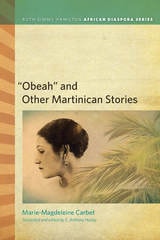
“Obeah” and Other Martinican Stories
Marie-Magdeleine Carbet
Michigan State University Press, 2017
This volume comprises French versions and English translations of seven short stories written by Marie-Magdeleine Carbet, Martinique’s most prolific woman writer. Four of these stories are previously unpublished, culled from documents obtained from Carbet’s niece. While analyses of the literature of the French Caribbean have tended to portray these people typically as suffering from pathologies of colonial oppression, the situations and reflections presented in these stories offer different perspectives on the lives and concerns of ordinary Martinicans and thus provide insight into some of the missing links of the sociocultural scene. This unique, multifaceted text fills an important pedagogical and scholarly need, and allows the reader to access the daily lives of French Caribbeans in a significantly authentic way.
[more]