Results by title
6 books match the query 'Oblivion'
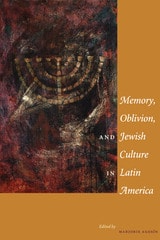
Memory, Oblivion, and Jewish Culture in Latin America
Edited by Marjorie Agosín
University of Texas Press, 2005
Latin America has been a refuge for Jews fleeing persecution from 1492, when Sepharad Jews were expelled from Spain, until well into the twentieth century, when European Jews sought sanctuary there from the horrors of the Nazi Holocaust. Vibrant Jewish communities have deep roots in countries such as Argentina, Mexico, Guatemala, and Chile—though members of these communities have at times experienced the pain of being "the other," ostracized by Christian society and even tortured by military governments. While commonalities of religion and culture link these communities across time and national boundaries, the Jewish experience in Latin America is irreducible to a single perspective. Only a multitude of voices can express it.
This anthology gathers fifteen essays by historians, creative writers, artists, literary scholars, anthropologists, and social scientists who collectively tell the story of Jewish life in Latin America. Some of the pieces are personal tales of exile and survival; some explore Jewish humor and its role in amalgamating histories of past and present; and others look at serious episodes of political persecution and military dictatorship. As a whole, these challenging essays ask what Jewish identity is in Latin America and how it changes throughout history. They leave us to ponder the tantalizing question: Does being Jewish in the Americas speak to a transitory history or a more permanent one?
Oblivion
Marc Auge
University of Minnesota Press, 2004
“Remembering or forgetting is doing gardener’s work, selecting, pruning. Memories are like plants: there are those that need to be quickly eliminated in order to help the others burgeon, transform, flower.”
For the health of the psyche and the culture, for the individual and the whole society, oblivion is as necessary as memory. One must know how to forget, Marc Augé suggests, not just to live fully in the present but also to comprehend the past.
Renowned as an anthropologist and an innovative social thinker, Augé’s meditation moves from how forgetting the present or recent past enables us to return to earlier pasts, to how forgetting propels us into the present, and finally to how forgetting becomes a necessary part of survival. Oblivion moves with authority and ease among a wide variety of sources—literature, common experience, psychoanalysis, philosophy, ethnography—to illustrate the interplay of memory and forgetting in the stories of life and death told across many cultures and many times. Memory and oblivion, he concludes, cannot be separated: “Memories are crafted by oblivion as the outlines of the shore are created by the sea.”
Oblivion and Stone
A Selection of Bolivian Poetry and FictionSandra Reyes
University of Arkansas Press, 1998
In a literature where recognition is hard earned, this anthology demonstrates what distinguishes contemporary Bolivian fiction and poetry from the rest of Latin American writing and shows clearly how Bolivian writers relate to that tradition.
Bolivia is a landlocked nation of mountains and high, arid plains, a place native writer Jesús Urzagasti calls the “Land of Silence.” This crucible of indigenous and European influences has contributed to the creation of a writing style that is always down-to-earth, often grittily realistic.
From this fundamental base, Bolivian writers express provincial customs and values, decry political oppression, and sound universal themes of isolation, even resignation; but, more often, they show the will to move forward as a people. This rich thematic mix encourages what critic Edgar Lora has called the “dynamic and vigorous social dis course” and the resulting “subversive, militant, and revolutionary” qualities of Bolivian literature.
Editor Sandra Reyes has gathered a panoramic sampling of twenty two poets and eighteen fiction writers. Focusing predominantly on living, practicing writers, this anthology defines the current literary voice of Bolivia and gives us a distillation of the contemporary Bolivian consciousness.
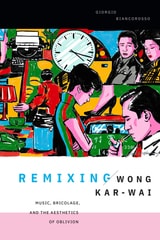
Remixing Wong Kar-wai
Music, Bricolage, and the Aesthetics of OblivionGiorgio Biancorosso
Duke University Press, 2025
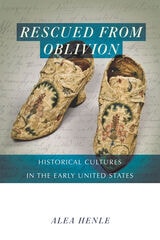
Rescued from Oblivion
Historical Cultures in the Early United StatesAlea Henle
University of Massachusetts Press, 2020
With in-depth research and an expansive scope, Rescued from Oblivion offers a vital account of the formation of historical culture and consciousness in the early United States, re-centering in the record groups long marginalized from the national memory. As Alea Henle demonstrates, these societies laid the groundwork for professional practices that are still embraced today: collection policies, distinctions between preservation of textual and nontextual artifacts, publication programs, historical rituals and commemorations, reconciliation of scholarly and popular approaches, and more. At the same time, officers of these early societies faced challenges to their historical authority from communities interested in preserving a broader range of materials and documenting more inclusive histories, including fellow members, popular historians, white women, and peoples of color.
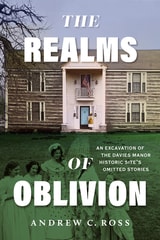
The Realms of Oblivion
An Excavation of the Davies Manor Historic Site's Omitted StoriesAndrew C. Ross
Vanderbilt University Press, 2024
Winner of the Tennessee History Book Award (Tennessee Historical Society and Tennessee Historical Commission), 2024
The Realms of Oblivion explores the complexities involved in reconciling competing versions of history, channeled through Davies Manor, a historic site near Memphis that once centered a wealthy slave-owning family’s sprawling cotton plantation. Interrogating the forces of memorialization that often go unquestioned in the stories we believe about ourselves and our communities, this book simultaneously tells an informative and engrossing bottom-up history—of the Davies family, of the Black families they enslaved and exploited across generations, and of Memphis and Shelby County—while challenging readers to consider just what upholds the survival of that history into the present day.
Written in an engaging and critical style, The Realms of Oblivion is grounded in a rich source base, ranging from nineteenth-century legal records to the personal papers of the Davies family to twentieth-century African American oral histories. Author Andrew C. Ross uses these sources to unearth the stark contrast between the version of Davies Manor’s history that was built out of nostalgia, and the version that records have proven to actually be true. As a result, Ross illuminates the ongoing need for a deep and honest reckoning with the history of the South and of the United States, on the part of both individuals and community institutions such as local historic sites and small museums.