Results by title
3 books match the query 'Obsessive-compulsive disorder'
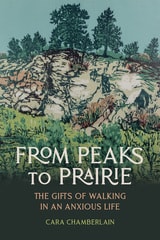
From Peaks to Prairie
The Gifts of Walking in an Anxious LifeCara Chamberlain
Oregon State University Press, 2026
Along twenty-nine trails near Yellowstone National Park, Cara Chamberlain leads readers on a journey of perseverance, drawing lessons from human and natural history. She reflects on being diagnosed with generalized anxiety disorder (GAD) and obsessive-compulsive disorder (OCD) and explores how walking helps manage anxiety, opening rich pathways of perception.
In From Peaks to Prairie, Chamberlain examines her personal life, family history, and struggles as she encounters animals and plants of Montana and Wyoming. Each essay is an episode mingling the past with the present, combining sightings of bears, birds, and wildflowers with memories of her Utah childhood and family. She observes, “I walk. It’s the way I’ve found not to eliminate GAD and OCD, as I used to long to do, but to live with them.” Mountains and prairies offer strength and nurture those who need them. It is on their paths that Chamberlain finds clarity.
Obsession
A HistoryLennard J. Davis
University of Chicago Press, 2008
We live in an age of obsession. Not only are we hopelessly devoted to our work, strangely addicted to our favorite television shows, and desperately impassioned about our cars, we admire obsession in others: we demand that lovers be infatuated with one another in films, we respond to the passion of single-minded musicians, we cheer on driven athletes. To be obsessive is to be American; to be obsessive is to be modern.
But obsession is not only a phenomenon of modern existence: it is a medical category—both a pathology and a goal. Behind this paradox lies a fascinating history, which Lennard J. Davis tells in Obsession. Beginning with the roots of the disease in demonic possession and its secular successors, Davis traces the evolution of obsessive behavior from a social and religious fact of life into a medical and psychiatric problem. From obsessive aspects of professional specialization to obsessive compulsive disorder and nymphomania, no variety of obsession eludes Davis’s graceful analysis.
Solitaire of Love
Cristina Peri Rossi
Duke University Press, 2000
Tracing the course of a relationship as it evolves into uncompromising self-destruction, the narrator of Solitaire of Love becomes addicted to his own passion and to the body of his beloved. Erotic, romantic love becomes bewitchment, producing a heightened state where time is measured in the rhythms of a chosen body and pride becomes subservient to obsession. The specifics of this other body trump any claim to ordinary existence for the narrator, as sex becomes a kind of idolatrous slavery and love becomes a mechanism for self-immolation. As in Peri Rossi’s other works, an ambiguous sense of gender and sexuality arise from her uniquely experimental prose and mystically erotic logic. Language is subsumed into this process as a way to bear witness, to transfix and capture the love object. The limbo of obsession, as described by Peri Rossi, creates an infantilizing brand of loneliness, broken by flashes of joy, insight, fury, and fear.
This novel was originally published in Spanish in 1988.