Results by title
4 books match the query 'Obsolescence'
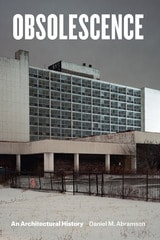
Obsolescence
An Architectural HistoryDaniel M. Abramson
University of Chicago Press, 2016
In the innovative and wide-ranging Obsolescence, Daniel M. Abramson investigates this notion of architectural expendability and the logic by which buildings lose their value and utility. The idea that the new necessarily outperforms and makes superfluous the old, Abramson argues, helps people come to terms with modernity and capitalism’s fast-paced change. Obsolescence, then, gives an unsettling experience purpose and meaning.
Belief in obsolescence, as Abramson shows, also profoundly affects architectural design. In the 1960s, many architects worldwide accepted the inevitability of obsolescence, experimenting with flexible, modular designs, from open-plan schools, offices, labs, and museums to vast megastructural frames and indeterminate building complexes. Some architects went so far as to embrace obsolescence’s liberating promise to cast aside convention and habit, envisioning expendable short-life buildings that embodied human choice and freedom. Others, we learn, were horrified by the implications of this ephemerality and waste, and their resistance eventually set the stage for our turn to sustainability—the conservation rather than disposal of resources. Abramson’s fascinating tour of our idea of obsolescence culminates in an assessment of recent manifestations of sustainability, from adaptive reuse and historic preservation to postmodernism and green design, which all struggle to comprehend and manage the changes that challenge us on all sides.
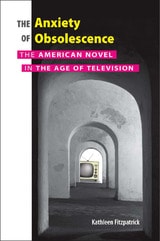
The Anxiety of Obsolescence
The American Novel in the Age of TelevisionKathleen Fitzpatrick
Vanderbilt University Press, 2006
It almost goes without saying that the rise in popularity of television has killed the audience for "serious" literature. This is such a given that reading Fitzpatrick's challenge to this notion can be very disconcerting, as she traces the ways in which a small cadre of writers of "serious" literature--DeLillo, Pynchon, and Franzen, for instance--have propagated this myth in order to set themselves up as the last bastions of good writing. Fitzpatrick first explores whether serious literature was ever as all-pervasive as critics of the television culture claim and then asks the obvious question: what, or who, exactly, are these guys defending good writing against?
Fitzpatrick examines the ways in which the anxiety about the supposed death of the novel is built on a myth of the novel's past ubiquity and its present displacement by television. She explores the ways in which this myth plays out in and around contemporary fiction and how it serves as a kind of unacknowledged discourse about race, class, and gender. The declaration constructs a minority status for the "white male author" who needs protecting from television's largely female and increasingly non-white audience. The novel, then, is transformed from a primary means of communication into an ancient, almost forgotten, and thus, treasured form reserved for the well-educated and well-to-do, and the men who practice it are exalted as the practitioners of an almost lost art.
Such positioning serves to further marginalize women writers and writers of color because it makes the novel, by definition, the preserve of the poor endangered white man. If the novel is only a product of a small group of white men, how can the contributions of women and writers of color be recognized? Instead, this positioning abandons women and people of color to television as a creative outlet, and in return, cedes television to them. Fitzpatrick argues that there's a level of unrecognized patronization in assuming that television serves no purpose but to provide dumb entertainment to bored women and others too stupid to understand novels. And, instead, she demonstrates the real positive effects of a televisual culture.
The Obsolescence of Human Rights
The Alt-Right, the Pandemic and Science as an Emerging Political CleavageFilip Balunovic
Central European University Press, 2026

The Obsolescence of the Human
Günther Anders
University of Minnesota Press, 2025
Now available in English—one of the twentieth century’s most important works on the philosophy of technology
With this first English translation of influential German philosopher Günther Anders’s 1956 masterpiece of critical theory, The Obsolescence of the Human, a new generation of readers can now engage with his prescient and haunting vision of a “world without us” dominated by technology.
Looking at technological events such as the detonation of the nuclear bomb and the arrival of televisions in our living rooms, Anders advances a warning of what humanity looks like in a world where it has surrendered all agency. He outlines the new emotional landscapes that shape our relationship to increasingly capable technology, including Promethean shame, the human sense of unease our own superior technological innovations can instill. Confronting the growing gap between what we can collectively create and what we can individually comprehend, Anders speculates on the trajectory of a developing technological world that rapidly exceeds our ability to control or even foresee its negative consequences.
The Obsolescence of the Human prefigures contemporary posthumanist discourse and is eerily predictive of current debates around automation, global warming, and artificial intelligence. Providing new ways to conceptualize the intersection of technology and emotion, it offers groundbreaking frameworks for future-oriented ethics. Radical in both its stylistic experimentation and its theoretical insights, this new translation presents a cautionary tale regarding the human capacity to usher in its own destruction.
Retail e-book files for this title are screen-reader friendly with images accompanied by short alt text and/or extended descriptions.