Results by title
5 books match the query 'Obstacles'
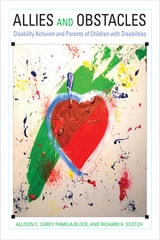
Allies and Obstacles
Disability Activism and Parents of Children with DisabilitiesAllison C. Carey, Pamela Block, and Richard K. Scotch
Temple University Press, 2020
Parents of children with disabilities often situate their activism as a means of improving the world for their child. However, some disabled activists perceive parental activism as working against the independence and dignity of people with disabilities. This thorny relationship is at the heart of the groundbreaking Allies and Obstacles.
The authors chronicle parents’ path-breaking advocacy in arenas such as the right to education and to liberty via deinstitutionalization as well as how they engaged in legal and political advocacy. Allies and Obstacles provides a macro analysis of parent activism using a social movement perspective to reveal and analyze the complex—and often tense—relationship of parents to disability rights organizations and activism.
The authors look at organizational and individual narratives using four case studies that focus on intellectual disability, psychiatric diagnoses, autism, and a broad range of physical disabilities including cerebral palsy and muscular dystrophy. These cases explore the specific ways in which activism developed among parents and people with disabilities, as well as the points of alliance and the key points of contestation. Ultimately, Allies and Obstacles develops new insights into disability activism, policy, and the family.

False Hopes
Overcoming the Obstacles to a Sustainable, Affordable MedicineCallahan, Daniel
Rutgers University Press, 1999
Negotiating With ETA
Obstacles To Peace In The Basque Country, 1975-1988Robert P. Clark
University of Nevada Press, 1990
Since the late 1960s, the Basque insurgent organization ETA (Euzkadi ta Askatasuna, or Basque Homeland and Freedom) has been engaged in a violent struggle against the Spanish state in an effort to gain the independence of the Basque Country. ETA violence has led to the death of hundreds of people, making the organization the most violent insurgent group in Europe. Between 1975 and 1988, nearly thirty attempts to negotiate an end to violence, with a few limited exceptions, all ended in failure. This important book examines why the efforts to negotiate have failed and makes suggestions on how to improve the chances for successful discussion in the future. Although Clark does not disprove the conventional wisdom that negotiation with terrorists is a bad idea, he does begin from the opposing point of view that there may be some positive values to be realized from such negotiation.Negotiating with ETA describes the various factions that are interested in the outcome of such negotiations and the Spanish antiterrorist policy throughout the period under examination. The book also recounts the early attempts to negotiate, the first attempt at "social reintegration," various attempts by the Basque Government to get negotiations started, negotiation efforts under the Spanish socialist government of Felipe González, and the lengthy negotiations that took place in Algeria. A wide range of scholars and specialists will find this book valuable, including those interested in contemporary Spanish politics, ethnic nationalism, Basque affairs, the problem of terrorism, and conflict resolution.

Obstacles to Environmental Progress
A US PerspectivePeter C. Schulze
University College London, 2022
Despite the comprehensively understood severity of environmental problems faced today, progress in the United States is continually stymied, making sustainability feel like a far-off goal. Obstacles to Environmental Progress takes up the structural, political, and cultural forces that routinely hinder progress on existing environmental issues. Addressing problems both small and large, often regardless of whether an issue is controversial, this book illustrates obstacles that manifest in the United States but are globally pertinent. Peter Schulze identifies eighteen practical obstacles that fall into three categories: scientific challenges to anticipating and detecting problems; political and economic factors that interfere with responding; and obstacles to effective responses. This book seeks to hasten environmental progress by bridging academic disciplines to forewarn and forearm those who might otherwise encounter these anti-environmentalist obstacles in an ad-hoc manner.
Reforming Intelligence
Obstacles to Democratic Control and EffectivenessEdited by Thomas C. Bruneau and Steven C. Boraz
University of Texas Press, 2007
These days, it's rare to pick up a newspaper and not see a story related to intelligence. From the investigations of the 9/11 commission, to accusations of illegal wiretapping, to debates on whether it's acceptable to torture prisoners for information, intelligence—both accurate and not—is driving domestic and foreign policy. And yet, in part because of its inherently secretive nature, intelligence has received very little scholarly study. Into this void comes Reforming Intelligence, a timely collection of case studies written by intelligence experts, and sponsored by the Center for Civil-Military Relations (CCMR) at the Naval Postgraduate School, that collectively outline the best practices for intelligence services in the United States and other democratic states.
Reforming Intelligence suggests that intelligence is best conceptualized as a subfield of civil-military relations, and is best compared through institutions. The authors examine intelligence practices in the United States, United Kingdom, and France, as well as such developing democracies as Brazil, Taiwan, Argentina, and Russia. While there is much more data related to established democracies, there are lessons to be learned from states that have created (or re-created) intelligence institutions in the contemporary political climate. In the end, reading about the successes of Brazil and Taiwan, the failures of Argentina and Russia, and the ongoing reforms in the United States yields a handful of hard truths. In the murky world of intelligence, that's an unqualified achievement.