Results by title

3 books match the query 'Occupational mobility'

cover of Divergent Paths: Economic Mobility in the New American Labor Market

Divergent Paths

Economic Mobility in the New American Labor Market

Annette Bernhardt

Russell Sage Foundation, 2001

  The promise of upward mobility—the notion that everyone has the chance to get ahead—is one of this country's most cherished ideals, a hallmark of the American Dream. But in today's volatile labor market, the tradition of upward mobility for all may be a thing of the past. In a competitive world of deregulated markets and demanding shareholders, many firms that once offered the opportunity for advancement to workers have remade themselves as leaner enterprises with more flexible work forces. Divergent Paths examines the prospects for upward mobility of workers in this changed economic landscape. Based on an innovative comparison of the fortunes of two generations of young, white men over the course of their careers, Divergent Paths documents the divide between the upwardly mobile and the growing numbers of workers caught in the low-wage trap. The first generation entered the labor market in the late 1960s, a time of prosperity and stability in the U.S. labor market, while the second generation started work in the early 1980s, just as the new labor market was being born amid recession, deregulation, and the weakening of organized labor. Tracking both sets of workers over time, the authors show that the new labor market is more volatile and less forgiving than the labor market of the 1960s and 1970s. Jobs are less stable, and the penalties for failing to find a steady employer are more severe for most workers. At the top of the job pyramid, the new nomads—highly credentialed, well-connected workers—regard each short-term project as a springboard to a better-paying position, while at the bottom, a growing number of retail workers, data entry clerks, and telemarketers, are consigned to a succession of low-paying, dead-end jobs. While many commentators dismiss public anxieties about job insecurity as overblown, Divergent Paths carefully documents hidden trends in today's job market which confirm many of the public's fears. Despite the celebrated job market of recent years, the authors show that the old labor market of the 1960s and 1970s propelled more workers up the earnings ladder than does today's labor market. Divergent Paths concludes with a discussion of policy strategies, such as regional partnerships linking corporate, union, government, and community resources, which may help repair the career paths that once made upward mobility a realistic ambition for all American workers.
[more]
cover of Occupational Mobility in American Business and Industry, 1928-1952

Occupational Mobility in American Business and Industry, 1928-1952

W. Lloyd Warner and James C. Abegglen

University of Minnesota Press, 1955

Occupational Mobility in American Business and Industry, 1928–1952 was first published in 1955. Minnesota Archive Editions uses digital technology to make long-unavailable books once again accessible, and are published unaltered from the original University of Minnesota Press editions.

Is the American occupational system rigid or flexible? How has it changed in the last twenty-five years? What factors help to influence the selection of business leaders? Questions like these are answered in this comprehensive study of occupational mobility, made by two social scientists at the University of Chicago. The study is based on information about 8,000 executives in the largest business firms of America. The rate of movement of men from various occupational backgrounds into positions of business leadership today is compared with that of 1928, as reported in the well-known study of Taussig and Joslyn, American Business Leaders. Warner and Abegglen present their complete research data, many of the findings in tabular form. The research encompasses all kinds of businesses and industries in every part of the country and persons at all levels of top management.
[more]
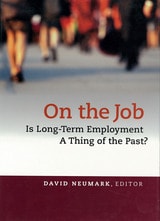
cover of On the Job: Is Long-Term Employment a Thing of the Past?

On the Job

Is Long-Term Employment a Thing of the Past?

David, editor Neumark

Russell Sage Foundation, 2000

In recent years, a flurry of reports on downsizing, outsourcing, and flexible staffing have created the impression that stable, long-term jobs are a thing of the past. According to conventional wisdom, workers can no longer count on building a career with a single employer, and job security is a rare prize. While there is no shortage of striking anecdotes to fuel these popular beliefs, reliable evidence is harder to come by. Researchers have yet to determine whether we are witnessing a sustained, economy-wide decline in the stability of American jobs, or merely a momentary rupture confined to a few industries and a few classes of workers. On the Job launches a concerted effort to reconcile the conflicting evidence about job stability and security. The book examines the labor force as a whole, not merely the ousted middle managers who have attracted the most publicity. It looks at the situation of women as well as men, young workers as well as old, and workers on part-time, non-standard, or temporary work schedules. The evidence suggests that long-serving managers and professionals suffered an unaccustomed loss of job security in the 1990s, but there is less evidence of change for younger, newer recruits. The authors bring our knowledge of the labor market up to date, connecting current conditions in the labor market with longer-term trends that have evolved over the past two decades. They find that  layoffs in the early 1990s disrupted the implicit contract between employers and staff, but it is too soon to declare a permanent revolution in the employment relationship. Having identified the trends, the authors seek to explain  them and to examine their possible consequences. If the bonds between employee and employer are weakening, who stands to benefit? Frequent job-switching can be a sign of success for a worker, if each job provides a stepping stone to something better, but research in this book shows that workers gained less from changing jobs in the 1980s and 1990s than in earlier decades. The authors also evaluate the third-party intermediaries, such as temporary help agencies, which profit from the new flexibility in the matching of workers and employers. Besides opening up new angles on the evidence, the authors mark out common ground and pin-point those areas where gaps in our knowledge remain and popular belief runs ahead of reliable evidence. On the Job provides an authoritative basis for spotting the trends and interpreting the fall-out as U.S. employers and employees rethink the terms of their relationship.
[more]