Results by title
11 books match the query 'Odysseus, King of Ithaca (Mythological character)'
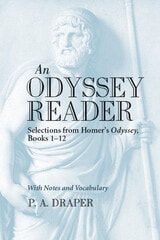
An Odyssey Reader
Selections from Homer's Odyssey, Books 1-12P. A. Draper
University of Michigan Press, 2012
Homer's Odyssey has captivated readers and influenced writers and artists for more than 2,000 years. Reading the poem in its original language provides an experience as challenging as it is rewarding. Most students encountering Homeric Greek for the first time need considerable help, especially with vocabulary and constructions that differ from the more familiar Attic forms. For anyone who has completed studies in elementary Greek, this edition provides the assistance necessary to read, understand, and appreciate the first book of the Odyssey in its original language.
Structured to maximize reading ease, P. A. Draper's volume stands out among introductions to the Greek Odyssey. Readers of this edition will appreciate the positioning of all notes facing the Greek text; the frequent vocabulary entries; the complete glossary; the appendix on basic Homeric forms and grammar; and the copious annotations on vocabulary, grammar, meter, historical and mythological allusions, and literary interpretation.
Primarily designed as a textbook, this volume will be an effective classroom tool and a useful acquisition for any library supporting a classics program. The book will find readers among high school and college Greek students, advanced students in Homer or epic poetry classes, graduate students working on reading-list requirements, and anyone interested in maintaining Greek reading skills.
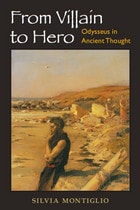
From Villain to Hero
Odysseus in Ancient ThoughtSilvia Montiglio
University of Michigan Press, 2011
Praise for Silvia Montiglio
"[A] brilliant and important book. . . . "
---Journal of Religion, on Silence in the Land of Logos
"[A]n invigorating reevaluation of both the ancient symbolic landscape and our preconceptions of it."
---American Journal of Philology, on Wandering in Ancient Greek Culture
Best known for his adventures during his homeward journey as narrated in Homer's Odyssey, Odysseus remained a major figure and a source of inspiration in later literature, from Greek tragedy to Dante's Inferno to Joyce's Ulysses. Less commonly known, but equally interesting, are Odysseus' "wanderings" in ancient philosophy: Odysseus becomes a model of wisdom for Socrates and his followers, Cynics and Stoics, as well as for later Platonic thinkers. From Villain to Hero: Odysseus in Ancient Thought follows these wanderings in the world of ancient Greek and Roman philosophy, retracing the steps that led the cunning hero of Homeric epic and the villain of Attic tragedy to become a paradigm of the wise man.
From Villain to Hero explores the reception of Odysseus in philosophy, a subject that so far has been treated only in tangential or limited ways. Diverging from previous studies, Montiglio outlines the philosophers' Odysseus across the spectrum, from the Socratics to the Middle Platonists. By the early centuries CE, Odysseus' credentials as a wise man are firmly established, and the start of Odysseus' rehabilitation by philosophers challenges current perceptions of him as a villain. More than merely a study in ancient philosophy, From Villain to Hero seeks to understand the articulations between philosophical readings of Odysseus and nonphilosophical ones, with an eye to the larger cultural contexts of both. While this book is the work of a classicist, it will also be of interest to students of philosophy, comparative literature, and reception studies.

JARMAN (all this maddening beauty) and other plays
Caridad Svich
Intellect Books, 2016
“Svich is one of the finest poet/playwrights of this generation. . . . She is a playwright whose plays perform like dramatic poems that are wondrous to the ear and moving to the heart.”—Seth Gordon, Repertory Theatre of St. Louis
Siren Songs
Gender, Audiences, and Narrators in the OdysseyLillian Eileen Doherty
University of Michigan Press, 1995
Siren Songs synthesizes audience-oriented and narratological approaches, and examines the relationships among three kinds of audiences: internal, implied, and actual. The author prefaces her own reading of the Odyssey with an analysis of the issues posed by the earlier feminist readings on which she builds. Should the Odyssey be read as a "closed" text, that is, as one whose meaning is highly determined, or as an "open" text whose contradictions and ambiguities undercut its overt meanings?
Siren Songs presents a feminist critique of the Odyssey in an accessible manner aimed at a more general audience. All Greek is translated, and critical terminology is clearly defined.
Lillian Eileen Doherty is Associate Professor of Classics, University of Maryland, College Park.
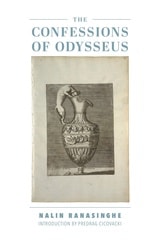
The Confessions of Odysseus
Nalin Ranasinghe
St. Augustine's Press, 2021
Predrag Cicovacki in his indispensable preface to the book, elucidates: “In Ranasinghe’s view, Odysseus is both the first recognizable human being and a model of curious and concupiscent human rationality that constantly strives toward the virtues of self-knowledge and moderation. Homer leads us to believe that the cosmos leans toward virtue, although its fundamental truths may be inherently unspeakable. This is the line of thought that Ranasinghe believes was further developed by Socrates, Plato, and Jesus, while being obscured by Aristotle, Augustine, and their followers. Homer’s later epic and his central insights are, according to Ranasinghe, the most fertile soil on which a humane civilization can grow and flourish.”
Yet Ranasinghe ultimately says it best. “Homer must be read as the wisest Greeks did, not for fantastic tales of the Olympians but because his myths reveal eternal constants of the human state: the soul’s ruling passions and the possibility of knowing and educating these false gods. Wrestled with thus the Iliad becomes a cautionary tale, not one urging literal reading or mindless mimesis. It may always be that for the few who grasp Homer, many more will obey his gods or imitate his antiheroes; but the Odyssey hints that while its poet sees this potential for misuse, he is willing to take a noble risk and hope that eros can listen to and educate thumos. This faith is implicit in his tale of Achilles and the Trojan War. It is vital today that we see how the West’s end resembles its angry origins, as depicted in the Iliad. This is why Homer is said to be as fresh as the morning newspaper. His wisdom may outlive our literacy.”
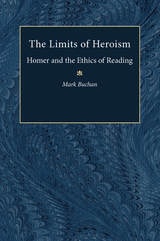
The Limits of Heroism
Homer and the Ethics of ReadingMark Buchan
University of Michigan Press, 2005
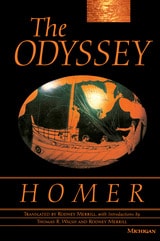
The Odyssey
Homer, Translated by Rodney Merrill
University of Michigan Press, 2002
This epic began life as the music composed by a "singer of tales," not as words on a page. As such, its meter allows for pleasing variations with a strong basic "beat," thus providing a rhythmic impetus that carries the story swiftly forward. The resulting "music" has important repercussions for the reader's perception of the many repeated elements that provide structure for the poem and bring out significant themes, just as the repetitions in a piece of music do.
This edition of the Odyssey includes selections for further reading, a list of proper names (with a guide to pronunciation), and three maps. It also provides introductory discussions of how the work came into being and was transmitted until it became the work we read, how it is divided into six "performance sessions" of four books each, and how the poem's various themes are developed. Rodney Merrill's Odyssey is thus an ideal edition for students, teachers, and general readers.
The audiobook is available on twelve cassettes, and is read by Rodney Merrill. This version will bring Homer's epic masterpiece to life like never before. Perfect for the car or classroom!
Rodney Merrill is retired and an independent scholar. He has taught at Stanford University, the University of San Francisco, and the University of California, Berkeley.
Thomas R. Walsh, Senior Professor at Occidental College, has written articles on Homeric poetics, with a forthcoming book on anger in Homer.
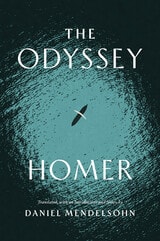
The Odyssey
Homer
University of Chicago Press, 2025
The most accurate and poetic translation of the world's greatest epic, which is now a film by Academy Award winner Christopher Nolan!
“This may be the best translation of The Odyssey yet."—Edith Hall, The Telegraph
A magnificent feat of translation, hailed by classicists and poets alike as a “momentous achievement”: “thrilling,” “rich and rhythmical,” “superb,” “mesmerizing,” “searingly faithful—yet absolutely original.”
With this edition of Homer’s Odyssey, the celebrated author, critic, and classicist Daniel Mendelsohn brings the great epic to vividly poetic new life. Widely known for his essays on classical literature and culture in The New Yorker and many other publications, Mendelsohn gives us a line-for-line rendering of The Odyssey that is both engrossing as poetry and true to its source. Rejecting the streamlining and modernizing approach of many recent translations, he artfully reproduces the epic’s formal qualities—meter, enjambment, alliteration, assonance—and in so doing restores to Homer’s masterwork its archaic grandeur. Mendelsohn’s expansive six-beat line, far closer to the original than that of other recent translations, allows him to capture each of Homer’s dense verses without sacrificing the amplitude and shadings of the original.
The result is the richest, most ample, most precise, and most musical Odyssey in English, conveying the beauty of its poetry, the excitement of its hero’s adventures, and the profundity of its insights. Supported by an extensive introduction and the fullest notes and commentary currently available, Daniel Mendelsohn’s Odyssey is poised to become the authoritative version of this magnificent and enduringly influential masterpiece.
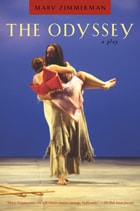
The Odyssey
A PlayMary Zimmerman
Northwestern University Press, 2006
With her trademark irreverent and witty twist on classic works, Zimmerman brings to life the story of Odysseus's ten-year journey
This dramatic adaptation of Homer's myth begins with a modern young woman who is struggling to understand Robert Fitzgerald's translation of The Odyssey. A classical muse appears, and the young woman becomes the goddess Athena--a tireless advocate for Odysseus in his struggle to get home. Zimmerman's adaptation depicts his encounters with characters such as Circe, the Cyclops, Poseidon, Calypso, the Sirens, and others in new and exciting ways.
The Unknown Odysseus
Alternate Worlds in Homer's OdysseyThomas Van Nortwick
University of Michigan Press, 2009
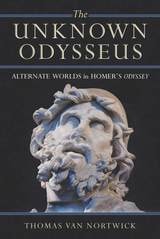
The Unknown Odysseus is a study of how Homer creates two versions of his hero, one who is the triumphant protagonist of the revenge plot and another, more subversive, anonymous figure whose various personae exemplify an entirely different set of assumptions about the world through which each hero moves and about the shape and meaning of human life. Separating the two perspectives allows us to see more clearly how the poem's dual focus can begin to explain some of the notorious difficulties readers have encountered in thinking about the Odyssey. In The Unknown Odysseus, Thomas Van Nortwick offers the most complete exploration to date of the implications of Odysseus' divided nature, showing how it allows Homer to explore the riddles of human identity in a profound way that is not usually recognized by studies focusing on only one "real" hero in the narrative. This new perspective on the epic enriches the world of the poem in a way that will interest both general readers and classical scholars.
---David Quint, London Review of Books
"Thomas Van Nortwick's eloquently written book will give the neophyte a clear interpretive path through the epic while reminding experienced readers why they should still care about the Odyssey's unresolved interpretive cruces. The Unknown Odysseus is not merely accessible, but a true pleasure to read."
---Lillian Doherty, University of Maryland
"Contributing to an important new perspective on understanding the epic, Thomas Van Nortwick wishes to resist the dominant, even imperial narrative that tries so hard to trick, beguile, and even bully its listeners into accepting the inevitability of Odysseus' heroism."
---Victoria Pedrick, Georgetown University
Thomas Van Nortwick is Nathan A. Greenberg Professor of Classics at Oberlin College and author of Somewhere I Have Never Travelled: The Second Self and the Hero's Journey in Ancient Epic (1992) and Oedipus: The Meaning of a Masculine Life (1998).
Jacket art: Head of Odysseus from a sculptural group representing Odysseus killing Polyphemus in the Museo Archeologico Nazionale in Sperlonga, Italy. Photograph by Marie-Lan Nguyen.
Ulysses in Black
Ralph Ellison, Classicism, and African American LiteraturePatrice D. Rankine
University of Wisconsin Press, 2008
In this groundbreaking work, Patrice D. Rankine asserts that the classics need not be a mark of Eurocentrism, as they have long been considered. Instead, the classical tradition can be part of a self-conscious, prideful approach to African American culture, esthetics, and identity. Ulysses in Black demonstrates that, similar to their white counterparts, African American authors have been students of classical languages, literature, and mythologies by such writers as Homer, Euripides, and Seneca.
Ulysses in Black closely analyzes classical themes (the nature of love and its relationship to the social, Dionysus in myth as a parallel to the black protagonist in the American scene, misplaced Ulyssean manhood) as seen in the works of such African American writers as Ralph Ellison, Toni Morrison, and Countee Cullen. Rankine finds that the merging of a black esthetic with the classics—contrary to expectations throughout American culture—has often been a radical addressing of concerns including violence against blacks, racism, and oppression. Ultimately, this unique study of black classicism becomes an exploration of America’s broader cultural integrity, one that is inclusive and historic.
Outstanding Academic Title, Choice Magazine