Results by title
3 books match the query 'Ohio Country'

Log Construction
In The Ohio Country, 1750-1850Donald A. Hutslar
Ohio University Press, 1992
Hutslar’s extensive fieldwork is valuable to students of vernacular architecture and preservationists and this abridged paperback edition of his book is a boon to travelling or local history buffs who can refer to this wealth of information at their leisure.
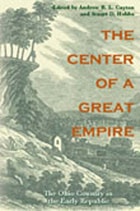
The Center of a Great Empire
The Ohio Country in the Early RepublicAndrew R. L. Cayton
Ohio University Press, 2005
“The people who lived in what became the seventeenth state in the American Union in 1803 were not only at the center of a great empire, they were at the center of the most important historical developments in the revolutionary Atlantic World.”
—From the introduction
Nowhere did the revolutions in politics, commerce, and society in the late eighteenth and early nineteenth centuries occur more quickly or more thoroughly than in the Ohio country. A forested borderland dominated by American Indians in 1780, Ohio was a landscape of farms and towns inhabited by people from all over the world by 1830. The Center of a Great Empire: The Ohio Country in the Early Republic chronicles this dramatic and all-encompassing change.
Andrew R. L. Cayton and Stuart D. Hobbs have assembled an impressive collection of articles by established and rising scholars. They address the conquest of Native Americans, the emergence of a democratic political culture, the origins of capitalism, the formation of public culture, the growth of evangelical Protestantism, the ambiguous status of African Americans, and social life in a place that most regarded as the cutting edge of human history.
For The Center of a Great Empire, distinguished historians of the American nation in its first decades question conventional wisdom. They emphasize contingency rather than inevitability and contention rather than progress. Downplaying the frontier character of Ohio, they offer new interpretations and open new paths of inquiry through investigations of race, education, politics, religion, family, commerce, colonialism, and conquest. As it underscores key themes in the history of the United States, The Center of a Great Empire pursues issues that have fascinated people for two centuries.
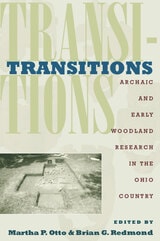
Transitions
Archaic and Early Woodland Research in the Ohio CountryMartha P. Otto
Ohio University Press, 2008
The late archaic and early woodland peoples lived in the Ohio region between 5,000 and 2,000 years ago. This was a time of transition, when hunters and gatherers began to grow native seed crops, establish more permanent settlements, and develop complex forms of ritual and ceremonialism, sometimes involving burial mound construction.
The focused archaeological studies described in Transitions: Archaic and Early Woodland Research in the Ohio Country shed light on this important episode in human cultural development. The authors describe important archaeological sites such as the rich Late Archaic settlements of southwestern Ohio and the early Adena Dominion Land Company enclosure in Franklin County. They present detailed accounts of Native American behavior, such as the use of smoking pipes by Adena societies and a reconstruction of mound use and ritual.
Transitions is the result of a comprehensive, long-term study focusing on particular areas of Ohio with the most up-to-date and detailed treatment of Ohio’s native cultures during this important time of change. This book will be of great value to students and other readers who wish to go beyond the general and often dated treatments of Ohio archaeology currently available.