Results by title
4 books match the query 'Okinawa-ken (Japan)'
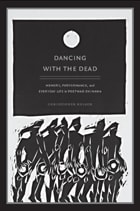
Dancing with the Dead
Memory, Performance, and Everyday Life in Postwar OkinawaChristopher T. Nelson
Duke University Press, 2008
Challenging conventional understandings of time and memory, Christopher T. Nelson examines how contemporary Okinawans have contested, appropriated, and transformed the burdens and possibilities of the past. Nelson explores the work of a circle of Okinawan storytellers, ethnographers, musicians, and dancers deeply engaged with the legacies of a brutal Japanese colonial era, the almost unimaginable devastation of the Pacific War, and a long American military occupation that still casts its shadow over the islands. The ethnographic research that Nelson conducted in Okinawa in the late 1990s—and his broader effort to understand Okinawans’ critical and creative struggles—was inspired by his first visit to the islands in 1985 as a lieutenant in the U.S. Marine Corps.
Nelson analyzes the practices of specific performers, showing how memories are recalled, bodies remade, and actions rethought as Okinawans work through fragments of the past in order to reconstruct the fabric of everyday life. Artists such as the popular Okinawan actor and storyteller Fujiki Hayato weave together genres including Japanese stand-up comedy, Okinawan celebratory rituals, and ethnographic studies of war memory, encouraging their audiences to imagine other ways to live in the modern world. Nelson looks at the efforts of performers and activists to wrest the Okinawan past from romantic representations of idyllic rural life in the Japanese media and reactionary appropriations of traditional values by conservative politicians. In his consideration of eisā, the traditional dance for the dead, Nelson finds a practice that reaches beyond the expected boundaries of mourning and commemoration, as the living and the dead come together to create a moment in which a new world might be built from the ruins of the old.
Nelson analyzes the practices of specific performers, showing how memories are recalled, bodies remade, and actions rethought as Okinawans work through fragments of the past in order to reconstruct the fabric of everyday life. Artists such as the popular Okinawan actor and storyteller Fujiki Hayato weave together genres including Japanese stand-up comedy, Okinawan celebratory rituals, and ethnographic studies of war memory, encouraging their audiences to imagine other ways to live in the modern world. Nelson looks at the efforts of performers and activists to wrest the Okinawan past from romantic representations of idyllic rural life in the Japanese media and reactionary appropriations of traditional values by conservative politicians. In his consideration of eisā, the traditional dance for the dead, Nelson finds a practice that reaches beyond the expected boundaries of mourning and commemoration, as the living and the dead come together to create a moment in which a new world might be built from the ruins of the old.
[more]
The Community of Nuchi Du Takara ("Life Is the Ultimate Treasure") in Postwar Okinawa
Local Subjectivity within and against EmpireMasamichi (Marro) Inoue
University of Michigan Press, 2025
Against the background of the prolonged US military presence in post–World War II Okinawa, The Community of Nuchi Du Takara (“Life Is the Ultimate Treasure”) in Postwar Okinawa explores the conflict between Okinawa and the US-Japan alliance. Developing the local notion of nuchi du takara into an analytical concept, Inoue examines how Okinawan activists, artists, writers, and other social actors have resisted US military presence, particularly the planned construction of a new military facility in northern Okinawa. The concept of nuchi du takara also helps Inoue explore complex negotiations Okinawa has had with Washington and Tokyo beyond resistance and protest, a process that involves developing a local communal capacity to embrace diverse and often contradictory attitudes toward the US military. Inoue’s grounded investigation underscores the possibility of small yet significant, incremental social changes from below, a possibility that ultimately points toward the World Republic—an international politics built upon peace, democracy, and shared affluence—against the sovereignty of global capitalism.
[more]
The Limits of Okinawa
Japanese Capitalism, Living Labor, and Theorizations of CommunityWendy Matsumura
Duke University Press, 2015
Since its incorporation into the Japanese nation-state in 1879, Okinawa has been seen by both Okinawans and Japanese as an exotic “South,” both spatially and temporally distinct from modern Japan. In The Limits of Okinawa, Wendy Matsumura traces the emergence of this sense of Okinawan difference, showing how local and mainland capitalists, intellectuals, and politicians attempted to resolve clashes with labor by appealing to the idea of a unified Okinawan community. Their numerous confrontations with small producers and cultivators who refused to be exploited for the sake of this ideal produced and reproduced “Okinawa” as an organic, transhistorical entity. Informed by recent Marxist attempts to expand the understanding of the capitalist mode of production to include the production of subjectivity, Matsumura provides a new understanding of Okinawa's place in Japanese and world history, and it establishes a new locus for considering the relationships between empire, capital, nation, and identity.
[more]
When the Bones Speak
The Living, the Dead, and the Sacrifice of Contemporary OkinawaChristopher T. Nelson
Duke University Press, 2025
Haunted by the past, ordinary Okinawans struggle to live with the unbearable legacies of war, Japanese nationalism, and American imperialism. They are caught up in a web of people and practices—living and dead, visible and immaterial—that exert powerful forces often beyond their control. In When the Bones Speak, Christopher T. Nelson examines the myriad ways contemporary Okinawans experience, remember, and contest sacrifice. He attends to the voices of those who find their vocation in service to others, from shamans, fortune tellers, laborers, and artists to dead soldiers, war survivors, antiwar activists, and Christian missionaries. Nelson shows how the memories of past sacrifices, atrocities, and exploitation as well as residual trauma shape modern life in Okinawa and the possibility and hope for creative action grounded in the everyday. Offering new understandings of colonial transformation, wartime violence, and military occupation, Nelson writes from the intersection of temporalities and possibilities, where the hard finality of the past may be broken open to reveal a “not yet” that has always remained just beyond reach.
[more]