Results by title
5 books match the query 'Olmecs'
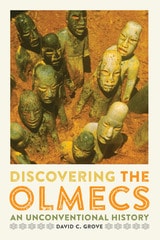
Discovering the Olmecs
An Unconventional HistoryBy David C. Grove
University of Texas Press, 2014
The Olmecs are renowned for their massive carved stone heads and other sculptures, the first stone monuments produced in Mesoamerica. Seven decades of archaeological research have given us many insights into the lifeways of the Olmecs, who inhabited parts of the modern Mexican states of Veracruz and Tabasco from around 1150 to 400 BC, and there are several good books that summarize the current interpretations of Olmec prehistory. But these formal studies don’t describe the field experiences of the archaeologists who made the discoveries. What was it like to endure the Olmec region’s heat, humidity, mosquitoes, and ticks to bring that ancient society to light? How did unforeseen events and luck alter carefully planned research programs and the conclusions drawn from them? And, importantly, how did local communities and individuals react to the research projects and discoveries in their territories?
In this engaging book, a leading expert on the Olmecs tells those stories from his own experiences and those of his predecessors, colleagues, and students. Beginning with the first modern explorations in the 1920s, David Grove recounts how generations of archaeologists and local residents have uncovered the Olmec past and pieced together a portrait of this ancient civilization that left no written records. The stories are full of fortuitous discoveries and frustrating disappointments, helpful collaborations and deceitful shenanigans. What emerges is an unconventional history of Olmec archaeology, a lively introduction to archaeological fieldwork, and an exceptional overview of all that we currently know about the Olmecs.
Fanning the Sacred Flame
Mesoamerican Studies in Honor of H. B. NicholsonMatthew A. Boxt
University Press of Colorado, 2020
Covering all of Mesoamerica across all time periods, contributors include Patricia R. Anawalt, Alfredo López Austin, Anthony Aveni, Robert M. Carmack, David C. Grove, Richard D. Hansen, Leonardo López Luján, Kevin Terraciano, and more. Eloise Quiñones Keber provides a thorough biographical sketch, detailing Nicholson's academic and professional journey. Publication supported, in part, by The Patterson Foundation and several private donors.

Farming, Hunting, and Fishing in the Olmec World
By Amber M. VanDerwarker
University of Texas Press, 2006
The Olmec who anciently inhabited Mexico's southern Gulf Coast organized their once-egalitarian society into chiefdoms during the Formative period (1400 BC to AD 300). This increase in political complexity coincided with the development of village agriculture, which has led scholars to theorize that agricultural surpluses gave aspiring Olmec leaders control over vital resources and thus a power base on which to build authority and exact tribute.
In this book, Amber VanDerwarker conducts the first multidisciplinary analysis of subsistence patterns at two Olmec settlements to offer a fuller understanding of how the development of political complexity was tied to both agricultural practices and environmental factors. She uses plant and animal remains, as well as isotopic data, to trace the intensification of maize agriculture during the Late Formative period. She also examines how volcanic eruptions in the region affected subsistence practices and settlement patterns. Through these multiple sets of data, VanDerwarker presents convincing evidence that Olmec and epi-Olmec lifeways of farming, hunting, and fishing were driven by both political and environmental pressures and that the rise of institutionalized leadership must be understood within the ecological context in which it occurred.
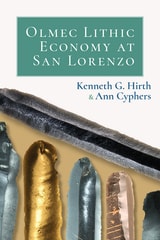
Olmec Lithic Economy at San Lorenzo
Kenneth Hirth
University Press of Colorado, 2020
The obsidian blade was the cutting tool of choice across Mesoamerica and used in a wide range of activities, from domestic food preparation to institutional ritual activities. Hirth and Cyphers conducted a three-decade investigation of obsidian artifacts recovered at Puerto Malpica, the earliest known workshop, and seventy-six other sites on San Lorenzo Island, where these tools were manufactured for local and regional distribution. Evidence recovered from these excavations provides some of the first information on how early craft specialists operated and how the specialized technology used to manufacture obsidian blades spread across Mesoamerica. The authors use geochemical analyses to identify thirteen different sources for obsidian during San Lorenzo’s occupation. This volcanic glass, not locally available, was transported over great distances, arriving in nodular and finished blade form.
Olmec Lithic Economy at San Lorenzo offers a new way to analyze the Preclassic lithic economy—the procurement, production, distribution, and consumption of flaked stone tools—and shows how the study of lithics aids in developing a comprehensive picture of the internal structure and operation of Olmec economy. The book will be significant for Mesoamericanists as well as students and scholars interested in economy, lithic technology, and early complex societies.
Unseen Art
Making, Vision, and Power in Ancient MesoamericaClaudia Brittenham
University of Texas Press, 2023
In Unseen Art, Claudia Brittenham unravels one of the most puzzling phenomena in Mesoamerican art history: why many of the objects that we view in museums today were once so difficult to see. She examines the importance that ancient Mesoamerican people assigned to the process of making and enlivening the things we now call art, as well as Mesoamerican understandings of sight as an especially godlike and elite power, in order to trace a gradual evolution in the uses of secrecy and concealment, from a communal practice that fostered social memory to a tool of imperial power.
Addressing some of the most charismatic of all Mesoamerican sculptures, such as Olmec buried offerings, Maya lintels, and carvings on the undersides of Aztec sculptures, Brittenham shows that the creation of unseen art has important implications both for understanding status in ancient Mesoamerica and for analyzing art in the present. Spanning nearly three thousand years of the Indigenous art of Mexico, Guatemala, Honduras, and Belize, Unseen Art connects the dots between vision, power, and inequality, providing a critical perspective on our own way of looking.