Results by title
2 books match the query 'Olmsted, Frederick Law'
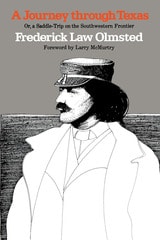
A Journey through Texas; or, a Saddle-Trip on the Southwestern Frontier
By Frederick Law Olmsted
University of Texas Press, 1978
Early in the year 1854 Frederick Law Olmsted, a young New England journalist, crossed the Louisiana border and set off on horseback into the teeth of the Texas winter. In A Journey through Texas he recounts his travels along the Old San Antonio Road through East Texas' piney woods, the dry prairies further west, the chaparral of South Texas, the coastal prairies, and the rich bottomlands around Houston and Galveston.
Olmsted does not romanticize the discomforts of his trip—the monotonous food, crude housing, wet and dry northers, rough companions—yet his book reflects a sense of limitless possibility for this new and open country. The cultured Easterner remembers in relentless detail the squalor and brutality met with in parts of East Texas, but he writes fondly of the civility and cleanliness of the German settlements around New Braunfels.
In his introductory "A Letter to a Southern Friend," omitted in earlier reprints, Olmsted sets forth his views opposing the extension of slavery into the West and promoting free-soil agriculture for frontier states.
The remarkably versatile Olmsted is best known as the founder of landscape architecture in America and for works including Central Park and Stanford University.
In his Foreword, Larry McMurtry calls A Journey through Texas an "intelligent, lively, readable book, packed with keen observation and lightened by a delicate strain of humor."
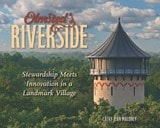
Olmsted's Riverside
Stewardship Meets Innovation in a Landmark VillageCathy Jean Maloney
Southern Illinois University Press, 2024
WINNER, Certificate of Excellence in “Scholarly Publications” from the Illinois State Historical Society’s 2025 Best of Illinois History Awards!
Honorable Mention, 2025 Society of Midland Authors Award in History!
The challenge to preserve Chicagoland’s unique haven
Just outside the bustling metropolis of Chicago lies the unlikely green oasis of Riverside, Illinois, a small village that has continued to directly influence American landscapes and suburbs since the 1870s. Once farmland, the location provided a blank canvas for preeminent designers Fredrick Law Olmsted and Calvert Vaux’s manifestation of a truly democratic society. Olmsted’s Riverside details the village’s historical significance, harmony with nature, and its nearly 150-year impact on American suburbs today.
Cathy Jean Maloney explores how Riverside’s layout and design presaged today’s urban planning goals of walkability, green space, public transportation access, sustainability, and resiliency. Houses in Riverside are set back from the road, sidewalks meander along gently curving roads, and public green spaces abound. Maloney shows how Riverside’s leaders and residents struggled with stewardship of Olmsted’s ideals by balancing competing interests in suburban development and Chicago sprawl from the 1870s to the 2020s. She details in chronological chapters how the village adapted to tragedies such as the Great Fire of 1871 and the Panic of 1873, as well as advancements in transportation, local civic life, urban policy, and environmental thought, all while staying true to the framework inherited from Olmsted and Vaux.
Olmsted’s Riverside provides engaging examples of how citizen involvement can protect a community’s ideals. This richly illustrated volume combines landscape architecture, regional history, and urban design to show how audacious civic planning and thoughtful conservation can provide a model for future American suburbs.