Results by title

3 books match the query 'Online identities'

cover of Buy It Now: Lessons from eBay

Buy It Now

Lessons from eBay

Michele White

Duke University Press, 2012
In Buy It Now, Michele White examines eBay and its emphasis on community and social norms, revealing the cultural assumptions about gender, race, and sexuality that are reinforced throughout the site. She shows how instructional texts, rule systems, and advertisements "configure the user," allowing eBay to indicate how the site is supposed to function while also upholding particular values and practices. White details how eBay reinforces stereotypes about gender and sexuality, looking, for example, at descriptions included in wedding dress listings, and how eBay directs individuals to the "Adult Only" part of the website when they use the search terms "gay" and "lesbian." She discloses the ways that eBay promises a caring community but its "Black Americana" category reproduces racism by allowing sellers' narratives that excuse and romanticize slavery and insult African Americans. White also looks at how participants challenge eBay's categories, rules, and values, examining widely used strategies of resistance by sellers and buyers in the lesbian and gay interest listings. By analyzing the organizational and cultural logics present in eBay, White emphasizes how other Internet settings, including craigslist, are not as transparent, community-oriented, and empowering as they claim. She proposes methods for researching and reconceptualizing new media sites.
[more]
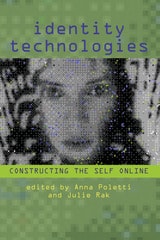
cover of Identity Technologies: Constructing the Self Online

Identity Technologies

Constructing the Self Online

Edited by Anna Poletti and Julie Rak

University of Wisconsin Press, 2013

Identity Technologies is a substantial contribution to the fields of autobiography studies, digital studies, and new media studies, exploring the many new modes of self-expression and self-fashioning that have arisen in conjunction with Web 2.0, social networking, and the increasing saturation of wireless communication devices in everyday life.
            This volume explores the various ways that individuals construct their identities on the Internet and offers historical perspectives on ways that technologies intersect with identity creation. Bringing together scholarship about the construction of the self by new and established authors from the fields of digital media and auto/biography studies, Identity Technologies presents new case studies and fresh theoretical questions emphasizing the methodological challenges inherent in scholarly attempts to account for and analyze the rise of identity technologies. The collection also includes an interview with Lauren Berlant on her use of blogs as research and writing tools.
[more]
cover of Online a Lot of the Time: Ritual, Fetish, Sign

Online a Lot of the Time

Ritual, Fetish, Sign

Ken Hillis

Duke University Press, 2009

A wedding ceremony in a Web-based virtual world. Online memorials commemorating the dead. A coffee klatch attended by persons thousands of miles apart via webcams. These are just a few of the ritual practices that have developed and are emerging in online settings. Such Web-based rituals depend on the merging of two modes of communication often held distinct by scholars: the use of a device or mechanism to transmit messages between people across space, and a ritual gathering of people in the same place for the performance of activities intended to generate, maintain, repair, and renew social relations. In Online a Lot of the Time, Ken Hillis explores the stakes when rituals that would formerly have required participants to gather in one physical space are reformulated for the Web. In so doing, he develops a theory of how ritual, fetish, and signification translate to online environments and offer new forms of visual and spatial interaction. The online environments Hillis examines reflect the dynamic contradictions at the core of identity and the ways these contradictions get signified.

Hillis analyzes forms of ritual and fetishism made possible through second-generation virtual environments such as Second Life and the popular practice of using webcams to “lifecast” one’s life online twenty-four hours a day, seven days a week. Discussing how people create and identify with their electronic avatars, he shows how the customs of virtual-world chat reinforce modern consumer-based subjectivities, allowing individuals to both identify with and distance themselves from their characters. His consideration of web-cam cultures links the ritual of exposing one’s life online to a politics of visibility. Hillis argues that these new “rituals of transmission” are compelling because they provide a seemingly material trace of the actual person on the other side of the interface.

[more]