Results by title
80 books match the query 'Ontology' and 7 start with a
A World of Many
Ontology and Child Development among the Maya of Southern MexicoNorbert Ross
Rutgers University Press, 2023

After Life
Eugene Thacker
University of Chicago Press, 2010
In After Life, Eugene Thacker clears the ground for a new philosophy of life by recovering the twists and turns in its philosophical history. Beginning with Aristotle’s originary formulation of a philosophy of life, Thacker examines the influence of Aristotle’s ideas in medieval and early modern thought, leading him to the work of Immanuel Kant, who notes the inherently contradictory nature of “life in itself.” Along the way, Thacker shows how early modern philosophy’s engagement with the problem of life affects thinkers such as Gilles Deleuze, Georges Bataille, and Alain Badiou, as well as contemporary developments in the “speculative turn” in philosophy.
At a time when life is categorized, measured, and exploited in a variety of ways, After Life invites us to delve deeper into the contours and contradictions of the age-old question, “what is life?”
Alien Phenomenology, or What It’s Like to Be a Thing
Ian Bogost
University of Minnesota Press, 2012
Humanity has sat at the center of philosophical thinking for too long. The recent advent of environmental philosophy and posthuman studies has widened our scope of inquiry to include ecosystems, animals, and artificial intelligence. Yet the vast majority of the stuff in our universe, and even in our lives, remains beyond serious philosophical concern.
In Alien Phenomenology, or What It’s Like to Be a Thing, Ian Bogost develops an object-oriented ontology that puts things at the center of being—a philosophy in which nothing exists any more or less than anything else, in which humans are elements but not the sole or even primary elements of philosophical interest. And unlike experimental phenomenology or the philosophy of technology, Bogost’s alien phenomenology takes for granted that all beings interact with and perceive one another. This experience, however, withdraws from human comprehension and becomes accessible only through a speculative philosophy based on metaphor.
Providing a new approach for understanding the experience of things as things, Bogost also calls on philosophers to rethink their craft. Drawing on his own background as a videogame designer, Bogost encourages professional thinkers to become makers as well, engineers who construct things as much as they think and write about them.
Animacies
Biopolitics, Racial Mattering, and Queer AffectMel Y. Chen
Duke University Press, 2012
Chen's book is the first to bring the concept of animacy together with queer of color scholarship, critical animal studies, and disability theory. Through analyses of dehumanizing insults, the meanings of queerness, animal protagonists in recent Asian/American art and film, the lead in toys panic in 2007, and the social lives of environmental illness, Animacies illuminates a hierarchical politics infused by race, sexuality, and ability. In this groundbreaking book, Chen rethinks the criteria governing agency and receptivity, health and toxicity, productivity and stillness—and demonstrates how attention to the affective charge of matter challenges commonsense orderings of the world.

Apocalypse of Truth
Heideggerian MeditationsJean Vioulac
University of Chicago Press, 2021
In his first book to be translated into English, Vioulac radicalizes Heidegger’s understanding of truth as disclosure through the notion of truth as apocalypse. This “apocalypse of truth” works as an unveiling that reveals both the finitude and mystery of truth, allowing a full confrontation with truth-as-absence. Engaging with Heidegger, Marx, and St. Paul, as well as contemporary figures including Giorgio Agamben, Alain Badiou, and Slavoj Žižek, Vioulac’s book presents a subtle, masterful exposition of his analysis before culminating in a powerful vision of “the abyss of the deity.” Here, Vioulac articulates a portrait of Christianity as a religion of mourning, waiting for a god who has already passed by, a form of ever-present eschatology whose end has always already taken place. With a preface by Jean-Luc Marion, Apocalypse of Truth presents a major contemporary French thinker to English-speaking audiences for the first time.
Aristotle's Ontology of Change
Mark Sentesy
Northwestern University Press, 2020
Aristotle may be the only thinker to propose a noncircular definition of change. With his landmark argument that change did, in fact, exist, Aristotle challenged established assumptions about what it is and developed a set of conceptual frameworks that continue to provide insight into the nature of reality. This groundbreaking work on change, however, has long been interpreted through a Platonist view of change as unreal. By offering a comprehensive reexamination of Aristotle’s pivotal arguments, and establishing his positive ontological conception of change, Sentesy makes a significant contribution to scholarship on Aristotle, ancient philosophy, the history and philosophy of science, and metaphysics.
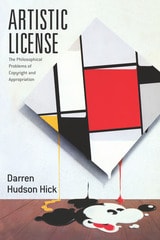
Artistic License
The Philosophical Problems of Copyright and AppropriationDarren Hudson Hick
University of Chicago Press, 2017
Engaging with long-standing debates about the nature of originality, authorship, and artists’ rights, Hick examines the philosophical challenges presented by the role of intellectual property in the artworld and vice versa. Using real-life examples of artists who have incorporated copyrighted works into their art, he explores issues of artistic creation and the nature of infringement as they are informed by analytical aesthetics and legal and critical theory. Ultimately, Artistic License provides a critical and systematic analysis of the key philosophical issues that underlie copyright policy, rethinking the relationship between artist, artwork, and the law.