Results by title
10 books match the query 'Open'
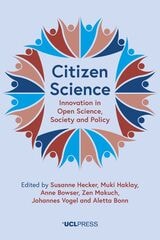
Citizen Science
Innovation in Open Science, Society and PolicyEdited by Susanne Hecker, Muki Haklay, Anne Bowser, Zen Makuch, Johannes Vogel, and Aletta Bonn
University College London, 2018
This book identifies and explains the role of citizen science within innovation in science and society, and as a vibrant and productive science-policy interface. The scope of this volume is global, geared towards identifying solutions and lessons to be applied across science, practice and policy. The chapters consider the role of citizen science in the context of the wider agenda of open science and open innovation and discuss progress towards responsible research and innovation, two of the most critical aspects of science today.
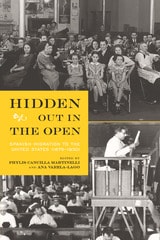
Hidden Out in the Open
Spanish Migration to the United States (1875-1930)Phylis Cancilla Martinelli
University Press of Colorado, 2018
The chapters in this volume are geographically wide-ranging, reflecting the transnational nature of the Spanish diaspora in the Americas, encompassing networks that connected Spain, Cuba, Latin American countries, the United States, and American-controlled territories in Hawai’i and Panama. The geographic diversity reveals the different jobs immigrants engaged in, from construction gangs in the Panama Canal to mining crews in Arizona and West Virginia. Contributors analyze the Spanish experience in the United States from a variety of perspectives, discussing rural and urban enclaves, the role of the state, and the political mobilization of migrants, using a range of methodological approaches that examine ethnicity, race, gender, and cultural practices through the lenses of sociology, history, and cultural studies.
The mention of the Spanish influence in the United States often conjures up images of conquistadores and padres of old. Forgotten in this account are the Spanish immigrants who reached American shores in the late nineteenth and early twentieth centuries. Hidden Out in the Open reveals the role of the modern migration of Spaniards in this "land of immigrants" and rectifies the erasure of Spain in the American narrative. The book will be of interest to scholars and students of US history and the history of modern Spain and Europe, as well as those interested ethnic and migration/diaspora studies, Hispanic/Latino studies, and the study of working class and radicalism.
Contributors: Brian D. Bunk, Christopher J. Castañeda, Thomas Hidalgo, Beverly Lozano, Phylis Cancilla Martinelli, Gary R. Mormino, George E. Pozzetta†, Ana Varela-Lago.
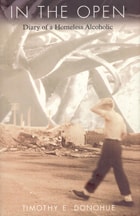
In the Open
Diary of a Homeless AlcoholicTimothy E. Donohue
University of Chicago Press, 1996
Donohue's experiences are brutal, but his perceptions are poetic. This account of an intelligent and sensitive man in the grip of alcoholism and homelessness challenges our perceptions of those on the margins of American contemporary life.
"Donohue recorded this often-moving account during a four-year period of homelessness caused by his alcoholism. . . . There are many brilliant observations here on a range of topics, including human nature, technology, and capitalism. . . . Donohue's life on the fringe also provides an inside look at the homeless system of overnight shelters, labor offices, and food stamp providers. But, somehow, in spite of all the negatives, a hopeful book emerges."—Booklist
"A startlingly original book. In this confessional age, Donohue's diary becomes a different sort of tell-all, a palimpsest that forces us to extract the author from his own writing. . . . Donohue comes to resemble Swift's Gulliver"—Nicholas Nesson, Boston Phoenix
"Donohue punctuates his account of 'domiciling within the black walls of a mosquito-infested night' with rambling metaphysical asides in the style of an eighteenth-century philosophe."—Molly McQuade, Lingua Franca
"Despite hunger, homelessness, dead-end jobs and abusive drinking, what is most striking about Donohue is his amazing optimism and endurance."—Patrick Markee, Nation
"Donohue is a gifted writer. . . . But what gives [his diary] the breath of life is that it is written by an artist."—Alec Wilkinson, Los Angeles Times Book Review

Open And Equitable Scholarly Communication Creating A More
Nancy Maron
Assoc of College & Research Libraries, 2019
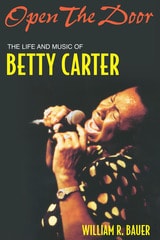
Open the Door
The Life and Music of Betty CarterWilliam R. Bauer
University of Michigan Press, 2003
This book looks at Betty Carter's contribution to the music world and delves behind the scenes to show Carter's growth as a businesswoman who took charge of her career.
Drawing upon revealing interviews with Carter, the author shows how ever-changing shifts in the music industry affected the singer's life and influenced her music. Bauer shows through his analysis of her musical examples how Carter absorbed various musical influences, from Sarah Vaughan and Billie Holiday to Miles Davis, and made them her own. From her apprenticeship with Gladys Hampton, Carter grew to become a shrewd dealer who learned to do her own contracting, A&R, and marketing and distribution. By chronicling one of jazz's great singers and composers, the book sheds light on how early jazz musicians got their work to the public and how this process has changed during the past fifty years.
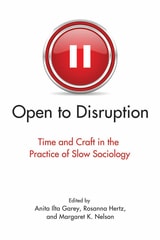
Open to Disruption
Time and Craft in the Practice of Slow SociologyAnita Ilta Garey
Vanderbilt University Press, 2014
Some researchers describe how disruptions prompted them to expand the boundaries of their discipline and invent concepts that could more accurately describe phenomena that previously had no name and no scholarly history. Sometimes scholars themselves caused the disruption as they circled back to work they had considered "done" and allowed the possibility of rethinking earlier findings.
Open to the Public
Studies in Japan's Recent Past, Volume 10Leslie Pincus, ed.
Duke University Press, 0
Stories of Open
Opening Peer Review through Narrative InquiryEmily Ford
Assoc of College & Research Libraries, 2021
Stories of Open: Opening Peer Review through Narrative Inquiry examines the methods and processes of peer review, as well as the stories of those who have been through it. Eleven chapters are divided into three parts:
• Part 1: Orientation. This section offers a conceptual frame for the book, providing details about narrative inquiry as a methodology and the author’s worldview and research approach.
• Part 2: The Stories (The Story Middle). What is the standard experience of peer review in our field? This section shares stories told from a variety of viewpoints and roles—author, editor, and referee—and explores how these roles interact, the tension between them, and the duality and sometimes multiplicity of roles experienced by any one individual.
• Part 3: Coda. These four chapters tie the stories to the idea of open and look in detail at the research method, as well as imagine how we might move forward—reflecting on our past stories to create future ones.
When we open ourselves to others’ experiences, we reflect on our own. Stories of Open offers questions for reflection at the end of many chapters in order to assist in the continued exploration of your own experiences with peer review, and encourages the use of these reflections in creating new and improved peer review methods.
This book is also available as an open access edition at https://bit.ly/ACRLStoriesofOpen

Techniques for Electronic Resource Management
TERMS and the Transition to OpenJill Emery
American Library Association, 2020
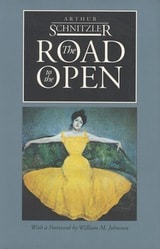
The Road to the Open
Arthur Schnitzler
Northwestern University Press, 1991