Results by title
2 books match the query 'Opp, Karl-Dieter'

Origins of a Spontaneous Revolution
East Germany, 1989Karl-Dieter Opp, Peter Voss, and Christiane Gern
University of Michigan Press, 1995
November 1989: East Germans danced on the Berlin Wall, and the communist regime began to collapse. A unique revolution has occurred: changes were brought about by peaceful, spontaneous demonstrations. No group organized the famous gatherings of thousands of people at the Karl Marx Square in Leipzig on October 9, 1989, and no government or military attempt was made to crack down on the demonstrations.The events of the GDR revolution have been well documented, but until now there has been no comprehensive attempt to explain the revolution. The authors contend that any explanation must focus on the individual GDR citizen; while situating the individual at the focal point of their analysis, they demonstrate how political events and reforms, in the GDR and neighboring countries, motivated citizens to act despite the risk to their lives. Applying a version of the theory of rational action that uses “soft” incentives and individual perceptions, the authors select the factors that help explain the GDR revolution. New findings include that political discontent — not economic — was a major cause for participation in the demonstrations.Not limiting themselves to theoretical speculations, the authors support their arguments with original documents, jokes, slogans, and a unique data set drawn from a representative survey of 1,300 Leipzig residents in 1990 focusing exclusively on the revolutionary period. Written in a clear and accessible style, this book will be of interest to general readers as well as sociologists, historians, and political scientists.
[more]
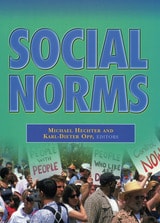
Social Norms
Michael Hechter
Russell Sage Foundation, 2001
Social norms are rules that prescribe what people should and should not do given their social surroundings and circumstances. Norms instruct people to keep their promises, to drive on the right, or to abide by the golden rule. They are useful explanatory tools, employed to analyze phenomena as grand as international diplomacy and as mundane as the rules of the road. But our knowledge of norms is scattered across disciplines and research traditions, with no clear consensus on how the term should be used. Research on norms has focused on the content and the consequences of norms, without paying enough attention to their causes. Social Norms reaches across the disciplines of sociology, economics, game theory, and legal studies to provide a well-integrated theoretical and empirical account of how norms emerge, change, persist, or die out. Social Norms opens with a critical review of the many outstanding issues in the research on norms: When are norms simply devices to ease cooperation, and when do they carry intrinsic moral weight? Do norms evolve gradually over time or spring up spontaneously as circumstances change? The volume then turns to case studies on the birth and death of norms in a variety of contexts, from protest movements, to marriage, to mushroom collecting. The authors detail the concrete social processes, such as repeated interactions, social learning, threats and sanctions, that produce, sustain, and enforce norms. One case study explains how it can become normative for citizens to participate in political protests in times of social upheaval. Another case study examines how the norm of objectivity in American journalism emerged: Did it arise by consensus as the professional creed of the press corps, or was it imposed upon journalists by their employers? A third case study examines the emergence of the norm of national self-determination: has it diffused as an element of global culture, or was it imposed by the actions of powerful states? The book concludes with an examination of what we know of norm emergence, highlighting areas of agreement and points of contradiction between the disciplines. Norms may be useful in explaining other phenomena in society, but until we have a coherent theory of their origins we have not truly explained norms themselves. Social Norms moves us closer to a true understanding of this ubiquitous feature of social life.
[more]