Results by title
10 books match the query 'Opposition'

A Life In The Struggle
Ivory Perry and the Culture of OppositionGeorge Lipsitz
Temple University Press, 1995

Muslim Communities Reemerge
Historical Perspectives on Nationality, Politics, and Opposition in the Former Soviet Union and YugoslaviaAndreas Kappeler, Gerhard Simon, and Georg Brunner, eds.
Duke University Press, 1994
In fourteen chapters and an updated introduction, European and North American specialists examine the recent evolution of Islamic expression and practice in these former Communist regions, as well as its political significance within officially atheistic regimes. Representing a wide range of disciplines and perspectives, the authors detail how the modern ethno-religious situation developed and matured in hostile circumstances, the degree of latitude the local Muslims achieved in religious expression, and what prospect the future seemed to offer just before the breakup of the Soviet Union and the Federal Republic of Yugoslavia. Overall, the book provides a thorough analysis of the coincidence and tension between ethnic and religious identity in two countries officially devoted to the separation of ethnic groups in domestic cultural arrangements but not in the social or political realm.
Contributors. Edward Allworth, Hans Bräker, Marie Broxup, Georg Brunner, Bert G. Fragner, Uwe Halbach, Wolfgang Höpken, Andreas Kappeler, Edward J. Lazzerini, Richard Lorenz, Alexandre Popovi´c, Sabrina Petra Ramet, Azade-Ayse Rorlich, Gerhard Simon, Tadeusz Swietochowski

Natural Resource Development and Human Rights in Latin America
State and non-state actors in the promotion of and opposition to extractivismEdited by Malayna Raftopoulos and Radoslaw Poweska
University of London Press, 2017

Opposition and Intimidation
The Abortion Wars and Strategies of Political HarassmentAlesha E. Doan
University of Michigan Press, 2007
The abortion fight has long been a crucible of political tactics, with both sides employing strategies ranging from litigation to civil disobedience to outright violence. Anti-abortion activists have arguably been more tactically innovative than their pro-choice peers. Opposition and Intimidation looks at how their use of political harassment fits—or doesn't—with more conventional political efforts in the struggle over abortion.
Alesha Doan's insightful interviews and observations powerfully portray anti-abortion activists' relationship to the objects of their protest. Her portrait is augmented by thorough quantitative analysis of harassment's role within the movement's multitiered strategy—a strategy that Doan shows has forced a decline in the availability and popularity of abortions. Using her unique study of the anti-abortion movement as a model, Doan extends her findings to propose a novel and valuable theory of the new politics of harassment.
"An interesting and sophisticated account. Seamlessly weaves narrative and analysis, tying local action to national strategy. Explores uncharted territory in the abortion controversy and expands our understanding of political action."
—Deborah R. McFarlane, University of New Mexico
"For 40 years, abortion politics have been endlessly fascinating to American scholars and journalists alike because they generate unique political phenomena that challenge traditional theories of political behavior. In this book, Doan goes straight to the heart of the matter by describing, evaluating, and explaining one of the most characteristic and complex of these phenomena—political harassment. In a well-written narrative that weaves qualitative and quantitative data, she gives us the first scholarly look at this political tactic, whose relevance and use go well beyond American abortion politics."
—Chris Mooney, University of Illinois at Springfield
"The book contributes to political theory and knowledge by adding new empirical data gathered from interviews with those in the front lines of the struggle over abortion. The author refines and develops a category of unconventional political participation—political harassment of nongovernmental actors—and explains why it is particularly effective in undermining the rights of women seeking abortions, as well as the rights of abortion service providers."
—Nikki R. Van Hightower, Texas A&M University
Alesha E. Doan is Assistant Professor of Political Science at the University of Kansas.

Political Epistemics
The Secret Police, the Opposition, and the End of East German SocialismAndreas Glaeser
University of Chicago Press, 2011
What does the durability of political institutions have to do with how actors form knowledge about them? Andreas Glaeser investigates this question in the context of a fascinating historical case: socialist East Germany’s unexpected self-dissolution in 1989. His analysis builds on extensive in-depth interviews with former secret police officers and the dissidents they tried to control as well as research into the documents both groups produced. In particular, Glaeser analyzes how these two opposing factions’ understanding of the socialist project came to change in response to countless everyday experiences. These investigations culminate in answers to two questions: why did the officers not defend socialism by force? And how was the formation of dissident understandings possible in a state that monopolized mass communication and group formation? He also explores why the Stasi, although always well informed about dissident activities, never developed a realistic understanding of the phenomenon of dissidence.
Out of this ambitious study, Glaeser extracts two distinct lines of thought. On the one hand he offers an epistemic account of socialism’s failure that differs markedly from existing explanations. On the other hand he develops a theory—a sociology of understanding—that shows us how knowledge can appear validated while it is at the same time completely misleading.
Routing the Opposition
Social Movements, Public Policy, and DemocracyDavid S. Meyer
University of Minnesota Press, 2005

Silencing the Opposition
Antinuclear Movements and the Media in the Cold WarAndrew Rojecki
University of Illinois Press, 1999
We can trace many important strategic decisions to compelling official fictions such as Kennedy's "missile gap" and Reagan's "window of vulnerability." Over the years, antinuclear movements have had mixed success debunking these fictions, raising public consciousness, and reorienting government policy.
Andrew Rojecki explores links between nuclear arms policy and the visibility of opposition groups in the media. He pays particular interest to two cycles of protest: the test ban movement of the Eisenhower and the Kennedy administrations and the Reagan-era nuclear freeze movement. As Rojecki shows, space devoted to the opposition as well as the quality of the coverage varied widely from the first to the second period. The change reflected different climates of public opinion and foreign policy but also a subtle shift in political culture that undermined the legitimacy of citizen protest. As the rationalized policymaking of government agencies, think tanks, and university departments increasingly restricted public debate, the potential for citizens to influence nuclear politics became more circumscribed while nuclear weapons continued to proliferate.
State and Opposition in Military Brazil
By Maria Helena Moreira Alves
University of Texas Press, 1985
Based on extensive research into opposition and government documents, including the previously unavailable Manual Básico da Escola de Guerra, Maria Helena Moreira Alves provides a rich description of the long and tortuous attempt by the Brazilian military government to create a workable “national security state” in the face of determined and resilient opposition.
She interviewed more than one hundred key figures in government, the military, business, professional associations, the Catholic church, grassroots organizations, and trade unions in order to analyze politically and historically the relationship between civil society and government structures in Brazil during the years 1964–1983. Her study charts the rise and subsequent decline of the military government’s power, concluding with a discussion of the abertura policy instituted under General João Batista Figueiredo.

Waves of Opposition
Labor and the Struggle for Democratic RadioElizabeth Fones-Wolf
University of Illinois Press, 2006
Radio sparked the massive upsurge of organized labor during the Great Depression. The powerful new medium became an important weapon in the ideological war between labor and business. Corporations used radio to sing the praises of individualism and consumerism, while unions emphasized equal rights, industrial democracy, and social justice.
Elizabeth Fones-Wolf analyzes the battle to utilize, and control, the airwaves in radio's early era. Working chronologically, she explores the advent of local labor radio stations such as WCFL and WEVD, labor's campaigns against corporate censorship, and union experiments with early FM broadcasting. Using union archives and broadcast industry records, Fones-Wolf demonstrates radio's key role in organized labor's efforts to fight business's domination of political discourse throughout the 1930s, 1940s, and 1950s. She concludes with a look at how labor's virtual disappearance from today's media helps explain why unions have become so marginalized, and offers important historical lessons for revitalizing organized labor.
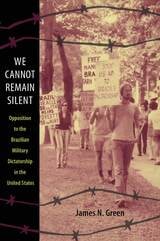
We Cannot Remain Silent
Opposition to the Brazilian Military Dictatorship in the United StatesJames N. Green
Duke University Press, 2010
Green interviewed many of the activists who educated journalists, government officials, and the public about the abuses taking place under the Brazilian dictatorship. Drawing on those interviews and archival research from Brazil and the United States, he describes the creation of a network of activists with international connections, the documentation of systematic torture and repression, and the cultivation of Congressional allies and the press. Those efforts helped to expose the terror of the dictatorship and undermine U.S. support for the regime. Against the background of the political and social changes of the 1960s and 1970s, Green tells the story of a decentralized, international grassroots movement that effectively challenged U.S. foreign policy.