Results by title
2 books match the query 'Ordering'
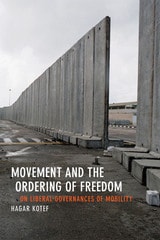
Movement and the Ordering of Freedom
On Liberal Governances of MobilityHagar Kotef
Duke University Press, 2015
We live within political systems that increasingly seek to control movement, organized around both the desire and ability to determine who is permitted to enter what sorts of spaces, from gated communities to nation-states. In Movement and the Ordering of Freedom, Hagar Kotef examines the roles of mobility and immobility in the history of political thought and the structuring of political spaces. Ranging from the writings of Locke, Hobbes, and Mill to the sophisticated technologies of control that circumscribe the lives of Palestinians in the Occupied West Bank, this book shows how concepts of freedom, security, and violence take form and find justification via “regimes of movement.” Kotef traces contemporary structures of global (im)mobility and resistance to the schism in liberal political theory, which embodied the idea of “liberty” in movement while simultaneously regulating mobility according to a racial, classed, and gendered matrix of exclusions.
[more]

The Ordering of Time
From the Ancient Computus to the Modern ComputerArno Borst
University of Chicago Press, 1993
This book is a concise history of the use and interpretation of time, written by one of the foremost medievalists in Europe today.
Arno Borst examines the various ways that time has been calculated by numbers and measured by instruments over several centuries, from the computus—an ancient method of determining times and dates—to the present-day computer. In a wide-ranging discussion, he analyzes the classical Greek concepts of divine, natural, and human time; the universal time of ancient Rome; the Easter cycle of the Middle Ages; the development of the mechanical clock in the fourteenth and fifteenth centuries; early modern chronology; and twentieth-century data processing.
Borst argues that although many centuries and countless different instruments—sundials, horologia, abaci, astrolabes, calendars, and calculating machines—separate the medieval computus from the modern computer, each generation has had to answer the same question: how can we make the best use of our available time to improve our lives? The computer, he suggests, is merely a new instrument employed for an ancient purpose.
Lively and accessible, The Ordering of Time will be welcomed by students and researchers in social and cultural history, the history of science and mathematics, as well as anyone interested in the history of time and numbers.
[more]