Results by title
8 books match the query 'Organic'
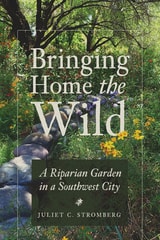
Bringing Home the Wild
A Riparian Garden in a Southwest CityJuliet C. Stromberg
University of Arizona Press, 2023
When living in a large sprawling city, one may feel disconnected and adrift. Finding ways to belong and have positive effects is challenging. In Bringing Home the Wild, botanist Juliet C. Stromberg demonstrates how ecologically guided gardening develops a sense of place, restores connections to nature, and brings joy and meaning to our lives.
This book follows a two-decade journey in ecologically guided gardening on a four-acre irrigated parcel in Phoenix, Arizona, from the perspective of a retired botanist and her science historian partner. Through humor and playful use of language, Bringing Home the Wild not only introduces the plants who are feeding them, buffering the climate, and elevating their moods but also acknowledges the animals and fungi who are pollinating the plants and recycling the waste. Some of the plants featured are indigenous to the American Southwest, while others are part of the biocultural heritage of the cityscape. This book makes the case for valuing inclusive biodiversity and for respectful interactions with all wild creatures, regardless of their historical origin.
As author and partner learn to cohabit with the plants who feed them, calm them, entertain them, and protect them from the increasing heat, their desire to live sustainably, ethically, and close to the land becomes even stronger, revealing the importance of observing, appreciating, and learning from the ecosystems of which we are a part.
Dear Dirt Doctor
Questions Answered the Natural WayBy Howard Garrett
University of Texas Press, 2003
Howard Garrett has converted gardeners throughout Texas and beyond to gardening the natural way without chemical fertilizers and toxic pesticides. In this revised and updated edition of The Dirt Doctor's Guide to Organic Gardening, he uses a question-and-answer format to present a wealth of new information on organic gardening, landscaping, pest control, and natural living. The book also incorporates valuable feedback and suggestions from gardeners who've successfully used Howard's methods.
Discriminating Taste
How Class Anxiety Created the American Food RevolutionFinn, S. Margot
Rutgers University Press, 2017
For the past four decades, increasing numbers of Americans have started paying greater attention to the food they eat, buying organic vegetables, drinking fine wines, and seeking out exotic cuisines. Yet they are often equally passionate about the items they refuse to eat: processed foods, generic brands, high-carb meals. While they may care deeply about issues like nutrition and sustainable agriculture, these discriminating diners also seek to differentiate themselves from the unrefined eater, the common person who lives on junk food.
Discriminating Taste argues that the rise of gourmet, ethnic, diet, and organic foods must be understood in tandem with the ever-widening income inequality gap. Offering an illuminating historical perspective on our current food trends, S. Margot Finn draws numerous parallels with the Gilded Age of the late nineteenth century, an era infamous for its class divisions, when gourmet dinners, international cuisines, slimming diets, and pure foods first became fads.
Examining a diverse set of cultural touchstones ranging from Ratatouille to The Biggest Loser, Finn identifies the key ways that “good food” has become conflated with high status. She also considers how these taste hierarchies serve as a distraction, leading middle-class professionals to focus on small acts of glamorous and virtuous consumption while ignoring their class’s larger economic stagnation. A provocative look at the ideology of contemporary food culture, Discriminating Taste teaches us to question the maxim that you are what you eat.

Food for Change
The Politics and Values of Social MovementsJeff Pratt and Pete Luetchford
Pluto Press, 2013
Concern about our food system is growing, from the costs of industrial farming to the dominant role of supermarkets and recurring scandals about the origins and content of what we eat.
Food for Change documents the way alternative food movements respond to these concerns by trying to create more closed economic circuits within which people know where, how, and by whom their food is produced.
Jeff Pratt, Peter Luetchford and other contributors explore the key political and economic questions of food through the everyday experience and vivid insights of farmers and consumers, using fieldwork from case studies in four European countries (France, Spain, Italy and England). Food for Change is an insightful consideration of connections between food and wider economic relations and draws on a rich vein of anthropological writing on the topic.
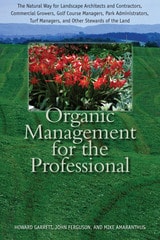
Organic Management for the Professional
The Natural Way for Landscape Architects and Contractors, Commercial Growers, Golf Course Managers, Park Administrators, Turf Managers, and Other Stewards of the LandBy Howard Garrett, John Ferguson, and Mike Amaranthus
University of Texas Press, 2012
Can you manage the landscape of a golf course, city park, or corporate campus without synthetic fertilizers and toxic pesticides? Absolutely! Organic landscaping is not only possible on a large scale, but it also makes sense both economically and environmentally. It promotes healthy soils and plants, which require less water and sequester more carbon—a winning combination for both your bottom line and the planet’s fight against resource depletion and global warming. Organic programs on a commercial scale have enormous potential to make a difference in the quality of our environment, our use of fuels, and our climate. And as those who have already converted to organics have discovered, they also cost a lot less over the long term.
Organic Management for the Professional is the first comprehensive guide to “going green” in large-scale landscaping. Nationally recognized organic gardening expert Howard Garrett, with associates John Ferguson and Mike Amaranthus, not only explains in detail how to manage projects with natural organic techniques, but also presents the material in clear, simple terms so that commercial and institutional property owners can understand what to ask of their landscape architects, contractors, growers, and maintenance people. They give detailed, proven instructions for the key components of organic landscaping—soil building, correct planting techniques, fertilizing, pest control, compost, and mulch. Then they show how to apply these organic methods in large-scale landscaping, commercial growing (orchards, tree farms, nurseries, and greenhouse operations), and recreational properties (golf courses, parks, and sports fields).
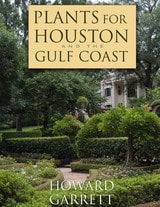
Plants for Houston and the Gulf Coast
By Howard Garrett
University of Texas Press, 2008
Whether you're a first-time homeowner, dedicated gardener, or landscape professional, if you're gardening on the Gulf Coast, you need Howard Garrett's Plants for Houston and the Gulf Coast. Garrett is one of Texas's top organic gardening experts, and gardeners rely on him for accurate, sensible advice about what to plant and how to maintain healthy yards and landscapes without synthetic fertilizers and toxic pesticides. In Plants for Houston and the Gulf Coast, Garrett presents nearly 400 plants, both native and adapted, that grow well in Southeast Texas.
Like all of Howard Garrett's books, Plants for Houston and the Gulf Coast is loaded with indispensable gardening information:
- Nearly 400 trees, shrubs, groundcovers and vines, annuals and perennials, and grasses
- 400 full-color, close-up photos of the plants
- Expert information about each plant's appearance, growing requirements, landscape uses, potential problems, and other interesting facts
- Precise, easy-to-follow instructions about how to design a garden, prepare the soil, install trees and other plants, grow grass and control weeds, and maintain the landscape and control pests
- A detailed gardening calendar for Southeast Texas that lists specific plants to plant and maintenance tasks to perform each month
No other book currently available provides such extensive and reliable information for Texas Gulf Coast gardeners.

Texas Gardening the Natural Way
The Complete HandbookBy Howard Garrett
University of Texas Press, 2004
Compost your old "complete" gardening guide. There's a new way of gardening in Texas that's healthier for people and the environment, more effective at growing vigorous plants and reducing pests, cheaper to maintain, and just more fun. It's Howard Garrett's "The Natural Way" organic gardening program, and it's all here in Texas Gardening the Natural Way.
This book is the first complete, state-of-the-art organic gardening handbook for Texas. Using Howard Garrett's new mainstream gardening techniques, Texas Gardening the Natural Way presents a total gardening program:
- How to plan, plant, and maintain beautiful landscapes without using chemical fertilizers and toxic pesticides.
- Gardening fundamentals: soils, landscape design, planting techniques, and maintenance practices.
- Includes more native and adaptable varieties of garden and landscape plants than any other guide on the market.
- Trees: 134 species of evergreens, berry- and fruit-bearing, flowering, yellow fall color, orange fall color, and red fall color.
- Shrubs and specialty plants: 85 species for sun, shade, spring flowering, summer flowering, and treeform shrubs.
- Ground covers and vines: 51 species for sun and shade.
- Annuals and perennials: 136 species for fall color, winter color, summer color in shade and sun, and spring color. Also seeding rates for wildflowers.
- Lawn grasses: 10 species for sun and shade, with additional information on 16 native grasses, seeding rates for 32 grasses, and suggested mowing heights.
- Fruits, nuts, and vegetables: 58 species, with a vegetable planting chart and information on organic pecan and fruit tree growing, fruit varieties for Texas, grape and pecan varieties, and gardening by the moon.
- Common green manure crops: 29 crops that help enrich the soil.
- Herbs: 66 species for culinary and medicinal uses.
- Bugs: 73 types of helpful and harmful bugs, with organic remedies for pests, lists of beneficial bugs and plants that attract them, a beneficial bug release schedule, and sources for beneficial bugs.
- Plant diseases: organic treatments for 55 common problems.
- Organic methods for repelling mice, rabbits, armadillos, beavers, cats, squirrels, and deer.
- Organic management practices: watering, fertilizing, controlling weeds, releasing beneficial insects, biological controls (including bats and purple martins), and recipes for Garrett Juice, fire ant control drench, vinegar herbicide, Sick Tree Treatment, and Tree Trunk Goop.
- Average first and last freeze dates for locations around the state.
- Organic fertilizers and soil amendments: 61 varieties, including full instructions for making compost.
- Organic pest control products: 30 varieties.
- Common house plants and poisonous plants.
- Instructions for climbing vegetable structures and bat houses.
- 833 gorgeous full-color photographs.

The Texas Way
Money, Power, Politics, and Ambition at The UniversityBy William H. Cunningham
University of Texas Press, 2013
This engaging memoir details Bill Cunningham’s seven years as president of the University of Texas at Austin and his eight years as chancellor of the UT System. Along the way, he relates accounts of the important issues UT faced during that time, including fraternity hazing, affirmative action, the demise of the Southwest Conference and the creation of the Big 12, apartheid and divestment protests, the future of higher education in Texas, and many other issues.
The Texas Way outlines how money, power, politics, and ambition all play roles in the business of running the state’s premier university system, particularly in its relations with the state government. As president and then as chancellor, Cunningham dealt with conflict from all sides of the political spectrum, always striving to protect the university’s interests.
Bill Cunningham was at the center of many important issues during the fifteen years he served as president and chancellor. The Dolph Briscoe Center for American History at the University of Texas at Austin is pleased to publish Cunningham’s detailed and insightful memoir, which serves as a reminder of how these issues continue to resonate and affect higher education in Texas.