Results by title
3 books match the query 'Organism'

Perturbing the Organism
The Biology of Stressful ExperienceHerbert Weiner
University of Chicago Press, 1992
The concept of stress pervades modern society, with relief from it promised on everything from vitamin to vacation packages. Yet there exists no generally accepted classification of stressful experience, nor is the concept itself universally considered a valid subject for research.
This authoritative work is the first to analyze critically the entire range of research and theory on stress in animals and humans, from the earliest studies in the 1930s up to the present day. Herbert Weiner not only documents the many empirical and conceptual advances of recent years, but also supplies a new working definition and classification of stressful experience. He describes the integrated, organismic responses to stressful environmental changes, tasks, and challenges in terms of functional adaptation: the failure of these responses results in injury, ill-health, disease, and death. To examine the coordination between behavior and bodily functions, Weiner reviews current knowledge on how stressful experiences also alter biobehavioral rhythms.
Providing a useful, integrative concept of stress rooted in an understanding of the organism as an interactive communication system composed of many subsystems, Perturbing the Organism will interest a wide range of clinicians and researchers throughout the medical and behavioral sciences.
The John D. and Catherine T. MacArthur Foundation Series on Mental Health and Development
[more]
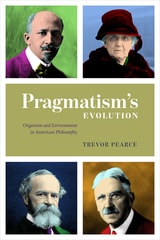
Pragmatism's Evolution
Organism and Environment in American PhilosophyTrevor Pearce
University of Chicago Press, 2020
In Pragmatism’s Evolution, Trevor Pearce demonstrates that the philosophical tradition of pragmatism owes an enormous debt to specific biological debates in the late 1800s, especially those concerning the role of the environment in development and evolution. Many are familiar with John Dewey’s 1909 assertion that evolutionary ideas overturned two thousand years of philosophy—but what exactly happened in the fifty years prior to Dewey’s claim? What form did evolutionary ideas take? When and how were they received by American philosophers?
Although the various thinkers associated with pragmatism—from Charles Sanders Peirce to Jane Addams and beyond—were towering figures in American intellectual life, few realize the full extent of their engagement with the life sciences. In his analysis, Pearce focuses on a series of debates in biology from 1860 to 1910—from the instincts of honeybees to the inheritance of acquired characteristics—in which the pragmatists were active participants. If we want to understand the pragmatists and their influence, Pearce argues, we need to understand the relationship between pragmatism and biology.
Although the various thinkers associated with pragmatism—from Charles Sanders Peirce to Jane Addams and beyond—were towering figures in American intellectual life, few realize the full extent of their engagement with the life sciences. In his analysis, Pearce focuses on a series of debates in biology from 1860 to 1910—from the instincts of honeybees to the inheritance of acquired characteristics—in which the pragmatists were active participants. If we want to understand the pragmatists and their influence, Pearce argues, we need to understand the relationship between pragmatism and biology.
[more]
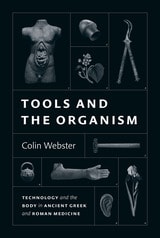
Tools and the Organism
Technology and the Body in Ancient Greek and Roman MedicineColin Webster
University of Chicago Press, 2023
The first book to show how the concept of bodily organs emerged and how ancient tools influenced conceptualizations of human anatomy and its operations.
Medicine is itself a type of technology, involving therapeutic tools and substances, and so one can write the history of medicine as the application of different technologies to the human body. In Tools and the Organism, Colin Webster argues that, throughout antiquity, these tools were crucial to broader theoretical shifts. Notions changed about what type of object a body is, what substances constitute its essential nature, and how its parts interact. By following these changes and taking the question of technology into the heart of Greek and Roman medicine, Webster reveals how the body was first conceptualized as an “organism”—a functional object whose inner parts were tools, or organa, that each completed certain vital tasks. He also shows how different medical tools created different bodies.
Webster’s approach provides both an overarching survey of the ways that technologies impacted notions of corporeality and corporeal behaviors and, at the same time, stays attentive to the specific material details of ancient tools and how they informed assumptions about somatic structures, substances, and inner processes. For example, by turning to developments in water-delivery technologies and pneumatic tools, we see how these changing material realities altered theories of the vascular system and respiration across Classical antiquity. Tools and the Organism makes the compelling case for why telling the history of ancient Greco-Roman medical theories, from the Hippocratics to Galen, should pay close attention to the question of technology.
[more]