Results by title
25 books match the query 'Organizing'
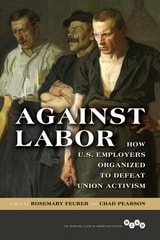
Against Labor
How U.S. Employers Organized to Defeat Union ActivismEdited by Rosemary Feurer and Chad Pearson
University of Illinois Press, 2017
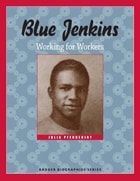
Blue Jenkins
Working for WorkersJulia Pferdehirt
Wisconsin Historical Society Press, 2011
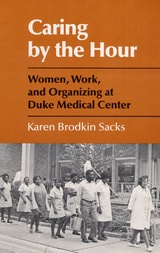
Caring by the Hour
Women, Work, and Organizing at Duke Medical CenterKaren Brodkin Sacks
University of Illinois Press, 1988
In addition to an analysis of the dynamics of women's activism, Caring by the Hour provides a comparative study of Duke Medical Center's treatment of both black and white female workers. Sacks links patterns of racial segregation in clerical jobs to the relationship between race, working conditions, and unequal opportunities for black and white women, and to their differing work cultures and patterns of public militance. She also discusses recent changes in service, clerical, and professional work and their effects on white and black women, placing them in the context of national changes in health funding and policies.
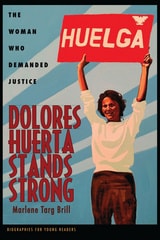
Dolores Huerta Stands Strong
The Woman Who Demanded JusticeMarlene Targ Brill
Ohio University Press, 2018
Selected as a Bank Street College of Education Best Children’s Book of the Year for 2018 (Category: Twelve–Fourteen)
“A biography for the times … An excellent read for anyone hoping to believe one person can make a difference.” —Kirkus (starred review)
“This well-told, age-appropriate account of a vital and essential activist deserves a place in all middle grade collections.” —School Library Journal (starred review)
Today, we know Dolores Huerta as the cofounder, with Cesar Chavez, of the National Farmworkers Association, which later became the United Farm Workers of America. We know her as a tireless advocate for the rights of farmworkers, Mexican American immigrants, women, and LGBTQ populations. And we know her as the recipient of the Presidential Medal of Freedom from Barack Obama in 2012.
Before all that, though, Huerta was a child in the farming community of Stockton, California, and then a teenager whose teachers underestimated her because she was Chicana. When she became a teacher herself, she witnessed her students coming to school shoeless and hungry. Many took days off from school to work in the farm fields to help feed their families. What could she do to help them? A young mother at the time, Huerta quit her teaching job to organize their parents. That began her journey to educate a nation about who produces our food and the conditions under which they work.
Dolores Huerta Stands Strong follows Huerta’s life from the mining communities of the Southwest where her father toiled, to the vineyards and fields of California, and across the country to the present day. As she worked for fair treatment for others, Dolores earned the nation’s highest honors. More important, she found her voice.

Fires on the Border
The Passionate Politics of Labor Organizing on the Mexican FronteraRosemary Hennessy
University of Minnesota Press, 2013
The history of the maquiladoras has been punctuated by workers’ organized resistance to abysmal working and living conditions. Over years of involvement in such movements, Rosemary Hennessy was struck by an elusive but significant feature of these struggles: the extent to which organizing is driven by attachments of affection and antagonism, belief, betrayal, and identification.
What precisely is the “affective” dimension of organizing for justice? Are affects and emotions the same? And how can their value be calculated? Fires on the Border takes up these questions of labor and community organizing—its “affect-culture”—on Mexico’s northern border from the early 1970s to the present day. Through these campaigns, Hennessy illuminates the attachments and identifications that motivate people to act on behalf of one another and that bind them to a common cause. The book’s unsettling, even jarring, narratives bring together empirical and ethnographic accounts—of specific campaigns, the untold stories of gay and lesbian organizers, love and utopian longing—in concert with materialist theories of affect and the critical good sense of Mexican organizers.
Teasing out the integration of affect-culture in economic relations and cultural processes, Hennessy provides evidence that sexuality and gender as strong affect attractors are incorporated in the harvesting of surplus labor. At the same time, workers’ testimonies confirm that the capacities for bonding and affective attachment, far from being entirely at the service of capital, are at the very heart of social movements devoted to sustaining life.
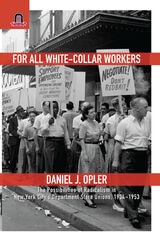
For All White-Collar Workers
The Possibilities of Radicalism in New York City's Department Store Unions, 1934–1953Daniel J. Opler
The Ohio State University Press, 2007
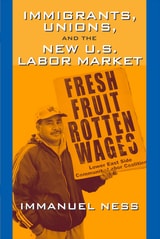
Immigrants Unions & The New Us Labor Mkt
Immanuel Ness
Temple University Press, 2005
Japanese and Chinese Immigrant Activists
Organizing in American and International Communist Movements, 1919–1933Fowler, Josephine
Rutgers University Press, 2007
Japanese and Chinese immigrants in the United States have traditionally been characterized as hard workers who are hesitant to involve themselves in labor disputes or radical activism. How then does one explain the labor and Communist organizations in the Asian immigrant communities that existed from coast to coast between 1919 and 1933? Their organizers and members have been, until now, largely absent from the history of the American Communist movement. In Japanese and Chinese Immigrant Activists, Josephine Fowler brings us the first in-depth account of Japanese and Chinese immigrant radicalism inside the United States and across the Pacific.
Drawing on multilingual correspondence between left-wing and party members and other primary sources, such as records from branches of the Japanese Workers Association and the Chinese Nationalist Party, Fowler shows how pressures from the Comintern for various sub-groups of the party to unite as an “American” working class were met with resistance. The book also challenges longstanding stereotypes about the relationships among the Communist Party in the United States, the Comintern, and the Soviet Party.
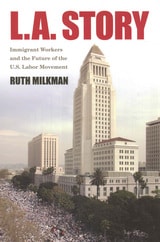
L.A. Story
Immigrant Workers and the Future of the U.S. Labor MovementRuth Milkman
Russell Sage Foundation, 2006

Libraries amid Protest
Books, Organizing, and Global ActivismSherrin Frances
University of Massachusetts Press, 2020
Libraries amid Protest unpacks how these protest libraries—labor-intensive, temporary installations in parks and city squares, poorly protected from the weather, at odds with security forces—continue to arise. In telling the stories of these surprising and inspiring spaces through interviews and other research, Sherrin Frances confronts the complex history of American public libraries. She argues that protest libraries function as the spaces of opportunity and resistance promised, but not delivered, by American public libraries.
Middle Class Union
Organizing the ‘Consuming Public’ in Post-World War I AmericaMark W. Robbins
University of Michigan Press, 2017
Combining social history with interdisciplinary approaches to the study of consumption and symbolic space, Middle Class Union illustrates how acts of consumption, representations of the middle class in literary, journalistic, and artistic discourses, and ground-level organizing combined to enable white-collar activists to establish themselves as both the middle class and the backbone of the nation. This book contributes to labor history by examining the nexus of class and consumption to show how many white-collar workers drew on their consumer identity to express an anti-labor politics, later facilitating the struggles of unions throughout the post–World War I years. It also contributes to political history by emphasizing how these middle-class activists laid important groundwork for both 1920s business conservatism and New Deal liberalism. They exerted their political influence well before the post–World War II period, when a self-interested and powerful middle-class consumer identity is more widely acknowledged to have taken hold.
Organizing In Hard Times
Labor and Neighborhoods In HartfordLouise B. Simmons
Temple University Press, 1994
In 1990, Hartford, Connecticut, ranked as the eight poorest city in the country by the census; the real estate market was severely depressed; downtown insurance companies were laying off and the retail department stores were closing; public services were strained; and demolition sites abandoned for lack of funds pockmarked the streets. Hartford's problems are typical of those experienced in numerous U.S. cities affected by a lingering recession.
The harsh economic times felt throughout the city's workplaces and neighborhoods precipitated the formation of grassroots alliances between labor and community organizations. Coming together to create new techniques, their work has national implications for the development of alternative strategies for stimulating economic recovery.
Louise B. Simmons, a former Hartford City Councilperson, offers an insider's view of these coalitions, focusing on three activist unions—rhe New England Health Care Employees Union, the Hotel and Restaurant Employees, and the United Auto Workers—and three community groups—Hartford Areas Rally Together, Organized North Easterners-Clay Hill and North End, and Asylum Hill Organizing Project. Her in-depth analysis illustrates these groups' successes and difficulties in working together toward a new vision of urban politics.
In the series Labor and Social Change, edited by Paula Rayman and Carmen Sirianni.
Organizing the Lakota
The Political Economy of the New Deal on the Pine Ridge and Rosebud ReservationsThomas Biolsi
University of Arizona Press, 1992
Biolsi pays particular attention to the administrative means by which the OIA retained the power to design and implement tribal "self-government" as well as the power to control the flow of critical resources—rations, relief employment, credit—to the reservations. He also shows how this imbalance of power between the tribes and the federal bureaucracy influenced politics on the reservations, and argues that the crisis of authority faced by the Lakota tribal governments among their own would-be constituents—most dramatically demonstrated by the 1973 Wounded Knee occupation—is a direct result of their disempowerment by the United States.
Place-Keepers
Latina/x Art, Performance, and Organizing in the Twin CitiesJessica Lopez Lyman
University of Minnesota Press, 2025
An in-depth look at how Latina/x artists transform art into activism and reclaim space in the Twin Cities
In Place-Keepers, Jessica Lopez Lyman examines how Latina/x artists in the Twin Cities navigate and challenge the region’s deep-seated racial injustices. Using “Inter-Latina movidas”—subtle yet strategic actions through which Latina/x artists forge solidarities, mobilize for justice, and reclaim space—these artists respond to systemic oppression through public performances and behind-the-scenes negotiations with the state, nonprofits, and other institutions.
Centering Latina/x women and gender nonconforming artists from Chicana/Mexicana, U.S. Central American, and Caribbean backgrounds, Place-Keepers confronts reductionist theories of Latinidad that flatten ethnic and racial identities. It demonstrates how the creative and activist practices of these cultural organizers address urgent social struggles from resisting gentrification and environmental destruction to opposing police violence. Lopez Lyman situates these efforts within the broader history of racial justice organizing in Minnesota, tracing a lineage of resistance that long precedes the 2020 Minneapolis uprising following the murder of George Floyd.
Through firsthand accounts and revealing case studies, Place-Keepers charts how these artists harness aesthetics as a tool for movement-building, strategically redistributing resources and transforming policy. Expanding the foundational concept of “movidas” in Chicana/o/x and Latina/o/x studies by highlighting maneuvers of infiltration, improvisation, individual ritual, and interdependence, Lopez Lyman establishes a crucial framework for understanding art as activism.
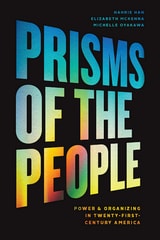
Prisms of the People
Power & Organizing in Twenty-First-Century AmericaHahrie Han, Elizabeth McKenna, and Michelle Oyakawa
University of Chicago Press, 2021
Prisms of the People addresses those questions and more. Using data from six movement organizations—including a coalition that organized a 104-day protest in Phoenix in 2010 and another that helped restore voting rights to the formerly incarcerated in Virginia—Hahrie Han, Elizabeth McKenna, and Michelle Oyakawa show that the power of successful movements most often is rooted in their ability to act as “prisms of the people,” turning participation into political power just as prisms transform white light into rainbows. Understanding the organizational design choices that shape the people, their leaders, and their strategies can help us understand how grassroots groups achieve their goals.
Linking strong scholarship to a deep understanding of the needs and outlook of activists, Prisms of the People is the perfect book for our moment—for understanding what’s happening and propelling it forward.
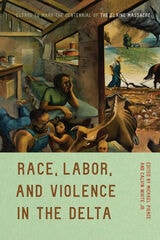
Race, Labor, and Violence in the Delta
Essays to Mark the Centennial of the Elaine MassacreMichael Pierce
University of Arkansas Press, 2022
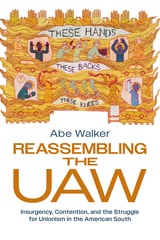
Reassembling the UAW
Insurgency, Contention, and the Struggle for Unionism in the American SouthAbe Walker
Temple University Press, 2026
Abe Walker chronicles the organizing campaign from its origin in 2014 to the union’s breakthrough victory in 2024, illustrating what went wrong—and what went right—along the way. Walker provides a systematic analysis of the strategic challenges and tactical shifts, showing the patterns that persisted across three election cycles while highlighting their differences, from global-level alliances to local labor issues.
Reassembling the UAW also demonstrates how rebel rank-and-file workers ousted the old-guard leadership and transformed the UAW into a militant union to achieve results. Ultimately, Walker offers valuable lessons for organizational strategy, the power of collective action, and the future of the labor movement.

Showers of Blessings
Myrtle Lawrence, Notable Sharecropper and Union OrganizerElizabeth Anne Payne
University of Arkansas Press, 2023
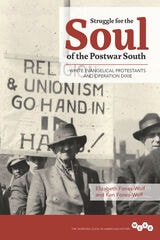
Struggle for the Soul of the Postwar South
White Evangelical Protestants and Operation DixieElizabeth Fones-Wolf and Ken Fones-Wolf
University of Illinois Press, 2015
The authors' nuanced look at working class religion reveals how laborers across the surprisingly wide evangelical spectrum interpreted their lives through their faith. Factors like conscience, community need, and lived experience led individual preachers to become union activists and mill villagers to defy the foreman and minister alike to listen to organizers. As the authors show, however, all sides enlisted belief in the battle. In the end, the inability of northern organizers to overcome the suspicion with which many evangelicals viewed modernity played a key role in Operation Dixie's failure, with repercussions for labor and liberalism that are still being felt today.
Identifying the role of the sacred in the struggle for southern economic justice, and placing class as a central aspect in southern religion, Struggle for the Soul of the Postwar South provides new understandings of how whites in the region wrestled with the options available to them during a crucial period of change and possibility.
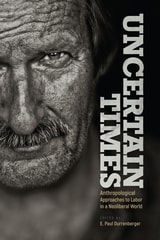
Uncertain Times
Anthropological Approaches to Labor in a Neoliberal WorldE. Paul Durrenberger
University Press of Colorado, 2017
In this first-ever collection of labor anthropology from around the world, the contributors to Uncertain Times assert that traditional labor unions have been co-opted by neoliberal policies of corporate capital and have become service organizations rather than drivers of social movements. The current structure of labor unions facilitates corporations’ need for a stable labor force while reducing their power to prevent outsourcing, subcontracting, and other methods of undercutting worker security and union power. Through case studies from Switzerland, Israel, Argentina, Mexico, the United States, Greece, Sweden,Turkey, Brazil and Spain, the authors demonstrate that this process of neutering unions has been uneven across time and space. They also show that the potential exists for renewed union power based on more vociferous and creative collective action. These firsthand accounts—from activist anthropologists in the trenches as union members and staff, as well as academics analyzing policy, law, worker organizing, and community impact—illustrate the many approaches that workers around the world are taking to reclaim their rights in this ever-shifting labor landscape.
Uncertain Times is the first book to use this crucial comparative, ethnographic approach for understanding the new rules of the global labor struggle and the power workers have to change those rules. The volume will be of great interest to students and scholars of anthropology, sociology of work, and labor studies; labor union leadership; and others interested in developing innovative methods for organizing working people, fomenting class consciousness, and expanding social movements.
Contributors: Alpkan Birelma, Emma Braden, Maria Eugenia de la O, Christopher Kelley, Staffan Löfving, Gadi Nissim, Darcy Pan, Steven Payne, Alicia Reigada, Julia Soul, Manos Spyridakis, Christian Zlolniski
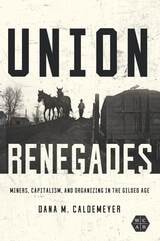
Union Renegades
Miners, Capitalism, and Organizing in the Gilded AgeDana M. Caldemeyer
University of Illinois Press, 2021
Nuanced and eye-opening, Union Renegades challenges popular notions of workers attitudes during the Gilded Age.
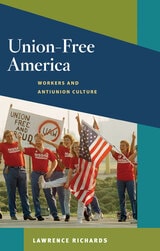
Union-Free America
Workers and Antiunion CultureLawrence Richards
University of Illinois Press, 2008
Union-Free America: Workers and Antiunion Culture confronts one of the most vexing questions with which labor activists and labor academics struggle: why is there so much opposition to organized labor in the United States? Scholars often point to powerful obstacles from employers or governmental policies, but Lawrence Richards offers a more complete picture of the causes for union decline in the postwar period by examining the attitudes of the workers themselves. Large numbers of American workers in the 1970s and 1980s told pollsters that they would vote against a union if an election were held at their place of employment, and Richards provides a provocative explanation for this hostility: a pervasive strain of antiunionism in American culture that has made many workers distrustful of organized labor.
Weighing the arguments of previous historians and sociologists, Richards posits that this underlying antiunion culture in America has been remarkably consistent over the course of half a century. Assessing organizing efforts among blue-collar, white-collar, and pink-collar workers, Richards examines the tactics and countertactics of company and union representatives who sought to either exploit or neutralize workers' popular negative stereotypes of organized labor's insidious control over workers' autonomy. The book considers a number of case studies of organizing drives throughout recent history, from the failed attempt by District 65 to organize clerical workers at New York University in 1970, to a similarly fruitless drive by the Textile Workers Union in 1980 at a textile factory in Charlottesville, Virginia. In both of these particular cases and in many more, antiunion culture has operated to hinder unions' efforts to organize the unorganized. By examining the manifestations and motivations of antiunion culture in the United States, Richards helps explain why so many American workers seem to vote against their own self-interest and declare themselves "Union Free and Proud."
Workers Can Win
A Guide to Organising at WorkIan Allinson
Pluto Press, 2022
Drawing on more than 20 years of organizing experience, Allinson combines practical techniques with an analysis of the theory and politics of organizing and unions.
The Covid, climate, and cost of living crises all hang heavy in the air. It's more obvious than ever that we need radical social and political change. But in the vacuum left by defeated labor movements, where should we begin? For longtime workplace activist Ian Allinson, the answer is clear: organizing at work is essential to rebuild working-class power.
The premise is simple: organizing builds confidence, capacity, and collective power - and with power, we can win change. Workers Can Win is an essential, practical guide for rank-and-file workers and union activists.
The book offers insight into tried and tested methods for effective organizing. It deals with tactics and strategies and addresses some of the roots of conflict, common problems with unions, and the resistance of management to worker organizing. As a 101 guide to workplace organizing with politically radical horizons, Workers Can Win is destined to become an essential tool for workplace struggles in the years to come.
Workplace Justice
Organizing Multi-Identity MovementsSharon Kurtz
University of Minnesota Press, 2002
An unheralded union battle offers new insight into identity politics.
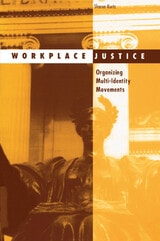
In 1991, Columbia University’s one thousand clerical workers launched a successful campaign for justice in their workplace. This diverse union-two-thirds black and Latina, three-fourths women-was committed to creating an inclusive movement organization and to fighting for all kinds of justice. How could they address the many race and gender injustices members faced, avoid schism, and maintain the unity needed to win? Sharon Kurtz, an experienced union activist and former clerical worker herself, was welcomed into the union and pursued these questions. Using this case study and secondary studies of sister clerical unions at Yale and Harvard, she examines the challenges and potential of identity politics in labor movements.
With the Columbia strike as a point of departure, Kurtz argues that identity politics are valuable for mobilizing groups, but often exclude members and their experiences of oppression. However, Kurtz believes that identity politics should not be abandoned as a component in building movements, but should be reframed-as multi-identity politics. In the end she shows an approach to organizing with great potential impact not only for labor unions but for any social movement.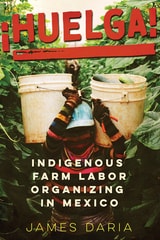
¡Huelga!
Indigenous Farm Labor Organizing in MexicoJames Daria
University of Arizona Press, 2026
On March 17, 2015, tens of thousands of Mexican farmworkers went on strike in San Quintin, Baja California, to protest horrible working conditions on the farms that produce most of the fresh fruits and vegetables you consume. Calling themselves the “slaves of the twenty-first century,” these mostly Indigenous men, women, and children rose up in defiance of the conditions of modern slavery, forced labor, sexual harassment, and “hunger wages.” This ethnography provides an in-depth look into how Indigenous farmworkers organize in the fields and their communities to improve wages and working conditions.
Since the strike, the farmworkers have organized a union to fight for justice in the fields. In this work, author James Daria accompanies these farmworkers as they struggle for dignity. Daria also charts the tensions inside the farmworker movement as women struggle to gain greater power in the home as well as at work. In an era of complex global integration, Daria shows us how what we eat is tied to the suffering of those who produce our food.
This book highlights and centers the Indigenous workers who struggle for justice in a global food system that connects us all.