Results by title
4 books match the query 'Orientations'
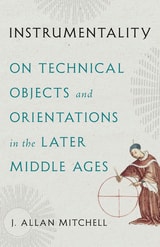
Instrumentality
On Technical Objects and Orientations in the Later Middle AgesJ. Allan Mitchell
University of Minnesota Press, 2024
From medieval to modern, exploring instrumental attitudes toward physical gadgets, diagrams, concepts, methods, and disciplines
Opening up the instrumental condition of the human for critical reflection and renewal, Instrumentality illuminates key moments in the intellectual history of the European Middle Ages. J. Allan Mitchell reveals how, in the predigital past, we can recognize many of the operative technics, analytics, and metaphorics that continue to shape human sense and cognition today.
Exploring the diverse modalities of medieval instruments, Mitchell’s case studies encompass techniques as seemingly distinct as time-keeping mechanisms, mathematical diagrams, logical syllogisms, and the literary devices of Geoffrey Chaucer and John Gower. A cultural and intellectual history, Mitchell’s work leads readers from three-dimensional objects (physical mechanisms) to two-dimensional inscriptions (maps and diagrams) and onward to overarching disciplinary norms in the early liberal and mechanical arts. Prying loose the subtle, adaptable, and generative concept of technical objects from limiting contemporary frameworks, he shows how these instruments are indispensable to the past—and the future—of the arts and culture at large.
Orientations
An Anthology of European Travel Writing on EuropeWendy Bracewell
Central European University Press, 2009
Orientations
Mapping Studies in the Asian DiasporaKandice Chuh and Karen Shimakawa, eds.
Duke University Press, 2001
With its recurrent themes of transnationalism, globalization, and postcoloniality, Orientations considers various embodiments of the Asian diaspora, including a rumination on minority discourses and performance studies, and a historical look at the journal Amerasia. Exploring the translation of knowledge from one community to another, other contributions consider such issues as Filipino immigrants’ strategies for enacting Asian American subjectivity and the link between area studies and the journal Subaltern Studies. In a section that focuses on how disciplines—or borders—form, one essay discusses “orientalist melancholy,” while another focuses on the construction of the Asian American persona during the Cold War. Other topics in the volume include the role Asian immigrants play in U.S. racial politics, Japanese American identity in postwar Japan, Asian American theater, and the effects of Asian and Asian American studies on constructions of American identity.
Contributors. Dipesh Chakrabarty, Kuan-Hsing Chen, Rey Chow, Kandice Chuh, Sharon Hom, Yoshikuni Igarashi, Dorinne Kondo, Russell Leong, George Lipsitz, Lisa Lowe, Martin F. Manalansan IV, David Palumbo-Liu, R. Radhakrishnan, Karen Shimakawa, Sau-ling C. Wong
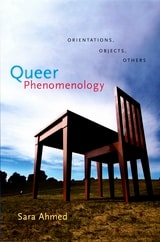
Queer Phenomenology
Orientations, Objects, OthersSara Ahmed
Duke University Press, 2006
Ahmed proposes that a queer phenomenology might investigate not only how the concept of orientation is informed by phenomenology but also the orientation of phenomenology itself. Thus she reflects on the significance of the objects that appear—and those that do not—as signs of orientation in classic phenomenological texts such as Husserl’s Ideas. In developing a queer model of orientations, she combines readings of phenomenological texts—by Husserl, Heidegger, Merleau-Ponty, and Fanon—with insights drawn from queer studies, feminist theory, critical race theory, Marxism, and psychoanalysis. Queer Phenomenology points queer theory in bold new directions.