Results by title
8 books match the query 'Ornithologists'
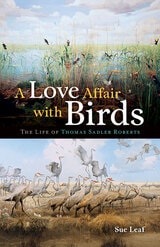
A Love Affair with Birds
The Life of Thomas Sadler RobertsSue Leaf
University of Minnesota Press, 2021
The father of Minnesota ornithology, whose life story opens a window on a lost world of nature and conservation in the state’s early days
Imagine a Minneapolis so small that, on calm days, the roar of St. Anthony Falls could be heard in town, a time when passenger pigeons roosted in neighborhood oak trees. Now picture a dapper professor conducting his ornithology class (the university’s first) by streetcar to Lake Harriet for a morning of bird-watching. The students were mostly young women—in sunhats, sailor tops, and long skirts, with binoculars strung around their necks. The professor was Thomas Sadler Roberts (1858–1946), a doctor for three decades, a bird lover virtually from birth, the father of Minnesota ornithology, and the man who, perhaps more than any other, promoted the study of the state’s natural history. A Love Affair with Birds is the first full biography of this key figure in Minnesota’s past.
Roberts came to Minnesota as a boy and began keeping detailed accounts of Minneapolis’s birds. These journals, which became the basis for his landmark work The Birds of Minnesota, also inform this book, affording a view of the state’s rich avian life in its early days—and of a young man whose passion for birds and practice of medicine in a young Minneapolis eventually dovetailed in his launching of the beloved Bell Museum of Natural History.
Bird enthusiast, doctor, author, curator, educator, conservationist: every chapter in Roberts’s life is also a chapter in the state’s history, and in his story acclaimed author Sue Leaf—an avid bird enthusiast and nature lover herself—captures a true Minnesota character and his time.
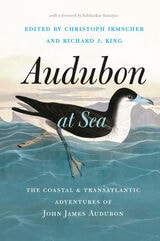
Audubon at Sea
The Coastal and Transatlantic Adventures of John James AudubonEdited by Christoph Irmscher and Richard J. King
University of Chicago Press, 2022
The American naturalist John James Audubon (1785–1851) is widely remembered for his iconic paintings of American birdlife. But as this anthology makes clear, Audubon was also a brilliant writer—and his keen gaze took in far more than creatures of the sky. Culled from his published and unpublished writings, Audubon at Sea explores Audubon’s diverse observations of the ocean, the coast, and their human and animal inhabitants. With Audubon expert Christoph Irmscher and scholar of the sea Richard J. King as our guides, we set sail from the humid expanses of the American South to the shores of England and the chilly landscapes of the Canadian North. We learn not only about the diversity of sea life Audubon documented—birds, sharks, fish, and whales—but also about life aboard ship, travel in early America, Audubon’s work habits, and the origins of beloved paintings. As we face an unfathomable loss of seabirds today, Audubon’s warnings about the fragility of birdlife in his time are prescient and newly relevant.
Charting the course of Audubon’s life and work, from his birth in Haiti to his death in New York City, Irmscher and King’s sweeping introduction and carefully drawn commentary confront the challenges Audubon’s legacy poses for us today, including his participation in American slavery and the thousands of birds he killed for his art. Rounded out by hundreds of historical and ornithological notes and beautiful illustrations, and with a foreword by distinguished photographer and conservationist Subhankar Banerjee, Audubon at Sea is the most comprehensively annotated collection of Audubon’s work ever published.
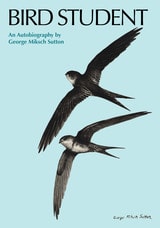
Bird Student
An AutobiographyAn Autobiography by George Miksch Sutton
University of Texas Press, 1980
At thirteen, George Miksch Sutton planned a school of ornithology centered around his collection of bird skins, feathers, bones, nests, eggs, and a prized stuffed crow. As an adult, he became one of the most prominent ornithologists and bird artists of the twentieth century. He describes his metamorphosis from amateur to professional in Bird Student.
Born in 1898, Sutton gives us his clearest memories of his boyhood in Nebraska, Minnesota, Oregon, Illinois, Texas, and West Virginia with his closely knit family. Recognizing birds, identifying them correctly, drawing them, and writing about them became more and more important to him. His intense admiration for Louis Agassiz Fuertes had a good deal to do with his beginning to draw birds in earnest, and his correspondence and his 1916 summer visit with the generous Fuertes taught him to look at birds with the eyes of a professional artist and to consider the possibility of making ornithology his career.
By 1918, Sutton had talked himself into a job at the Carnegie Museum of Natural History in Pittsburgh, which gave him fresh opportunities to learn and travel, and his 1920 field trip to the Labrador Peninsula stimulated his lifelong interest in arctic birds. Further expeditions to James Bay, the east coast of Hudson Bay—on leave from his job as state ornithologist of Pennsylvania—and Southampton Island at the north end of Hudson Bay, in search of the elusive blue goose and its nesting grounds, give us glimpses of field methods before the days of sophisticated equipment. Sutton ends his autobiography in 1935, with an account of his graduate days at Cornell University and his position as curator of the Fuertes Memorial Collection of Birds.
Bird Student is about raising young roadrunners and owls and prairie dogs, sailing (and being stranded) in arctic waters, preparing specimens in the hold of a ship, hunting birds and caribou and bears in almost inaccessible regions, canoeing in the Far North, camping in Florida, and delivering speeches in Pennsylvania. Sutton's gift for mixing facts and philosophy lets us see the evolution of a naturalist, as his inherent curiosity and innocent enjoyment of beauty led to a permanent desire to preserve this beauty.
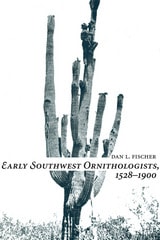
Early Southwest Ornithologists, 1528-1900
Dan Fischer
University of Arizona Press, 2001
With its colorful landscape and wonderful diversity of plant and animal communities, the southwestern borderlands have attracted naturalists for centuries. As Col. Thomas Henry noted in 1853, there “are to be found many curious birds, peculiar to the country.” This book identifies more than 100 early ornithologists and explorers who entered the Southwest from 1528 to 1900, all of whom have contributed in significant ways to our understanding of the region’s avian life.
Dan Fischer identifies those individuals who documented the natural history of the Southwest and summarizes their contributions to our knowledge about the region’s birds—particularly through discovering and naming them. He tells why the ornithologists came to the region, what they saw, who described and named the new discoveries, and who were the first to sketch or paint new birds.
Beginning with accounts of the earliest Spanish explorers such as Cabeza de Vaca and Coronado, Fischer considers all who visited the region through the end of the nineteenth century, including such renowned naturalists as William Gambel, John McCown, Adolphus Heermann, Elliott Coues, Charles Bendire, and Henry Henshaw. In between, he recalls English mining speculators, French traders, army explorers, railroad surveyors, and more—all of whom contributed to ornithological knowledge.
Although focusing on ornithologists, Fischer’s text reveals the wonderful variety of avian species in the region and their relationship with human history. Featuring a comprehensive bibliography, illustrations, and maps that portray the westward march of exploration, it is a major sourcebook for southwestern ornithology and an essential volume for anyone interested in birds.
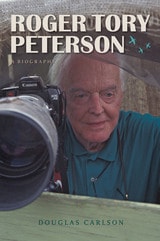
Roger Tory Peterson
A BiographyBy Douglas Carlson
University of Texas Press, 2007
Beginning with his 1934 Field Guide to the Birds, Roger Tory Peterson introduced literally millions of people to the pleasures of observing birds in the wild. His field guide, which has gone through five editions and sold more than four million copies, fostered an appreciation for the natural world that set the stage for the contemporary environmental movement. When Rachel Carson's Silent Spring sounded a warning about the threat to birds and their habitats in the 1960s, the Peterson field guides had already prepared the public and the scientific community to heed the warning and fight to save habitat and protect endangered species—a result that Peterson wholeheartedly approved.
In this authoritative, highly readable biography of Roger Tory Peterson (1908-1996), Douglas Carlson creates a fascinating portrait of the complex, often conflicted man behind the brand name. He describes how Peterson's obsession with birds began in boyhood and continued throughout a multifaceted career as a painter, writer, educator, environmentalist, and photographer. Carlson traces Peterson's long struggle to become both an accomplished bird artist and a scientific naturalist—competing goals that drove Peterson to work to the point of exhaustion and that also deprived him of many aspects of a normal personal life. Carlson also records Peterson's many lasting achievements, from the phenomenal success of the field guides, to the bird paintings that brought him renown as "the twentieth century's Audubon," to the establishment of the Roger Tory Peterson Institute to carry on his work in conservation and education.
The Lives of Dillon Ripley
Natural Scientist, Wartime Spy, and Pioneering Leader of the Smithsonian InstitutionRoger D. Stone
University Press of New England, 2017
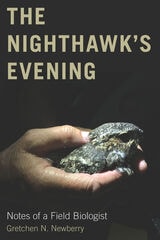
The Nighthawk's Evening
Notes of a Field BiologistGretchen N. Newberry
Oregon State University Press, 2021
This acrobatic, night-flying bird nests on rooftops and flocks in the thousands as it migrates from Alaska to Argentina and back every year. Nighthawks are strange animals, reptiles with feathers, sleepy during the day, but quick, agile, and especially adept at survival. They have the ability to withstand extreme temperatures and adapt to many habitats, but they are struggling for survival in the Anthropocene.
Newberry’s story focuses on the bird itself—its complex conservation status and cultural significance—and the larger, often hidden world of nocturnal animals. Along the way, she gives readers insight into the daily life of a scientist, especially one who works primarily at night. The Nighthawk’s Evening uses one scientist and one species to explore the challenges, disappointments, and successes of scientific research and conservation efforts. An accessible work of science, it will appeal to birders, students, wildlife managers, and anyone who is fascinated by urban wildlife.
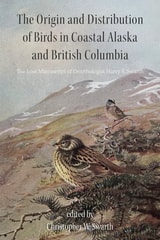
The Origin and Distribution of Birds in Coastal Alaska and British Columbia
The Lost Manuscript of Ornithologist Harry S. SwarthChristopher W. Swarth
Oregon State University Press, 2022
In 2019, Christopher Swarth, Harry’s grandson and a scientist in his own right, discovered the forgotten manuscript. This book includes the original unpublished manuscript, accompanied by contextual essays from contemporary ornithologists who examine the impact and relevance of Swarth’s research on coastal bird diversity, fox sparrow migration, and the systematic puzzle of the timberline sparrow. Expedition maps display field camps and exploration routes, and species checklists illustrate the variety of birds observed at key field sites. To bring additional color and insight, The Origin and Distribution of Birds in Coastal Alaska and British Columbia also includes excerpts from Harry Swarth’s field notes, a comprehensive list of Harry Swarth’s publications, and a glossary with historic and contemporary bird names. Naturalists, ornithologists, birders, and all those who want to learn more about the natural history of the region will delight in the rediscovery of this long-lost treasure.