Results by title
34 books match the query 'Orthodox'
A Dossier of Texts Relating to Gerosimos Avlonites
Ted A. Campbell
Bridwell Press, 2025
A Spiritual Revolution
The Impact of Reformation and Enlightenment in Orthodox Russia, 1700–1825Andrey V. Ivanov
University of Wisconsin Press, 2023
Embedded with lively portrayals of historical actors and vivid descriptions of political details, A Spiritual Revolution is the first large-scale effort to fully identify exactly how Western progressive thought influenced the Russian Church. These new ideas played a foundational role in the emergence of the country as a modernizing empire and the rise of the Church hierarchy as a forward-looking agency of institutional and societal change. Ivanov addresses this important debate in the scholarship on European history, firmly placing Orthodoxy within the much wider European and global continuum of religious change.

A Witness to the Silent Church
Memoirs of Ukrainian Cardinal Josyf SlipyjJosef Slipyj
Catholic University of America Press, 2025
Becoming Frum
How Newcomers Learn the Language and Culture of Orthodox JudaismSarah Bunin Benor
Rutgers University Press, 2012
Winner, 2013 Sami Rohr Choice Award for Jewish Literature
When non-Orthodox Jews become frum (religious), they encounter much more than dietary laws and Sabbath prohibitions. They find themselves in the midst of a whole new culture, involving matchmakers, homemade gefilte fish, and Yiddish-influenced grammar. Becoming Frum explains how these newcomers learn Orthodox language and culture through their interactions with community veterans and other newcomers. Some take on as much as they can as quickly as they can, going beyond the norms of those raised in the community. Others maintain aspects of their pre-Orthodox selves, yielding unique combinations, like Matisyahu’s reggae music or Hebrew words and sing-song intonation used with American slang, as in “mamish (really) keepin’ it real.”
Sarah Bunin Benor brings insight into the phenomenon of adopting a new identity based on ethnographic and sociolinguistic research among men and women in an American Orthodox community. Her analysis is applicable to other situations of adult language socialization, such as students learning medical jargon or Canadians moving to Australia. Becoming Frum offers a scholarly and accessible look at the linguistic and cultural process of “becoming.”
Beyond the Monastery Walls
The Ascetic Revolution in Russian Orthodox Thought, 1814–1914Patrick Lally Michelson
University of Wisconsin Press, 2017
Patrick Lally Michelson's intellectual history of asceticism in Russian Orthodox thought traces the development of these competing arguments from the early nineteenth century to the early months of World War I. He demonstrates that this discourse was an imaginative interpretation of lived Orthodoxy, primarily meant to satisfy the ideological needs of Russian thinkers and Orthodox intellectuals as they responded to the socioeconomic, political, and cultural challenges of modernity.
Brooklyn Odyssey
My Journey out of HasidismZalman Newfield
Temple University Press, 2026
Growing up in Crown Heights, Brooklyn as a member of the Chabad-Lubavitch Hasidic Orthodox Jewish community, Zalman Newfield was raised in an atmosphere of strict gender segregation, rigorous religious education, and nearly all-consuming ritual practices. Trained to be a Lubavitch emissary, he traveled around the world doing Jewish outreach to help usher in the messianic redemption. However, after exposure to the wider world, he abandoned the faith of his youth.
Brooklyn Odyssey is Newfield’s poignant and hopeful memoir about exiting Orthodoxy. He recounts asserting his individuality and taking the radical step of shaving his beard. Reflective about his upbringing, Newfield is open to and curious about a world beyond Brooklyn while also maintaining his profound bond with his family and Jewish tradition. He writes candidly about his emotional, intellectual, and social experiences in and out of the Lubavitch community.
From pivotal moments of devastation, including the illness and death of his younger brother and of his revered spiritual leader Rabbi Menachem Mendel Schneerson, to moments of joyful resolve, including the decision to pursue a doctorate and marry a non-Orthodox Jew, Newfield takes readers on his moving and impactful journey.
Degrees of Separation
Identity Formation While Leaving Ultra-Orthodox JudaismSchneur Zalman Newfield
Temple University Press, 2020
Those who exit a religion—particularly one they were born and raised in—often find themselves at sea in their efforts to transition to life beyond their community. In Degrees of Separation, Schneur Zalman Newfield, who went through this process himself, interviews seventy-four Lubavitch and Satmar ultra-Orthodox Hasidic Jews who left their communities.He presents their motivations for leaving as well as how they make sense of their experiences and their processes of exiting, detailing their attitudes and opinions regarding their religious upbringing. Newfield also examines how these exiters forge new ways of being that their upbringing had not prepared them for, while also considering what these particular individuals lose and retain in the exit process.
Degrees of Separation presents a comprehensive portrait of the prolonged state of being “in-between” that characterizes transition out of a totalizing worldview. What Newfield discovers is that exiters experience both a sense of independence and a persistent connection; they are not completely dislocated from their roots once they “arrive” at their new destination. Moreover, Degrees of Separation shows that this process of transitioning identity has implications beyond religion.
Denial and Repression of Anti-Semitism
Post-Communist Rehabilitation of the Serbian Bishop Nikolaj VelimirovicJovan Byford
Central European University Press, 2008
Expanding the Palace of Torah
Orthodoxy and FeminismTamar Ross
Brandeis University Press, 2004
This new edition brings this acclaimed and classic text back into print with a new essay by Tamar Ross which examines new developments in feminist thought since the book was first published in 2004.
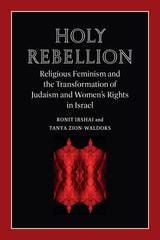
Holy Rebellion
Religious Feminism and the Transformation of Judaism and Women's Rights in IsraelRonit Irshai and Tanya Zion-Waldoks
Brandeis University Press, 2024
In Holy Rebellion, Ronit Irshai and Tanya Zion-Waldoks examine social change in Israel through a rigorous analysis of the shifting entanglements of religion, gender, and law in times of cultural transformation. They explore theological, halakhic, political, and sociological processes and show how they interact with one another in ways that advance women’s rights, as well as how they are met with a conservative backlash in the discourses and actions of the rabbinic establishment. Irshai and Zion-Waldoks build on legal philosopher Robert Cover’s 1982 paper “Nomos and Narrative,” which explained how cultural narratives and legal norms are reciprocally enforced or transformed. Expanding on this notion, Irshai and Zion-Waldoks propose a “narrative ripeness test,” an analytic tool that evaluates the relationship between culture and law to assess how and when change within a minority cultural community may be accelerated or hindered by state intervention.
Religious feminisms are emerging around the world, not solely in Israel, and this book helps elucidate how they create enduring and radical change. Many liberal states are also confronting an illiberal backlash and question the multicultural framework’s ability to serve the needs of minorities within minorities. Therefore, the theoretical framework offered by Irshai and Zion-Waldoks is applicable beyond the Israeli case, even as it offers deeper insights into an Israeli society in turmoil.

Holy Waters
Gender Segregation and the Rise of Haredi Politics in IsraelShayna Weiss
Rutgers University Press, 2027
Examining the politics of pools and beaches, Holy Waters reveals a surprising history about Haredi Jews and Israel. By looking at the battles to establish gender segregating swimming in Israel, which required a partnership between the Israeli government and its Haredi population to reshape public space, the book argues that the establishment of Israel created a new Haredi pragmatic politics. Unlike some Ultra-Orthodox Jews, who rejected the Jewish state entirely, these radical moderates worked with the state to make it feel more Jewish, and to improve life for its Haredi population, without embracing Zionist ideology. Holy Waters examines three cases: a failure to prevent mixed swimming in Jerusalem, the successful establishment of a separate beach in Tel Aviv, and the mixed results of a Diaspora awareness campaign. Connecting historical controversies to today’s debates of gender segregation, the book demonstrates how these radical moderates still influence Israel today.
This book is published with the support of the Jordan Schnitzer First Book Publication Award, administered by the Association for Jewish Studies.
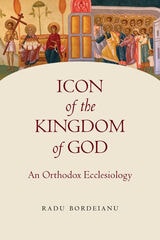
Icon of the Kingdom of God
An Orthodox EcclesiologyRadu Bordeianu
Catholic University of America Press, 2023
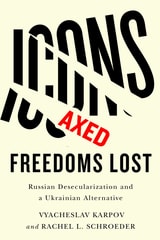
Icons Axed, Freedoms Lost
Russian Desecularization and a Ukrainian AlternativeVyacheslav Karpov
Rutgers University Press, 2025
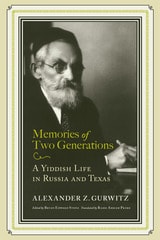
Memories of Two Generations
A Yiddish Life in Russia and TexasAlexander Z. Gurwitz, Edited and Introduced by Bryan Edward Stone
University of Alabama Press, 2022
The 1935 autobiography of Alexander Ziskind Gurwitz, an Orthodox Jew whose lively recounting of his life in Tsarist Russia and his immigration to San Antonio, Texas, in 1910 captures turbulent changes in early twentieth-century Jewish history
In 1910, at the age of fifty-one, Alexander Ziskind Gurwitz made the bold decision to emigrate with his wife and four children from southeastern Ukraine in Tsarist Russia to begin a new life in Texas. In 1935, in his seventies, Gurwitz composed a retrospective autobiography, Memories of Two Generations, that recounts his personal story both of the rich history of the lost Jewish world of Eastern Europe and of the rambunctious development of frontier Jewish communities in the United States.
In both Europe and America, Gurwitz inhabited an almost exclusively Jewish world. As a boy, he studied in traditional yeshivas and earned a living as a Hebrew language teacher and kosher butcher. Widely travelled, Gurwitz recalls with wit and insight daily life in European shtetls, providing perceptive and informative comments about Jewish religion, history, politics, and social customs. Among the book’s most notable features is his first-hand, insider’s account of the yearly Jewish holiday cycle as it was observed in the nineteenth century, described as he experienced it as a child.
Gurwitz’s account of his arrival in Texas forms a cornerstone record of the Galveston Immigration Movement; this memoir represents the only complete narrative of that migration from an immigrant’s point of view. Gurwitz’s descriptions about the development of a thriving Orthodox community in San Antonio provide an important and unique primary source about a facet of American Jewish life that is not widely known.
Gurwitz wrote his memoir in his preferred Yiddish, and this translation into English by Rabbi Amram Prero captures the lyrical style of the original. Scholar and author Bryan Edward Stone’s special introduction and illuminating footnotes round out a superb edition that offers much to experts and general readers alike.
Nihil Obstat
Religion, Politics, and Social Change in East-Central Europe and RussiaSabrina P. Ramet
Duke University Press, 1998
Based on interview research in Germany, Austria, Slovenia, Croatia, Bosnia, Serbia, and Macedonia, and on materials published in German, Italian, Serbo-Croatian, Polish, Czech, Slovak, Russian, and English, Ramet paints a clear picture of the political and religious fragility of former communist states, which are experiencing some aspects of freedom and choice for the first time. With its comprehensive discussion of the largest religious institutions in the area, especially the Catholic and Orthodox Churches, and its extensive survey of nontraditional religious associations that have become active in the region since 1989, this study makes a distinct contribution to growing discussions about the rise of fundamentalism and the inner dilemmas of modernity. With its depth of information and thoughtful exploration of cultural traditions, Nihil Obstat uniquely presents the ramifications and complexities of European religion in a postcommunist world.
Nonnus of Nisibis, Commentary on the Gospel of Saint John
Robert W. Thomson
SBL Press, 2014
A new English translation of the first text translated from Arabic to Armenian for research and classroom use
Robert W. Thomson translates this ninth-century commentary defending the miaphysite theological position of the Armenian church against the chalcedonian position of the Greek Byzantine church. Nonnus’s exegesis of the gospel falls in the context of trends in Eastern Christian biblical exposition, primarily the Syrian tradition. Therefore, Thomson emphasizes the parallels in Syriac commentaries on the book of John, noting also earlier Greek writers whose works were influential in Syria. This book is essential reading for anyone interested in the Armenian church and church history.
Features:
- Introductory material on the text’s history, manuscript traditions, and theological importance
- Translation of the Armenian text and commentary
- Bibliography covering the Armenian, Greek, Syriac, and Arabic texts as well as secondary sources

Orthodoxy
A Modern DenominationJoshua Shanes
Rutgers University Press, 2027
Orthodox Judaism is often perceived simply as the continuation of pre-modern Jewish tradition. In fact, Orthodoxy represents a diverse range of self-conscious attempts to promote new forms of Jewishness that are cast as unchanging over time, filling an urgent need in an age of constant change. In the midst of a tumultuous era, marked by the new values of Enlightenment, Orthodoxy emerged as a new term and movement, struggling to gain stability in a world of conflict and adaptation. Quite unlike its public reputation, Orthodoxy does not convey fixity; rather, it is an elastic term that embraces different and evolving sub-groups of Jews who do not necessarily embrace each other as they struggle to police their boundaries.
In this first comprehensive history of Orthodoxy, Joshua Shanes argues that Orthodox Jews are not traditional, but traditionalist. As the great historian Jacob Katz explained, traditionalists consciously attempt to recreate a pre-modern system in a new context and with decidedly modern tools, and in an environment that does not take its values as self-evident or authoritative. Even beyond the ritual and theological innovations of Orthodoxy – which are many - its awareness that other options are available produces a counter-intuitive break between Orthodoxy and the world it seeks to perpetuate.
This book traces the emergence and evolution of the term “Orthodoxy” in Judaism and the communities that claimed it, from Western and Central Europe into Eastern Europe, America, Israel and other parts of the Jewish Diaspora. It unpacks an intriguing historical irony: how a traditional culture evolved into a voluntary religio-political community maintained by a determined minority that viewed itself as the sole carriers of Jewish authenticity in the modern world.
Rabbi Esriel Hildesheimer and the Creation of a Modern Jewish Orthodoxy
David Ellenson
University of Alabama Press, 1990
Tradition, Modernity, and the Making of Modern Orthodoxy.
For many histories of Modern Orthodox Judaism, Rabbi Samson Raphael Hirsch stands as the primary architect of the movement's encounter with modernity. In Rabbi Esriel Hildesheimer and the Creation of a Modern Jewish Orthodoxy, distinguished scholar David Ellenson expands that narrative by recovering the life, thought, and enduring influence of one of Hirsch's most important contemporaries. Through a careful examination of Rabbi Esriel Hildesheimer's writings, leadership, educational initiatives, and responses to the social and intellectual challenges of nineteenth-century Europe, Ellenson demonstrates how Hildesheimer helped forge a model of Orthodoxy that remained firmly committed to Jewish tradition while engaging constructively with the modern world.
Set against a period of profound cultural, political, and religious transformation, this volume explores the tensions confronting European Jewry as modernization, secular education, religious pluralism, and changing political realities reshaped Jewish communal life. Ellenson shows how Hildesheimer addressed these challenges not through rigid isolation but through a pragmatic and intellectually sophisticated approach that balanced fidelity to halakhah with openness to selected aspects of modern culture and scholarship. His vision helped establish a framework for Modern Orthodoxy that continues to influence contemporary Jewish thought and practice.
Beyond its biographical focus, the study provides broader insights into the emergence of Modern Orthodoxy as a religious and intellectual movement. By illuminating Hildesheimer's efforts to integrate traditional scholarship with contemporary realities, Ellenson offers readers a deeper understanding of how Judaism has negotiated the relationship between heritage and change. The result is both a compelling portrait of an influential rabbinic figure and an important examination of the forces that shaped modern Jewish religious identity.
Rabbi Esriel Hildesheimer and the Creation of a Modern Jewish Orthodoxy is essential reading for scholars and students of Jewish studies, religious studies, theology, European history, intellectual history, and modern Judaism. It will also appeal to rabbis, educators, and general readers seeking to understand the historical roots of contemporary Orthodox Jewish life and the ongoing dialogue between tradition and modernity.
Recovering the Eucharistic Ecclesiology of the Early Church
An Introduction to Nicolas AfanasievAnastacia Wooden
Catholic University of America Press, 2025
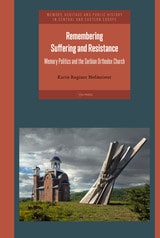
Remembering Suffering and Resistance
Memory Politics and the Serbian Orthodox ChurchKarin Roginer Hofmeister
Central European University Press, 2024
Assessing issues related to the Orthodox Church from an academic, secular point of view is a sensitive matter. However, by tracing and interpreting the engagement of the Serbian Church with the memory of Serbian heroic victimhood in World War II through a kind of “methodological agnosticism,” this volume has managed to tackle the subtle topic in a very delicate and value-neutral way. Arguing that the search for a collective memory is particularly urgent in the face of societal uncertainty and that religious institutions often use their memory potential to reaffirm their public relevance, the book examines the motivations, forms, strategies, and outcomes of a wide range of mnemonic activities the Serbian Orthodox Church engaged in following the upheavals caused by the collapse of Yugoslav socialism, the violent dissolution of the country, and the fall of the Milošević regime. These activities, taking place within the memory fields framed by the post-socialist, post-conflict, and post-secular horizons, took liturgical and non-liturgical forms, often involving a hybrid fusion of the two. As a result of this mnemonic endeavor, the author argues, the Church was successful in reasserting its power and legitimacy in the public sphere of post-2000 Serbia.
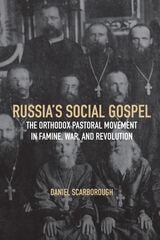
Russia's Social Gospel
The Orthodox Pastoral Movement in Famine, War, and RevolutionDaniel Scarborough
University of Wisconsin Press, 2023
This volume draws upon extensive archival research to examine the effects of the pastoral movement on Russian society and the Orthodox Church. Scarborough argues that the social work of parish clergymen shifted the focus of Orthodox practice in Russia toward cooperative social activism as a devotional activity. He furthers our understanding of Russian Orthodoxy by illuminating the difficult position of parish priests, who were charged with both spiritual and secular responsibilities but were supported by neither church nor state. His nuanced look at the pastorate shows how social and historical traumas shifted perceptions of what being religious meant, in turn affecting how the Orthodox Church organized itself, and contributed to Russia’s modernization.
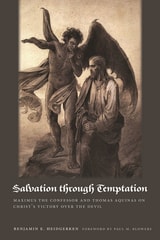
Salvation through Temptation
Maximus the Confessor and Thomas Aquinas on Christ's Victory over the DevilBenjamin E. Heidgerken
Catholic University of America Press, 2021
Saul Lieberman and the Orthodox
Marc B. Shapiro
University of Scranton Press, 2006
Serbian Orthodox Fundamentals
The Quest for an Eternal IdentityChristos Mylonas
Central European University Press, 2003
Soloveitchik's Children
Irving Greenberg, David Hartman, Jonathan Sacks, and the Future of Jewish Theology in AmericaDaniel Ross Goodman
University of Alabama Press, 2023
A revealing account of the three main disciples of Rabbi Joseph B. Soloveitchik, an essential figure in Orthodox Judaism in America
Orthodox Judaism is one of the fastest-growing religious communities in contemporary American life. Anyone who wishes to understand more about Judaism in America will need to consider the tenets and practices of Orthodox Judaism: who its adherents are, what they believe in, what motivates them, and to whom they turn for moral, intellectual, and spiritual guidance.
Among those spiritual leaders none looms larger than Rabbi Joseph B. Soloveitchik, heir to the legendary Talmudic dynasty of Brisk and a teacher and ordainer of thousands of rabbis during his time as a Talmud teacher at Yeshiva University from the Second World War until the 1980s. Soloveitchik was not only a Talmudic authority but a scholar of Western philosophy. While many books and articles have been written about Soloveitchik’s legacy and his influence on American Orthodoxy, few have looked carefully at his disciples in Torah and Talmud study, and even fewer at his disciples in Jewish thought and philosophy.
Soloveitchik’s Children: Irving Greenberg, David Hartman, Jonathan Sacks, and the Future of Jewish Theology in America is the first book to study closely three of Soloveitchik’s major disciples in Jewish thought and philosophy: Rabbis Irving (“Yitz”) Greenberg, David Hartman, and Jonathan Sacks. Daniel Ross Goodman narrates how each of these three major modern Jewish thinkers learned from and adapted Soloveitchik’s teachings in their own ways, even while advancing his philosophical and theological legacy.
The story of religious life and Judaism in contemporary America is incomplete without an understanding of how three of the most consequential Jewish thinkers of this generation adapted the teachings of one of the most consequential Jewish thinkers of the previous generation. Soloveitchik’s Children tells this gripping intellectual and religious story in a learned and engaging manner, shining a light on where Jewish religious thought in the United States currently stands—and where it may be heading in future generations.
Strictly Observant
Amish and Ultra-Orthodox Jewish Women Negotiating MediaRivka Neriya-Ben Shahar
Rutgers University Press, 2024
The Amish and ultra-Orthodox Jewish communities have typically been associated with strict religious observance, a renunciation of worldly things, and an obedience of women to men. Women’s relationship to media in these communities, however, betrays a more nuanced picture of the boundaries at play and women’s roles in negotiating them.
Strictly Observant presents a compelling ethnographic study of the complex dynamic between women in both the Pennsylvanian Old Order Amish and Israeli ultra-Orthodox Jewish communities and contemporary media technologies. These women regularly establish valuable social, cultural, and religious capital through the countless decisions for use and nonuse of media that they make in their daily lives, and in ways that challenge the gender hierarchies of each community. By exhibiting a deep awareness of how media can be managed to increase their social and religious reputations, these women prompt us to reconsider our outmoded understanding of the Amish and ultra-Orthodox Jewish communities, the role that women play in these communities as agents of change, and our own relationship to media today.
Studying Hasidism
Sources, Methods, PerspectivesMarcin Wodzinski
Rutgers University Press, 2019
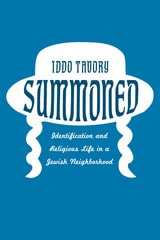
Summoned
Identification and Religious Life in a Jewish NeighborhoodIddo Tavory
University of Chicago Press, 2016
In Summoned, Tavory takes readers to the heart of the exhilarating—at times exhausting—life of the Beverly-La Brea Orthodox community. Just blocks from West Hollywood’s nightlife, the Orthodox community thrives next to the impure sights, sounds, and smells they encounter every day. But to sustain this life, as Tavory shows, is not simply a moral decision they make. To be Orthodox is to be constantly called into being. People are reminded of who they are as they are called upon by organizations, prayer quorums, the nods of strangers, whiffs of unkosher food floating through the street, or the rarer Anti-Semitic remarks. Again and again, they find themselves summoned both into social life and into their identity as Orthodox Jews. At the close of Tavory’s fascinating ethnography, we come away with a better understanding of the dynamics of social worlds, identity, interaction and self—not only in Beverly-La Brea, but in society at large.
The Book of Hours of the Armenian Church Zamagirk
English Translation, Contexts and PerspectivesMichael Daniel Findikyan
Catholic University of America Press, 2027
The Odyssey of a Syriac Christian
A Life of Faith Between East and WestRev. Emmanuel Pataq Siman
Catholic University of America Press, 2026
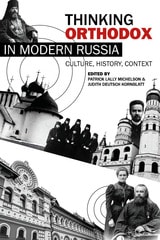
Thinking Orthodox in Modern Russia
Culture, History, ContextEdited by Patrick Lally Michelson and Judith Deutsch Kornblatt
University of Wisconsin Press, 2014
Volume editors Patrick Lally Michelson and Judith Deutsch Kornblatt provide a historical overview of Russian Orthodox thought and a critical essay on the current state of scholarship about religious thought in modern Russia. The contributors explore a wide range of topics, including Orthodox claims to a unique religious Enlightenment, contests over authority within the Russian Church, tensions between faith and reason in academic Orthodoxy, the relationship between sacraments and the self, the religious foundations of philosophical and legal categories, and the effect of Orthodox categories in the formation of Russian literature.
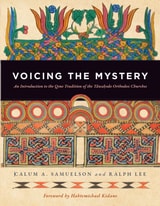
Voicing the Mystery
An Introduction to the Q?ne Tradition of the Täwa??do Orthodox ChurchesCalum A. Samuelson and Ralph Lee
Bridwell Press, 2026
This volume presents a new study of Qǝne, the extemporaneous sacred oral poetry of the Ethiopian and Eritrean Täwaḥǝdo churches. It discusses the technique of “Wax and Gold” used to compose Qǝne through which poets construct multilayered meaning using complex grammatical structures, polysemous vocabulary, and oblique allusions to texts and customs. The Introduction outlines the history of the Qǝne tradition, its liturgical function, and the challenges involved in understanding its multiple layers of meaning, and it provides a detailed account of the translation method developed for this study.
Aimed at both scholars of the Täwaḥǝdo tradition and a wider audience, this book exposes readers to an ancient poetic practice previously inaccessible without a comprehensive knowledge of Gǝʿǝz. The book introduces the new approach of Integrative Translation: each poem is presented through paired Plain and Poetic translations, enabling readers to perceive the branching meanings of the original Gǝʿǝz text and the diverse connections they evoke. A selection of fifteen qǝne poems is included, drawn from published collections compiled by notable traditional scholars of the churches, each featuring the Gǝʿǝz text and paired translations on facing pages.
Extensive annotations guide readers through the interpretive world in which Qǝne is composed, tracing the scriptural, liturgical, exegetical, hagiographical, and cultural sources that shape the tradition and illuminate the multiple meanings embedded in each poem. A Glossary also explains key terms and concepts. This is the first volume to make the Qǝne tradition accessible in English while preserving the distinctive multilayered character of the poetry.
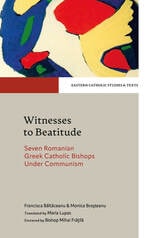
Witnesses to Beatitude
Seven Romanian Greek Catholic Bishops Under CommunismFrancisca Băltăceanu
Catholic University of America Press, 2026
Women of Valor
Orthodox Jewish Troll Fighters, Crime Writers, and Rock Stars in Contemporary Literature and CultureKaren E. H. Skinazi
Rutgers University Press, 2018
Media portrayals of Orthodox Jewish women frequently depict powerless, silent individuals who are at best naive to live an Orthodox lifestyle, and who are at worst, coerced into it. Karen E. H. Skinazi delves beyond this stereotype in Women of Valor to identify a powerful tradition of feminist literary portrayals of Orthodox women, often created by Orthodox women themselves. She examines Orthodox women as they appear in memoirs, comics, novels, and movies, and speaks with the authors, filmmakers, and musicians who create these representations. Throughout the work, Skinazi threads lines from the poem “Eshes Chayil,” the Biblical description of an Orthodox “Woman of Valor.” This proverb unites Orthodoxy and feminism in a complex relationship, where Orthodox women continuously question, challenge, and negotiate Orthodox and feminist values. Ultimately, these women create paths that unite their work, passions, and families under the framework of an “Eshes Chayil,” a woman who situates religious conviction within her own power.