Results by title

20 books match the query 'Other (Philosophy)'

cover of Alimentary Orientalism: Britain’s Literary Imagination and the Edible East

Alimentary Orientalism

Britain’s Literary Imagination and the Edible East

Yin Yuan

Bucknell University Press, 2023
What, exactly, did tea, sugar, and opium mean in eighteenth- and nineteenth-century Britain? Alimentary Orientalism reassesses the politics of Orientalist representation by examining the contentious debates surrounding these exotic, recently popularized, and literally consumable things. It suggests that the interwoven discourses sparked by these commodities transformed the period’s literary Orientalism and created surprisingly self-reflexive ways through which British writers encountered and imagined cultural otherness. Tracing exotic ingestion as a motif across a range of authors and genres, this book considers how, why, and whither writers used scenes of eating, drinking, and smoking to diagnose and interrogate their own solipsistic constructions of the Orient. As national and cultural boundaries became increasingly porous, such self-reflexive inquiries into the nature and role of otherness provided an unexpected avenue for British imperial subjectivity to emerge and coalesce.
[more]
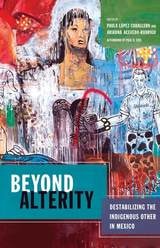
cover of Beyond Alterity: Destabilizing the Indigenous Other in Mexico

Beyond Alterity

Destabilizing the Indigenous Other in Mexico

Edited by Paula López Caballero and Ariadna Acevedo-Rodrigo; Afterword by Paul K. Eiss

University of Arizona Press, 2018

The concept of “indigenous” has been entwined with notions of exoticism and alterity throughout Mexico’s history. In Beyond Alterity, authors from across disciplines question the persistent association between indigenous people and radical difference, and demonstrate that alterity is often the product of specific political contexts.

Although previous studies have usually focused on the most visible ­aspects of differences—cosmovision, language, customs, resistance—the contributors to this volume show that emphasizing difference prevents researchers from seeing all the social phenomena where alterity is not obvious. Those phenomena are equally or even more constitutive of social life and include property relations (especially individual or private ones), participation in national projects, and the use of national languages.

The category of “indigenous” has commonly been used as if it were an objective term referring to an already given social subject. Beyond Alterity shows how this usage overlooks the fact that the social markers of differentiation (language, race or ethnic group, phenotype) are historical and therefore unstable. In opposition to any reification of geographical, cultural, or social boundaries, this volume shows that people who (self-)identify as indigenous share a multitude of practices with the rest of society and that the association between indigenous identification and alterity is the product of a specific political history.

Beyond Alterity is essential reading for anyone interested in understanding indigenous identity, race, and Mexican history and politics.
 
Contributors
 
Ariadna Acevedo-Rodrigo
Laura Cházaro
Michael T. Ducey
Paul K. Eiss
José Luis Escalona-Victoria
Vivette García Deister
Peter Guardino
Emilio Kourí
Paula López Caballero
Elsie Rockwell
Diana Lynn Schwartz
Gabriela Torres-Mazuera
[more]
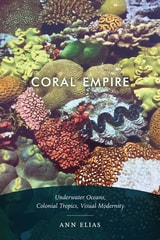
cover of Coral Empire: Underwater Oceans, Colonial Tropics, Visual Modernity

Coral Empire

Underwater Oceans, Colonial Tropics, Visual Modernity

Ann Elias

Duke University Press, 2019

From vividly colored underwater photographs of Australia's Great Barrier Reef to life-size dioramas re-creating coral reefs and the bounty of life they sustained, the work of early twentieth-century explorers and photographers fed the public's fascination with reefs. In the 1920s John Ernest Williamson in the Bahamas and Frank Hurley in Australia produced mass-circulated and often highly staged photographs and films that cast corals as industrious, colonizing creatures, and the undersea as a virgin, unexplored, and fantastical territory. In Coral Empire Ann Elias traces the visual and social history of Williamson and Hurley and how their modern media spectacles yoked the tropics and coral reefs to colonialism, racism, and the human domination of nature. Using the labor and knowledge of indigenous peoples while exoticizing and racializing them as inferior Others, Williamson and Hurley sustained colonial fantasies about people of color and the environment as endless resources to be plundered. As Elias demonstrates, their reckless treatment of the sea prefigured attitudes that caused the environmental crises that the oceans and reefs now face.
[more]
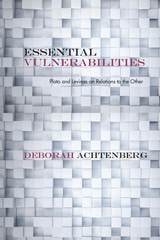
cover of Essential Vulnerabilities: Plato and Levinas on Relations to the Other

Essential Vulnerabilities

Plato and Levinas on Relations to the Other

Deborah Achtenberg

Northwestern University Press, 2014
In Essential Vulnerabilities, Deborah Achtenberg contests Emmanuel Levinas’s idea that Plato is a philosopher of freedom for whom thought is a return to the self. Instead, Plato, like Levinas, is a philosopher of the other. Nonetheless, Achtenberg argues, Plato and Levinas are different. Though they share the view that human beings are essentially vulnerable and essentially in relation to others, they conceive human vulnerability and responsiveness differently. For Plato, when we see beautiful others, we are overwhelmed by the beauty of what is, by the vision of eternal form. For Levinas, we are disrupted by the newness, foreignness, or singularity of the other. The other, for him, is new or foreign, not eternal. The other is unknowable singularity. By showing these similarities and differences, Achtenberg resituates Plato in relation to Levinas and opens up two contrasting ways that self is essentially in relation to others.
[more]
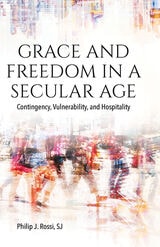
cover of Grace and Freedom in a Secular Age: Contingency, Vulnerability, and Hospitality

Grace and Freedom in a Secular Age

Contingency, Vulnerability, and Hospitality

Philip J. Rossi

Catholic University of America Press, 2022

In the course of a long and distinguished academic and civic career, the Canadian philosopher Charles Taylor has been, for articulate atheists and learned believers alike, an incisive, insightful, gracious, and challenging conversation partner on issues that arise at the intersection and interaction of religion, society, and culture. Grace and Freedom in a Secular Age offers a concise exposition of key ideas – contingency, otherness, freedom, vulnerability and mutuality – that inform his probing analyses of the dynamics of religious belief and religious denial in the pervasive contemporary culture he calls a “a secular age,” within which religious belief and practice have, for many, become just an option. Those ideas provide the basis from which Rossi argues that, despite a clear-eyed recognition of the deep fractures of meaning and the pervasive fragmentation of once stable societal connections that a secular age has brought in its wake, Taylor also sees and affirms strong grounds for hope in a healing of our broken and fractured world and for the possibilities—and the importance of—active human participation in that healing. Taylor points to signs indicative of potent re-compositions and renewals taking place in religious belief and practice from its interaction with the dynamics of secular culture, particularly ones that make possible radical enactments of deeper human solidarity and mutuality, of which the one most often potent is the reconciliation of enemies. In pointing out these signs, Taylor suggests a richly expansive reading of the Christian doctrine of Creation, as it marks the radical contingency of all that is upon a freely bestowed divine self-giving: Creation is the ongoing enactment of the divine hospitality of the Triune God.
[more]
cover of Hospitality, Volume I

Hospitality, Volume I

Jacques Derrida

University of Chicago Press, 2023

Jacques Derrida explores the ramifications of what we owe to others.

Hospitality reproduces a two-year seminar series delivered by Jacques Derrida at the École des hautes études en sciences sociales in Paris between 1995 and 1997. In these lectures, Derrida asks a series of related questions about responsibility and “the foreigner”: How do we welcome or turn away the foreigner? What does the idea of the foreigner reveal about kinship and the state, particularly in relation to friendship, citizenship, migration, asylum, assimilation, and xenophobia? Derrida approaches these questions through readings of several classical texts as well as modern texts by Heidegger, Arendt, Camus, and others. Central to his project is a rigorous distinction between conventional, finite hospitality, with its many conditions, and the aspirational idea of hospitality as something offered unconditionally to the stranger. This volume collects the first year of the seminar.

[more]
cover of Listening Awry: Music And Alterity In German Culture

Listening Awry

Music And Alterity In German Culture

David Schwarz

University of Minnesota Press, 2006

In his first book, Listening Subjects, David Schwarz succeeded in fusing post-Lacanian psychoanalytic, musical-theoretical, and musical-historical perspectives. In Listening Awry, he expands his project to “tell a story of historical modernism writ large”—how German music spanning two centuries refracts changes in society and culture, as well as the impacts of concepts introduced by psychoanalysis.Schwarz shows how post-Lacanian psychoanalysis can be applied to ideological interpellation that connects psychoanalysis to culture and how music theory can ground these considerations in precise details of musical textuality. He “listens awry” in several ways: by understanding musical meaning in both objective and socially structured ways, by embracing historical and also aesthetic approaches, by addressing high art as well as popular music, and by listening “around” conventional forms of musical meaning to reach toward that which evades signification.Structured around four themes—trauma, the other/Other, the look/gaze binary, and Judaism—Listening Awry explores five key moments in post-Enlightenment music: the rise of the singular orchestral conductor and the emergence of a new form of alterity, the Art Song and “the sublime of the delicate” (a correlate of the Kantian mathematical and dynamical sublime), the birth of psychoanalysis and the twentieth-century turn toward atonality, German war songs and the subversion of German music by the Nazis, and two different versions of Wagner’s Parsifal that were performed one hundred years apart and in radically different contexts.This highly original work, filled with imaginative readings and disquieting observations, links trauma with the culture and history of modernity and German music, deftly tying the experience of the body to the sounds it hears: how it reaches us slowly, penetrates the skin, and resonates.David Schwarz is assistant professor of music at the University of North Texas. He is the author of Listening Subjects: Music, Psychoanalysis, Culture.
[more]
cover of Phenomenology of the Alien: Basic Concepts

Phenomenology of the Alien

Basic Concepts

Translated from the German by Alexander Kozin and Tanja Stähler

Northwestern University Press, 2011

Tanja Stähler and Alexander Kozin’s elegant translation of Bernhard Waldenfels’s Phenomenology of the Alien (Grundmotive einer Phänomenologie des Fremden) introduces the English readership to the philosophy of alien-experience, a multifaceted and multidimensional phenomenon that permeates our everyday experiences of the life-world with immediate implications for the ways we conduct our social, political, and ethical affairs. 

With impressive erudition Waldenfels weaves in xenological themes from classical philosophy, contemporary phenomenology, literature, linguistics, sociology, and anthropology to address the boundaries of experience that unite and separate human beings, their collectives, their perceptions, and aspirations. While the debate has long raged in German-speaking circles, Waldenfels’s work is largely unavailable to the English-speaking audience, with the only other translation being The Order in the Twilight (1996). Phenomenology of the Alien is a superb introduction to both xenological phenomenology, and the the question of the alien as it has been unfolding in contemporary thought.

[more]
cover of Practices of Coexistence: Constructions of the Other in Early Modern Perceptions

Practices of Coexistence

Constructions of the Other in Early Modern Perceptions

Marianna D. Birnbaum

Central European University Press, 2017

The essays in this book provide interesting contributions to the ongoing debate concerning the representation of differing cultures, i.e., the “image of the Other” in the early modern period . They deal with images, projections, and perceptions, based on various experiences of coexistence. Although the individual contributions contain sources and references of iconography, this is not just another volume of art history or visual studies. As examples of practices in diverse historical contexts, the book includes a variety of textual material, such as literary productions, rhetorical exercises, dramatic applications, chronicles, epistles, and diary-like historical accounts that express ethnographic sensitivities. Thus, supported by a thorough research apparatus, these studies propose a new cultural history of the early modern coexistence of various communities, as identified in current research by young scholars. Another novel feature of the volume is the deliberate digression of traditional scholars’ focus and the investigation of rarely examined regions and practices. This approach allows the contributors to spotlight their special areas of research and to share a fresh new look at “the Renaissance.”
[more]
cover of Prodigal Son/Elder Brother: Interpretation and Alterity in Augustine, Petrarch, Kafka, Levinas

Prodigal Son/Elder Brother

Interpretation and Alterity in Augustine, Petrarch, Kafka, Levinas

Jill Robbins

University of Chicago Press, 1991

"I don't know of any other book that deals with the hermeneutical problem of the relationship between Christianity and Judaism in the way this one does. Full of cunning and unpredictable turns, Prodigal Son/Elder Brother addresses the question of the elder brother's fate by opposing two sets of readings, Christian and Jewish, ancient and modern, figural and midrashic. No one, after reading this book, will any longer connect Judaism and Christianity with a hyphen."—Gerald L. Burns, University of Notre Dame

"Through a creative reading of the prodigal son parable, Jill Robbins demonstrates the hermeneutical impasse of the Christian exegete who must and yet cannot incorporate the Old Testament. Having disclosed the aporia at the heart of Christian hermeneutics, she proposes an alternative approach to the Hebrew Bible and new interpretations of Augustine, Petrarch, Kafka, and Levinas. Robbins brilliantly integrates the discourses of biblical texts, literary works, and critical analysis."—Mark C. Taylor, Williams College

[more]
cover of Rethinking Global Sisterhood: Western Feminism and Iran

Rethinking Global Sisterhood

Western Feminism and Iran

Nima Naghibi

University of Minnesota Press, 2007

Western women’s involvement in Persia dates from the mid-nineteenth century, when female adventurers and missionaries first encountered their veiled Muslim “sisters.” Twentieth-century Western and state-sponsored Iranian feminists continued to use the image of the veiled woman as the embodiment of backwardness. Yet, following the 1979 revolution, indigenous Iranian feminists became more vocal in their resistance to this characterization.

In Rethinking Global Sisterhood, Nima Naghibi makes powerful connections among feminism, imperialism, and the discourses of global sisterhood. Naghibi investigates topics including the state-sponsored Women’s Organization of Iran and the involvement of feminists such as Betty Friedan and Gloria Steinem in the Iranian feminism movement before and during the 1979 revolution. With a potent analysis of cinema, she examines the veiled woman in the films of Tahmineh Milani, Ziba Mir-Hosseini and Kim Longinotto, and Mahnaz Afzali.

At a time when Western relations with the Muslim world are in crisis, Rethinking Global Sisterhood provides much-needed insights and explores the limitations and possibilities of cross-cultural feminist social and political interventions.

Nima Naghibi is assistant professor of English at Ryerson University in Toronto.

[more]
cover of Savages, Romans, and Despots: Thinking about Others from Montaigne to Herder

Savages, Romans, and Despots

Thinking about Others from Montaigne to Herder

Robert Launay

University of Chicago Press, 2018

From the sixteenth to the eighteenth centuries, Europeans struggled to understand their identity in the same way we do as individuals: by comparing themselves to others. In Savages, Romans, and Despots, Robert Launay takes us on a fascinating tour of early modern and modern history in an attempt to untangle how various depictions of “foreign” cultures and civilizations saturated debates about religion, morality, politics, and art.
 
Beginning with Mandeville and Montaigne, and working through Montesquieu, Diderot, Gibbon, Herder, and others, Launay traces how Europeans both admired and disdained unfamiliar societies in their attempts to work through the inner conflicts of their own social worlds. Some of these writers drew caricatures of “savages,” “Oriental despots,” and “ancient” Greeks and Romans. Others earnestly attempted to understand them. But, throughout this history, comparative thinking opened a space for critical reflection. At its worst, such space could give rise to a sense of European superiority. At its best, however, it could prompt awareness of the value of other ways of being in the world. Launay’s masterful survey of some of the Western tradition’s finest minds offers a keen exploration of the genesis of the notion of “civilization,” as well as an engaging portrait of the promises and perils of cross-cultural comparison.

[more]
cover of Self-Awareness and Alterity: A Phenomenological Investigation

Self-Awareness and Alterity

A Phenomenological Investigation

Dan Zahavi

Northwestern University Press, 1999

Winner of the 2000 The Edward Goodwin Ballard Prize in Phenomenology

In the rigorous and highly original Self-Awareness and Alterity, Dan Zahavi provides a sustained argument that phenomenology, especially in its Husserlian version, can contribute something decisive to the analysis of self-awareness. Taking on recent discussions within both analytical philosophy (Shoemaker, Castaneda, Nagel) and contemporary German philosophy (Henrich, Frank, Tugendhat), Zahavi argues that the phenomenological tradition has much more to offer when it comes to the problem of self-awareness than is normally assumed. As a contribution to the current philosophical debate concerning self-awareness, the book presents a comprehensive reconstruction of Husserl's theory of pre-reflective self-awareness, thereby criticizing a number of prevalent interpretations and a systematic discussion of a number of phenomenological insights related to this issue, including analyses of the temporal, intentional, reflexive, bodily, and social nature of the self.

[more]
cover of Self-Awareness and Alterity: A Phenomenological Investigation

Self-Awareness and Alterity

A Phenomenological Investigation

Dan Zahavi

Northwestern University Press, 2020

In the rigorous and highly original Self-Awareness and Alterity, Dan Zahavi provides a sustained argument that phenomenology, especially in its Husserlian version, can make a decisive contribution to discussions of self-awareness. Engaging with debates within both analytic philosophy (Elizabeth Anscombe, John Perry, Sydney Shoemaker, Héctor-Neri Castañeda, David Rosenthal) and contemporary German philosophy (Dieter Henrich, Manfred Frank, Ernst Tugendhat), Zahavi argues that the phenomenological tradition has much more to offer when it comes to the problem of self-awareness than is normally assumed.
 
As a contribution to the current philosophical debate concerning self-awareness, the book presents a comprehensive reconstruction of Husserl’s theory of pre-reflective self-awareness, thereby criticizing a number of prevalent interpretations. In addition, Zahavi also offers a systematic discussion of a number of phenomenological insights related to the issue of self-awareness, including analyses of the temporal, intentional, reflexive, bodily, and social nature of the self.
 
The new edition of this prize-winning book has been updated and revised, and all quotations have been translated into English. It also contains a new preface in which Zahavi traces the developments of the debates around self-awareness over the last twenty years and situates this book in the context of his subsequent work.
 
[more]
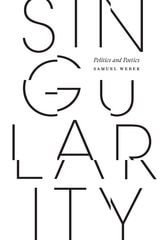
cover of Singularity: Politics and Poetics

Singularity

Politics and Poetics

Samuel Weber

University of Minnesota Press, 2021

An influential thinker on the concept of singularity and its implications on politics, theology, economics, psychoanalysis, and literature

For readers versed in critical theory, German and comparative literature, or media studies, a new book by Samuel Weber is essential reading. Singularity is no exception. Bringing together two decades of his essays, it hones in on the surprising implications of the singular and its historical relation to the individual in politics, theology, economics, psychoanalysis, and literature. Although singularity has long been a keyword in literary studies and philosophy, never has it been explored as in this book, which distinguishes singularity as an “aporetic” notion from individuality, with which it remains historically closely tied.

To speak or write of the singular is problematic, Weber argues, since once it is spoken of it is no longer strictly singular. Walter Benjamin observed that singularity and repetition imply each other. This approach informs the essays in Singularity. Weber notes that what distinguishes the singular from the individual is that it cannot be perceived directly, but rather experienced through feelings that depend on but also exceed cognition. This interdependence of cognition and affect plays itself out in politics, economics, and theology as well as in poetics. Political practice as well as its theory have been dominated by the attempt to domesticate singularity by subordinating it to the notion of individuality. Weber suggests that this political tendency draws support from what he calls “the monotheological identity paradigm” deriving from the idea of a unique and exclusive Creator-God. 

Despite the “secular” tendencies usually associated with Western modernity, this paradigm continues today to inform and influence political and economic practices, often displaying self-destructive tendencies. By contrast, Weber reads the literary writings of Hölderlin, Nietzsche, and Kafka as exemplary practices that put singularity into play, not as fiction but as friction, exposing the self-evidence of established conventions to be responses to challenges and problems that they often prefer to obscure or ignore.

[more]
cover of Surface Encounters: Thinking with Animals and Art

Surface Encounters

Thinking with Animals and Art

Ron Broglio

University of Minnesota Press, 2011

What it is like to be an animal? Ron Broglio wants to know from the inside, from underneath the fur and feathers. In examining this question, he bypasses the perspectives of biology or natural history to explore how one can construct an animal phenomenology, to think and feel as an animal other—or any other.

Until now phenomenology has grappled with how humans are embedded in their world. According to philosophical tradition, animals do not practice the self-reflexive thought that provides humans with depth of being. Without human interiority, philosophers have believed, animals live on the surface of things. But, Broglio argues, the surface can be a site of productive engagement with the world of animals, and as such he turns to humans who work with surfaces: contemporary artists.

Taking on the negative claim of animals living only on the surface and turning the premise into a positive set of possibilities for human–animal engagement, Broglio considers artists—including Damien Hirst, Carolee Schneemann, Olly and Suzi, and Marcus Coates—who take seriously the world of the animal on its own terms. In doing so, these artists develop languages of interspecies expression that both challenge philosophy and fashion new concepts for animal studies.
[more]
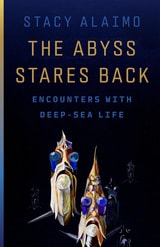
cover of The Abyss Stares Back: Encounters with Deep-Sea Life

The Abyss Stares Back

Encounters with Deep-Sea Life

Stacy Alaimo

University of Minnesota Press, 2025

In an era of accelerating extinctions, what does it mean to discover thousands of new species in the deep sea?

As we see the catastrophic effects of the Anthropocene proliferate, advanced technologies also grant us greater access to the furthest reaches of the world’s oceans, facilitating the discovery of countless new species. Sorting through the implications of this strange paradox, Stacy Alaimo explores the influence this newfound intimacy with the deep sea might have on our broader relationship to the nonhuman world. While many images of these abyssal creatures circulate as shallow clickbait, aesthetic representations can be enticing lures for speculating about their lives, profoundly expanding our environmental concern.

The Abyss Stares Back analyzes a diverse range of scientific, literary, and artistic accounts of deep-sea exploration, including work from the naturalist William Beebe and the artist Else Bostelmann as well as results of the Census of Marine Life that began at the turn of the twenty-first century. As she focuses on oft-overlooked creatures of the deep, such as tubeworms, hatchetfish, siphonophores, and cephalopods, which are typically cast as “alien,” Alaimo shows how depictions of the deep seas have been enmeshed in long colonial histories and racist constructions of a threatening abyss.

Drawing on feminist environmentalism, posthumanism, science and technology studies, and Indigenous and non-Western perspectives, Alaimo details how our understanding of science is fundamentally altered by aesthetic encounters with these otherworldly life forms. She argues that, although the deep sea is often thought of as a lifeless void with little connection to human existence, our increasing devastation of this realm underscores our ethical obligation to protect the biodiverse life in the depths. When the abyss stares back, it demands recognition.

Retail e-book files for this title are screen-reader friendly with images accompanied by short alt text and/or extended descriptions.
[more]
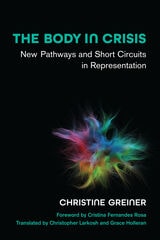
cover of The Body in Crisis: New Pathways and Short Circuits in Representation

The Body in Crisis

New Pathways and Short Circuits in Representation

Christine Greiner

University of Michigan Press, 2021
The Body in Crisis introduces the English-speaking world to the work of leading Latin American dance scholar and philosopher of the body, Christine Greiner. The book offers an innovative set of tools with which to examine the role of moving bodies and bodily actions in relation to worldwide concerns, including identity politics, alterity, migration, and belonging. The book places the concept of bodymedium in dialogue with the work of Giorgio Agamben to investigate notions of alterity, and shows how an understanding of the body-environment continuum can shed light on things left unnamed and at the margins. Greiner’s analyses draw from a broad range of theory concerned with the epistemology of the body, including cognitive science, political philosophy, evolutionary biology, and performance studies to illuminate radical experiences that question the limits of the body.  Her analysis of the role that bodies play in negotiations of power relations offers an original and unprecedented contribution to the field of dance studies and expands its scope to recognize theoretical models of inquiry developed in the Global South.
[more]
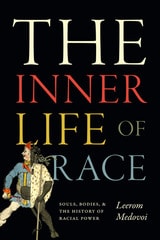
cover of The Inner Life of Race: Souls, Bodies, and the History of Racial Power

The Inner Life of Race

Souls, Bodies, and the History of Racial Power

Leerom Medovoi

Duke University Press, 2024
In The Inner Life of Race, Leerom Medovoi turns away from conventional views of race as a politics of the phenotypical body to theorize race instead as a politics of populational threat. Racism’s genealogy, argues Medovoi, invokes longstanding theological distinctions between the body and the soul. While the body can be seen and marked, the soul signals potentially threatening interiorities: dangerous intentions, beliefs, or desires. Race is the power-effect of reading the body in order to police the political threat of the soul. Medovoi’s genealogy begins with medieval deployments of inquisition and confession to wage war against heretics, infidels, and their threat to the salvation of souls. In early modern Spain, these pastoral technologies of power catalyzed the invention of race as a language for the danger of formerly Jewish and Muslim converts. Medovoi shows how this discourse expanded into anti-Blackness and anti-Indigeneity throughout the colonial world and modern Europe, laying the foundation for racialized capitalism and liberal governmentality. Medovoi weaves histories of color-line racism, nativism, Islamophobia, antisemitism, and anticommunism into a pathbreaking account of the political work populational racism accomplishes.
[more]
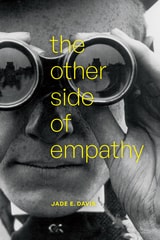
cover of The Other Side of Empathy

The Other Side of Empathy

Jade E. Davis

Duke University Press, 2023

In The Other Side of Empathy, Jade E. Davis contests the value of empathy as an affective or critical tool. Whether focusing on technology, colonialism, or racism, she shows how empathy can obscure relationships of dominance, control, submission, and victimization, arguing that these histories taint the whole concept of empathy. Drawing on digital archives of photographs, memoirs, newspapers, interviews, and advertisements regarding nineteenth-century ethnographic museums and human zoos, Davis shows how empathetic responses erase culpabilities from those institutions that commodify difference. She also contends that empathy’s mediation through digital technology cannot lead to more ethical actions, as technology only connects representations of people rather than the people themselves. In empathy’s place, Davis proposes mutual recognition as a way to see and experience others beyond colonial modes of empathy. Davis illustrates that moving beyond empathy allows for a more nuanced understanding of the colonial past and its ongoing impact while providing for a more meaningful affective engagement with the world.
[more]