Results by title
7 books match the query 'Other Animals'
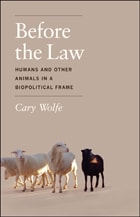
Before the Law
Humans and Other Animals in a Biopolitical FrameCary Wolfe
University of Chicago Press, 2012
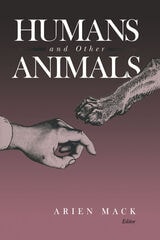
HUMANS AND OTHER ANIMALS
Edited by Arien Mack with a foreword by Marc Bekoff
The Ohio State University Press, 1999
In 1995 the New School for Social Research sponsored a landmark conference to explore human/animal interactions. Published as a special issue of the journal Social Research (under the title In the Company of Animals), this collection is now available for the first time in a book edition.

Humans and Other Animals
Cross-Cultural Perspectives on Human-Animal InteractionsSamantha Hurn
Pluto Press, 2012
Humans and Other Animals is about the myriad and evolving ways in which humans and animals interact, the divergent cultural constructions of humanity and animality found around the world, and individual experiences of other animals.
Samantha Hurn explores the work of anthropologists and scholars from related disciplines concerned with the growing field of anthrozoology. Case studies from a wide range of cultural contexts are discussed, and readers are invited to engage with a diverse range of human-animal interactions including blood sports (such as hunting, fishing and bull fighting), pet keeping and ‘petishism’, eco-tourism and wildlife conservation, working animals and animals as food. The idea of animal exploitation raised by the animal rights movements is considered, as well as the anthropological implications of changing attitudes towards animal personhood, and the rise of a posthumanist philosophy in the social sciences more generally.
Key debates surrounding these issues are raised and assessed and, in the process, readers are encouraged to consider their own attitudes towards other animals and, by extension, what it means to be human.
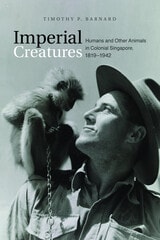
Imperial Creatures
Humans and Other Animals in Colonial Singapore, 1819-1942Timothy P. Barnard
National University of Singapore Press, 2019
Through a multidisciplinary consideration of fauna, Imperial Creatures weaves together a series of tales to document how animals were cherished, monitored, employed, and slaughtered in a colonial society. All animals, including humans, Barnard shows, have been creatures of imperialism in Singapore. Their stories teach us lessons about the structures that upheld such a society and how it developed over time, lessons of relevance to animal historians, to historians of Singapore, and to urban historians and imperial historians with an interest in environmental themes.
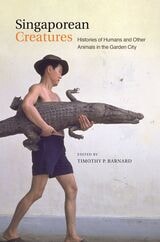
Singaporean Creatures
Histories of Humans and Other Animals in the Garden CityEdited by Timothy Barnard
National University of Singapore Press, 2024
Modern Singapore is the Garden City, a biophilic urban space that includes a variety of animals, from mosquitoes to humans, even polar bears. Singaporean Creatures brings together historians to contemplate this human-animal relationship and how it has shaped society—socially, economically, politically, and environmentally. It is a work of historical and ecological analysis, in which various institutions, perspectives, and events involving animals provide insight into how the larger society has been formed and developed over the last half-century. The interaction of all Singaporean creatures thus provides a lens through which we can understand the creation of a modern and urban nation-state, shaped by the forces of the Anthropocene.
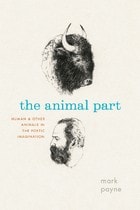
The Animal Part
Human and Other Animals in the Poetic ImaginationMark Payne
University of Chicago Press, 2010
How can literary imagination help us engage with the lives of other animals? The question represents one of the liveliest areas of inquiry in the humanities, and Mark Payne seeks to answer it by exploring the relationship between human beings and other animals in writings from antiquity to the present. Ranging from ancient Greek poets to modernists like Ezra Pound and William Carlos Williams, Payne considers how writers have used verse to communicate the experience of animal suffering, created analogies between human and animal societies, and imagined the kind of knowledge that would be possible if human beings could see themselves as animals see them.
The Animal Part also makes substantial contributions to the emerging discourse of the posthumanities. Payne offers detailed accounts of the tenuousness of the idea of the human in ancient literature and philosophy and then goes on to argue that close reading must remain a central practice of literary study if posthumanism is to articulate its own prehistory. For it is only through fine-grained literary interpretation that we can recover the poetic thinking about animals that has always existed alongside philosophical constructions of the human. In sum, The Animal Part marks a breakthrough in animal studies and offers a significant contribution to comparative poetics.
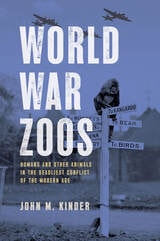
World War Zoos
Humans and Other Animals in the Deadliest Conflict of the Modern AgeJohn M. Kinder
University of Chicago Press, 2025
As Europe lurched into war in 1939, zookeepers started killing their animals. On September 1, as German forces invaded Poland, Warsaw began with its reptiles. Two days later, workers at the London Zoo launched a similar spree, dispatching six alligators, seven iguanas, sixteen southern anacondas, six Indian fruit bats, a fishing cat, a binturong, a Siberian tiger, five magpies, an Alexandrine parakeet, two bullfrogs, three lion cubs, a cheetah, four wolves, and a manatee over the next few months. Zoos worldwide did the same. The reasons were many, but the pattern was clear: The war that was about to kill so many people started by killing so many animals. Why? And how did zoos, nevertheless, not just survive the war but play a key role in how people did, too?
A harrowing yet surprisingly uplifting chronicle, Kinder’s World War Zoos traces how zoos survived the deadliest decades of global history, from the Great Depression, through the terrors of World War II, to the dawn of the Cold War. More than anything before or since, World War II represented an existential threat to the world’s zoological institutions. Some zoos were bombed; others bore the indignities of foreign occupation. Even zoos that were spared had to wrestle with questions rarely asked in public: What should they do when supplies ran low? Which animals should be killed to protect the lives of others? And how could zoos justify keeping dangerous animals that might escape and run wild during an aerial attack?
Zoos in wartime reveal the shared vulnerabilities of humans and animals during periods of social unrest and environmental peril. World War II–era zoos offered people ways to think about and grapple with imprisonment, powerlessness, and degradation. Viewed today, the story of zoos during World War II can be read as an allegory of twenty-first-century crises, as the effects of climate change threaten all life across the planet.
A one-of-a-kind history, World War Zoos is the story of how the world’s zoos survived the deadliest conflict of the twentieth century—and what was lost along the way.