Results by title

4 books match the query 'Outcomes'

cover of Outcomes of Engaged Education: From Transfer to Transformation

Outcomes of Engaged Education

From Transfer to Transformation

Linda Flower

University Press of Colorado, 2025

Revealing the impressive unseen outcomes community engaged and intellectually challenging classes can have for college students, Outcomes of Engaged Education combines case studies with introductions to informal methods for tracking how students transfer, transform, and apply such learning to their lives as well as how to engage them in this collaborative inquiry. Drawing on 20 years of data to document the significant outcomes such experiences have had for college students in their lives—up to ten years later—Linda Flower reveals a critical distinction between transfer and the transformation of knowledge. Each chapter embeds its methods in a set of case studies modeling the methods and reflecting on the findings emerging from its use. The result is a book that considers how we as teachers can draw our students into this inquiry and help them develop a more articulate awareness of their experiential knowledge, choices, and agency.
[more]
cover of Outcomes of General Education: An Appraisal of the General College Program

Outcomes of General Education

An Appraisal of the General College Program

Ruth E. Eckert

University of Minnesota Press, 1943

Outcomes of General Education was first published in 1943. Minnesota Archive Editions uses digital technology to make long-unavailable books once again accessible, and are published unaltered from the original University of Minnesota Press editions.
[more]
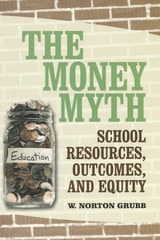
cover of The Money Myth: School Resources, Outcomes, and Equity

The Money Myth

School Resources, Outcomes, and Equity

W. Norton Grubb

Russell Sage Foundation, 2009

Can money buy high-quality education? Studies find only a weak relationship between public school funding and educational outcomes. In The Money Myth, W. Norton Grubb proposes a powerful paradigm shift in the way we think about why some schools thrive and others fail. The greatest inequalities in America's schools lie in factors other than fiscal support. Fundamental differences in resources other than money—for example, in leadership, instruction, and tracking policies—explain the deepening divide in the success of our nation's schoolchildren. The Money Myth establishes several principles for a bold new approach to education reform. Drawing on a national longitudinal dataset collected over twelve years, Grubb makes a crucial distinction between "simple" resources and those "compound," "complex," and "abstract" resources that cannot be readily bought. Money can buy simple resources—such as higher teacher salaries and smaller class sizes—but these resources are actually some of the weakest predictors of educational outcomes. On the other hand, complex resources pertaining to school practices are astonishingly strong predictors of success. Grubb finds that tracking policies have the most profound and consistent impact on student outcomes over time. Schools often relegate low-performing students—particularly minorities—to vocational, remedial, and special education tracks. So even in well-funded schools, resources may never reach the students who need them most. Grubb also finds that innovation in the classroom has a critical impact on student success. Here, too, America's schools are stratified. Teachers in underperforming schools tend to devote significant amounts of time to administration and discipline, while instructors in highly ranked schools dedicate the bulk of their time to "engaged learning," using varied pedagogical approaches. Effective schools distribute leadership among many instructors and administrators, and they foster a sense of both trust and accountability. These schools have a clear mission and coherent agenda for reaching goals. Underperforming schools, by contrast, implement a variety of fragmented reforms and practices without developing a unified plan. This phenomenon is perhaps most powerfully visible in the negative repercussions of No Child Left Behind. In a frantic attempt to meet federal standards and raise test scores quickly, more and more schools are turning to scripted "off the shelf" curricula. These practices discourage student engagement, suppress teacher creativity, and hold little promise of improving learning beyond the most basic skills. Grubb shows that infusions of money alone won't eradicate inequality in America's schools. We need to address the vast differences in the way school communities operate. By looking beyond school finance, The Money Myth gets to the core reasons why education in America is so unequal and provides clear recommendations for addressing this chronic national problem.
[more]
cover of The Outcomes of Counseling and Psychotherapy: Theory and Research

The Outcomes of Counseling and Psychotherapy

Theory and Research

Theodore Volsky, Jr.

University of Minnesota Press, 1965

The Outcomes of Counseling and Psychotherapy was first published in 1965. Minnesota Archive Editions uses digital technology to make long-unavailable books once again accessible, and are published unaltered from the original University of Minnesota Press editions.

How is the future behavior of a client or patient affected by counseling, casework, or psychotherapy? What fundamental personality changes, if any, can be attributed to such treatment? What does the counselor do that determines the outcome of his efforts? This volume deals with questions like these, questions which concern not only psychologists, psychiatrists, social workers, and other counselors, but also the communities, institutions, and agencies which support their work.

The report presented here is based on the findings of a ten-year project conducted at the University of Minnesota Student Counseling Bureau to assess the results of its counseling program. Since the early days of counseling at Minnesota, many studies, in a research program extending over a period of thirty years, have attempted to determine the effectiveness of counseling. In continuing these studies, the present authors have applied current statistical methods to contemporary counseling theory and practices. This account of the search for specific variables that define the goals of counseling, and for instruments to measure those variables objectively, is an important contribution to future research in the field. Ralph F. Berdie, director of the University of Minnesota Student Counseling Bureau, writes a foreword.

[more]