Results by title
4 books match the query 'Owen, David'
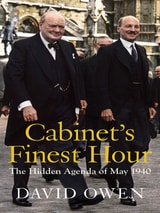
Cabinet's Finest Hour
The Hidden Agenda of May 1940David Owen
Haus Publishing, 2016
In May 1940, the British War Cabinet debated over the course of nine meetings a simple question: Should Britain fight on in the face of overwhelming odds, sacrificing hundreds of thousands of lives, or seek a negotiated peace? Using Cabinet papers from the United Kingdom’s National Archives, David Owen illuminates in fascinating detail this little-known, yet pivotal, chapter in the history of World War II.
Eight months into the war, defeat seemed to many a certainty. With the United States still a year and half away from entering, Britain found itself in a perilous position, and foreign secretary Lord Halifax pushed prime minister Winston Churchill to explore the possibility of a negotiated peace with Hitler, using Mussolini as a conduit. Speaking for England is the story of Churchill’s triumph in the face of this pressure, but it is also about how collective debate and discussion won the day—had Churchill been alone, Owen argues, he would almost certainly have lost to Halifax, changing the course of history. Instead, the Cabinet system, all too often disparaged as messy and cumbersome, worked in Britain’s interests and ensured that a democracy on the brink of defeat had the courage to fight on.
Eight months into the war, defeat seemed to many a certainty. With the United States still a year and half away from entering, Britain found itself in a perilous position, and foreign secretary Lord Halifax pushed prime minister Winston Churchill to explore the possibility of a negotiated peace with Hitler, using Mussolini as a conduit. Speaking for England is the story of Churchill’s triumph in the face of this pressure, but it is also about how collective debate and discussion won the day—had Churchill been alone, Owen argues, he would almost certainly have lost to Halifax, changing the course of history. Instead, the Cabinet system, all too often disparaged as messy and cumbersome, worked in Britain’s interests and ensured that a democracy on the brink of defeat had the courage to fight on.
[more]
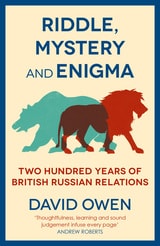
Riddle, Mystery, and Enigma
Two Hundred Years of British–Russian RelationsDavid Owen
Haus Publishing, 2022
A history of relations between Britain and Russia from the nineteenth century to the present.
With Riddle, Mystery, and Enigma, statesman and author David Owen tells the story of Britain’s relationship with Russia, which has been surprisingly underexplored. Through his characteristic insight and expertise, he depicts a relationship governed by principle as often as by suspicion, expediency, and necessity.
When the two nations formed a pragmatic alliance and fought together at the Battle of Navarino in Greece in 1827, it was overwhelmingly the work of the British prime minister, George Canning. His death brought about a drastic shift that would see the countries fighting on opposite sides in the Crimean War and jostling for power during the Great Game. It was not until the Russian Revolution of 1917 that another statesman had a defining impact on relations between Britain and Russia: Winston Churchill, who opposed Bolshevism yet never stopped advocating for diplomatic and military engagement with Russia. In the Second World War, he recognized early on the necessity of allying with the Soviets against the menace of Nazi Germany. Bringing us into the twenty-first century, Owen chronicles how both countries have responded to their geopolitical decline. Drawing on both imperial and Soviet history, he explains the unique nature of Putin’s autocracy and addresses Britain’s return to “blue water” diplomacy. Newly revised, this paperback edition features extended chapters on Putin’s Russia and the future of British–Russian relations after the Russo-Ukrainian War.
[more]
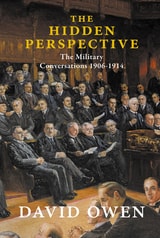
The Hidden Perspective
The Military Conversations 1906-1914David Owen
Haus Publishing, 2014
In 1905, British Foreign Secretary Edward Grey agreed to speak secretly with his French counterparts about sending a British expeditionary force to France in the event of a German attack. Neither Parliament nor the rest of the Cabinet was informed. The Hidden Perspective takes readers back to these tense years leading up to World War I and re-creates the stormy Cabinet meetings in the fall of 1911 when the details of the military conversations were finally revealed.
Using contemporary historical documents, David Owen, himself a former foreign secretary, shows how the foreign office’s underlying belief in Britain’s moral obligation to send troops to the Continent influenced political decision-making and helped create the impression that war was inevitable. Had Britain’s diplomatic and naval strategy been handled more skillfully during these years, Owen contends, the carnage of World War I might have been prevented altogether.
Using contemporary historical documents, David Owen, himself a former foreign secretary, shows how the foreign office’s underlying belief in Britain’s moral obligation to send troops to the Continent influenced political decision-making and helped create the impression that war was inevitable. Had Britain’s diplomatic and naval strategy been handled more skillfully during these years, Owen contends, the carnage of World War I might have been prevented altogether.
[more]
The UK's In-Out Referendum
EU Foreign and Defence Policy ReformDavid Owen
Haus Publishing, 2016
As David Owen notes in The UK’s In-Out Referendum, the European Union’s attempts at conflict resolution have left much to be desired. In the Ukraine, Baltic States, Turkey, and much of the Middle East, a lack of coherent policy has dominated. This book argues that the negotiations around the United Kingdom’s referendum vote represent an opportunity to enact wide-scale reform, not least to ensure that the nations of an increasingly politically integrated Eurozone do not come to dominate the foreign and security policy of the European Union in the years to come. To allow them to do so, Owen argues, would almost certainly see the policy of “common defense” advance at the expense of a lasting US commitment to NATO. Ultimately, Owen contends, Britain’s continued membership of a largely unreformed European Union would have serious implications for the United Kingdom’s security, and that foreign policy and security belong at the heart of the reforms the European Union so desperately needs.
[more]