Results by title
5 books match the query 'Owsley, Frank L.'
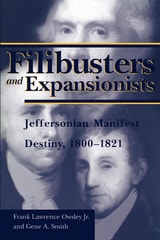
Filibusters and Expansionists
Jeffersonian Manifest Destiny, 1800-1821Frank L. Owsley
University of Alabama Press, 2004
Uncover the untold story of America’s 19th-century adventurers and their quest for empire.
The first two decades of the 19th century found many Americans eager to move away from the crowded eastern seaboard and into new areas where their goals of landownership might be realized. Such movement was encouraged by Presidents Jefferson, Madison, and Monroe—collectively known as the Jeffersonians—who believed that the country's destiny was to have total control over the entire North American continent. Migration patterns during this time changed the country considerably and included the roots of the slavery controversy that ultimately led to the Civil War. By the end of the period, although expansionists had not succeeded in moving into British Canada, they had obtained command of large areas from the Spanish South and Southwest, including acreage previously controlled by Native Americans.
Utilizing memoirs, diaries, biographies, newspapers, and vast amounts of both foreign and domestic correspondence, Frank Lawrence Owsley Jr. and Gene A. Smith reveal an insider’s view of the filibusters and expansionists, the colorful—if not sometimes nefarious—characters on the front line of the United States’s land grab. Owsley and Smith describe in detail the actions and characters involving both the successful and the unsuccessful efforts to expand the United States during this period—as well as the outspoken opposition to expansion, found primarily among the Federalists in the Northeast.
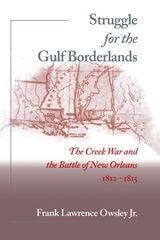
Struggle for the Gulf Borderlands
The Creek War and the Battle of New Orleans, 1812-1815Frank L. Owsley
University of Alabama Press, 2000
Examination of the Creek War which integrates that struggle into the larger conflict that broke out in 1812 between Great Britain and the United States.
Using American, British, and Spanish documents, many previously unknown, Frank Owsley’s study establishes the Creek War and the struggle to control the Gulf borderlands as integral parts of the War of 1812. The war between the United States and a large part of the Creek nation is usually studied as local or regional history. These documentary sources, however, show the larger picture. They show Spain to have been a major influence in the Creek War and indicate the extent to which the British were aiding the Indians and using them to redirect American troops. On the other hand, Andrew Jackson, in charge of the American forces on the Gulf Coast, emerged from the conflict as a first-rate military commander. His victories on the Gulf gave the West a leader and aided in shifting political power from the eastern seaboard to the South and West.
Owsley concludes that the victories in the Gulf region were of sufficient magnitude to justify the claim that the War of 1812 was not a draw but a decisive American victory and that had there been a general of Jackson's caliber on the northern frontier, the United States might have had a clear-cut victory there.
As a result of the war, the United States held its claim on Louisiana, annexed the Mobile district, forced Spain out of Florida, and broke the power of the southern Indians, thus opening vast lands for settlement from the new nation on the eastern seaboard.
The Creek War of 1813 and 1814
H. S. Halbert and T. H. Ball, edited by Frank L. Owsley, Jr.
University of Alabama Press, 1995
This standard account of one of the most controversial wars in which Americans have fought is again available, with introductory materials and a bibliography revised to reflect the advances in scholarship since the 1969 edition.
The first edition of Halbert and Ball's Creek War was published in 1895, and a new edition containing an introductory essay, supplementary notes, a bibliography, and an index by Frank L. Owsley Jr., was published in 1969. This standard account of one of the most controversial wars in which Americans have fought is again available, with introductory materials and a bibliography revised to reflect the advances in scholarship since the 1969 edition. This facsimile reproduction of the 1895 original provides a full and sympathetic account of the Indians' point of view, from the earliest visit of the great Shawnee chief Tecumseh to the southern tribes in 1811, through the buildup of apprehension and hostilities leading to the fateful battles at Burnt Corn, Fort Mims, and Holy Ground.
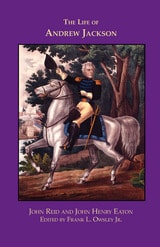
The Life of Andrew Jackson
John Reid
University of Alabama Press, 2007
The frontier fighter who rose to the presidency and reshaped a nation.
Original copies of the first, 1817, edition of this work are so rare that even the Library of Congress does not have an undamaged copy. Consequently scholars and students of Jackson have had to rely on later, incomplete or bowdlerized editions. It is therefore all the more valuable to have Owsley’s critical restoration of the original edition, complete with its useful maps.
The work is a straightforward history of Jackson’s military career, begun by John Reid, Jackson’s military aide throughout the War of 1812 and the ensuing Creek War. Reid wrote the first four chapters, and after his death John Eaton completed the work from Reid’s outline, notes, and papers. Owsley, quondam professor of history at Auburn University, has carefully restored the original edition, noted variants between this and successor editions, and included helpful apparatus, including a memoir of John Reid by Helen Reid Roberts, and indexes to the whole.
This is the first paperback edition of this valuable record.
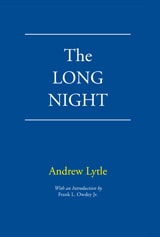
The Long Night
Andrew Lytle
University of Alabama Press, 1988
A first-rate novel that provides vivid descriptions of Alabama during an important period in the state’s history, The Long Night is set in the vicinity of Montgomery, Alabama, between 1850 and 1865. Originally published in 1936, the book is based on a true story related to Lytle by one of his close friends and colleagues at Vanderbilt University, Frank L. Owsley, who later became the chairman of The University of Alabama Department of History. In fact, the novel opens with a letter to Professor Owsley from the author, and Owsley’s son has written the introduction to this edition.
As described by George B. Tindall, The Long Night is “the episodic story of a young Alabamian beset by the moral dilemma of desire for revenge against the persecutors of his father and his larger duty in the war, a story that rose to its climax in the Battle of Shiloh.” The work is rich in its description of the land and people of Black-Belt Alabama during the mid-19th century.