Results by title
5 books match the query 'Oxford (England)'
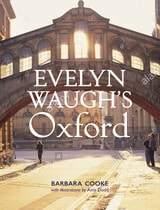
Evelyn Waugh's Oxford
Barbara Cooke
Bodleian Library Publishing, 2018
Evelyn Waugh’s Oxford years were so formative that the city never left him, appearing again and again in his novels in various forms. This book explores in rich visual detail the abiding importance of Oxford as both location and experience in Waugh’s works. Drawing on specially commissioned illustrations and previously unpublished photographic material, it provides a critically robust assessment of the author’s engagement with Oxford over the course of his literary career.
Following a brief overview of Waugh’s life and work, subsequent chapters examine the prose and graphic art Waugh produced as an undergraduate, together with his portrayal of Oxford in Brideshead Revisited and his memoir, A Little Learning. A specially commissioned, hand-drawn trail around Evelyn Waugh’s Oxford guides the reader around the city Waugh knew and loved through such iconic locations as the Botanic Garden, the Oxford Union, and the Chequers.
A unique literary biography, this book brings to life Waugh’s Oxford, exploring the lasting impression it made on one of the most accomplished literary craftsmen of the twentieth century.
[more]
John Fuller and the Sycamore Press
A Bibliographic HistoryRyan Roberts
Bodleian Library Publishing, 2010
[more]
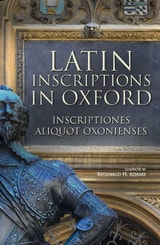
Latin Inscriptions in Oxford
Compiled with Translations by Reginald H. Adams
Bodleian Library Publishing, 2015
For six centuries following its foundation, Latin was the main language written and spoken at the University of Oxford. Today, one can still find Latin inscriptions carved into many of its monuments, as well those of the city, dating from the medieval period to the present day. But few of us can discern what all of these inscriptions mean.
For Latin Inscriptions in Oxford, Reginald H. Adams, a former scholar at St. John’s College, University of Oxford, has translated a selection of Latin inscriptions. Among them, he finds a great many tributes and memorials—to Queen Anne, Cardinal Wolsey, and T. E. Lawrence, but also to Irene Frude, a “most kindly landlady” on Little Clarendon who “provided each day for almost thirty-five years enormous breakfasts.” Some of the inscriptions offer concise commentary—“Without experiment, it is not possible to know anything adequately.” While others are instructive like the Rhodes House’s warning, “Let no one who is smoke-bearing enter here.”
Evocative mementoes of the past, the inscriptions collected by Adams bring insight to the vivid history of Oxford, the city and the university.
[more]
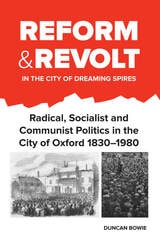
Reform and Revolt in the City of Dreaming Spires
Radical, Socialist and Communist Politics in the City of Oxford 1830–1980Duncan Bowie
University of Westminster Press, 2018
Books about Oxford have generally focused on the University rather than the city. This original book on the local politics of Oxford City from 1830 to 1980 is based on a comprehensive analysis of primary sources and tells the story of the city’s progressive politics. The book traces this history from Chartism and electoral reform in the mid-nineteenth century, through the early years of socialism to the impact of communism in the interwar period, the struggle between nuclear disarmers and Gaitskellites in the 1960s and the impact of the new revolutionary left in the late 1970s. Throughout the narrative, the book contrasts the two approaches of those engaged in progressive politics, those who focused on the politics of reform and improved government and those who preferred the politics of revolt, protest and revolutionary rhetoric. The author argues that a central feature of this history has been the co-existence and interaction of working- and middle- class elements. It rediscovers a rich heritage, a fascinating story and offers a rare wide-ranging chronological narrative of local UK city politics. Through its extensive quotes from primary sources, the book presents a vivid picture of local politics over 150 years.
[more]
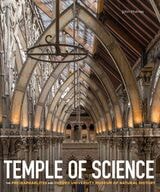
Temple of Science
The Pre-Raphaelites and Oxford University Museum of Natural HistoryJohn Holmes
Bodleian Library Publishing, 2020
Built between 1855 and 1860, the Oxford University Museum of Natural History is the extraordinary result of close collaboration between artists and scientists. The architect Benjamin Woodward consulted with two groups on the design and decoration of the building: a panel of Oxford scientists and dons, and the society of artists known as the Pre-Raphaelite Brotherhood. The museum's decorative art was modeled on the Pre-Raphaelites' principle of meticulous observation of nature, itself indebted to science. The structure was an experiment in using architecture and art to communicate natural history, modern science, and natural theology. Temple of Science sets out the history of the campaign to build the museum before taking the reader on a tour of the art found in the museum itself. It looks at the façade and the central court, the natural history carvings and marble columns illustrating different geological strata, and the meticulously carved sculptures of influential scientists. With unique insights and lavish illustrations, Temple of Science tells the story of one of the most remarkable collaborations between scientists and artists in European art.
[more]