Results by title

6 books match the query 'Pócs, Éva'
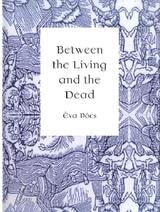
cover of Between the Living and the Dead: A Perspective on Witches and Seers in the Early Modern Age

Between the Living and the Dead

A Perspective on Witches and Seers in the Early Modern Age

Éva Pócs

Central European University Press, 1998
Éva Pócs, one of the most highly respected scholars of historical anthropology, has undertaken extensive research on the history of folk beliefs connected with communication and the supernatural sphere. In this book, she examines the relics of European shamanism in early modern sources, and the techniques and belief-systems of mediators found in the records of witchcraft trials from the sixteenth to the eighteenth century. The book explores the various communication systems known to early modern Hungarians, describes the role of these systems in everyday village life, and shows how they were connected to contemporary European systems, as well as new types of mediators and systems which function right up to the twentieth century. Representing a major contribution to the most up-to-date international research, Eva Pócs draws on significant East European material and literature not previously co-ordinated with that from the West.
[more]
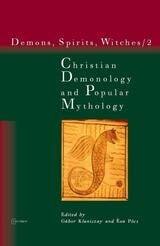
cover of Christian Demonology and Popular Mythology

Christian Demonology and Popular Mythology

Éva Pócs

Central European University Press, 2006
The authors—recognized historians, ethnologists, folklorists coming from four continents—present the latest research findings on the relationship, coexistence and conflicts of popular belief systems, Judeo-Christian mythology and demonology in medieval and modern Europe. The present volume focuses on the divergence between Western and Eastern evolution, on the different relationship of learned demonology to popular belief systems in the two parts of Europe. It discusses the conflict of saints, healers, seers, shamans with the representatives of evil; the special function of escorting, protecting, possessing, harming and healing spirits; the role of the dead, the ghosts, of pre-Christian, Jewish and Christian spirit-world, the antagonism of the devil and the saint.
[more]
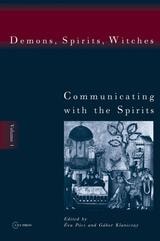
cover of Communicating with the Spirits

Communicating with the Spirits

Gábor Klaniczay

Central European University Press, 2005
Focuses on the problem of communication with the other world: the phenomenon of spirit possession and its changing historical interpretations, the imaginary schemes elaborated for giving accounts of the journeys to the other world, for communicating with the dead, and finally the historical archetypes of this kind of religious manifestation—trance prophecy, divination, and shamanism.Recognized historians and ethnologists analyze the relationship, coexistence and conflicts of popular belief systems, Judeo-Christian mythology and demonology in medieval and modern Europe. The essays address links between rites and beliefs, folklore and literature; the legacy of various pre-Christian mythologies; the syncretic forms of ancient, medieval and modern belief- and rite-systems; "pure" examples from religious-ethnological research outside Europe to elucidate European problems.
[more]
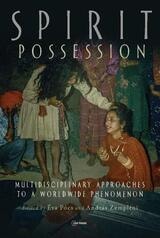
cover of Spirit Possession: Multidisciplinary Approaches to a Worldwide Phenomenon

Spirit Possession

Multidisciplinary Approaches to a Worldwide Phenomenon

Éva Pócs

Central European University Press, 2022

Possession, a seemingly irrational phenomenon, has posed challenges to generations of scholars rooted in Western notions of body-soul dualism, self and personhood, and a whole set of presuppositions inherited from Christian models of possession that was “good” or “bad.” The authors of the essays in this book present a new and more promising approach. They conceive spirit possession as a form of communication, of expressivity, of culturally defined behavior that should be understood in the context of local, vernacular theories and empiric reflections.

With the aim of reformulating the comparative anthropology of spirit possession, the editors have opened corridors between previously separate areas of research. Together, anthropologists and historians working on several historical periods and in different European, African, South American, and Asian cultural areas attempt to redefine the very concept of possession, freeing it from the Western notion of the self and more clearly delineating it from related matters such as witchcraft, devotion, or mysticism. The book also provides an overview of new research directions, including novel methods of participant observation and approaches to spirit possession as indigenous historiography
[more]
cover of The Power of Words: Studies on Charms and Charming in Europe

The Power of Words

Studies on Charms and Charming in Europe

James Kapalo

Central European University Press, 2013
n medieval and early modern Europe, the use of charms was a living practice in all strata of society. The essays in this latest CEU Press publication explore the rich textual tradition of archives, monasteries, and literary sources. The author also discusses texts amassed in folklore archives and ones that are still accessible through field work in many rural areas of Europe.
[more]
cover of Witchcraft Mythologies and Persecutions

Witchcraft Mythologies and Persecutions

Gábor Klaniczay

Central European University Press, 2008

This third, concluding volume of the series publishes 14 studies and the transcription of a round-table discussion on Carlo Ginzburg's Ecstasies. The themes of the previous two volumes, Communicating with the Spirits, and Christian Demonology and Popular Mythology, are further expanded here both as regards their interdisciplinary approach and the wide range of regional comparisons. While the emphasis of the second volume was on current popular belief and folklore as seen in the context of the historical sources on demonology, this volume approaches its subject from the point of view of historical anthropology. The greatest recent advances of witchcraft research occurred recently in two fields: (1) deciphering the variety of myths and the complexity of historical processes which lead to the formation of the witches' Sabbath, (2) the micro-historical analysis of the social, religious, legal and cultural milieu where witchcraft accusations and persecutions developed. These two themes are completed by some further insights into the folklore of the concerned regions which still carries the traces of the traumatic historical memories of witchcraft persecutions.
[more]