Results by title
5 books match the query 'Pacific settlement of international disputes'
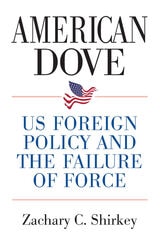
American Dove
US Foreign Policy and the Failure of ForceZachary C. Shirkey
University of Michigan Press, 2020
Zachary C. Shirkey argues that the United States is overly reliant on the active use of force and should employ more peaceful foreign policy tools. Force often fails to achieve its desired ends for both tactical and strategic reasons and is relatively infungible, making it an inappropriate tool for many US foreign policy goals. Rather than relying on loose analogies or common sense as many books on US grand strategy do, American Dove bases its argument directly on an eclectic mix of academic literature, including realist, liberal, and constructivist theory as well as psychology. Shirkey also argues against retrenchment strategies, such as offshore balancing and strategic restraint as lacking a moral component that leaves them vulnerable to hawkish policies that employ moral arguments in favor of action. US withdrawal would weaken the existing liberal international security, economic, and legal orders—orders that benefit the United States. Rather, the book argues the United States needs an energetic foreign policy that employs passive uses of force such as deterrence and nonmilitary tools such as economic statecraft, international institutions, international law, and soft power. Such a policy leaves room for a moral component, which is necessary for mobilizing the American public and would uphold the existing international order. Last, Shirkey argues that to be successful, doves must frame their arguments in terms of strategy rather than in terms of costs and must show that dovish policies are consistent with national honor and a broad range of American values. American Dove offers a framework for US grand strategy and a plan for persuading the public to adopt it.
[more]

Beyond Confrontation
Learning Conflict Resolution in the Post-Cold War EraJohn A. Vasquez, Sanford Jaffe, James Turner Johnson, and Linda Stamato, Editors
University of Michigan Press, 1996
The post-Cold War era has given rise to new issues and disputes. Ethnic and nationalist violence disturb the peace and pose special problems for the strongest states and the United Nations. Beyond Confrontation: Learning Conflict Resolution in the Post-Cold War Era gives an overview of possible conflict resolution techniques that can be used to help manage and prevent these kinds of disputes in today's new world order. It outlines how to go beyond power politics and establish a politics of resolution. During the Cold War, traditional techniques of conflict resolution were neglected since they were thought to be irrelevant and generally inapplicable to the relations between states. In the meantime, a vast literature and practice on conflict resolution has grown up on the domestic level that has been largely ignored by international politics specialists. The contributors to this volume cull this literature for the insights it can shed on the process of developing worldwide stability. Moreover, they go beyond traditional discipline boundaries and bring to bear the best current work in political science, social psychology, law, management, sociology, and ethics on the important task of creating a more peaceful world order. Contributors include James Turner Johnson, John A. Vasquez, Robert A. Baruch Bush, Ronald J. Fisher, Deborah M. Kolb, Eileen E Babbitt, Louis Kriesberg, Dean G. Pruitt, John W. Burton, and Charles E Doran.
[more]
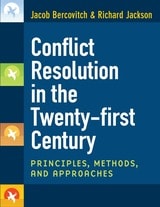
Conflict Resolution in the Twenty-first Century
Principles, Methods, and ApproachesJacob Bercovitch and Richard Jackson
University of Michigan Press, 2009
In the past, arbitration, direct bargaining, the use of intermediaries, and deference to international institutions were relatively successful tools for managing interstate conflict. In the face of terrorism, intrastate wars, and the multitude of other threats in the post–Cold War era, however, the conflict resolution tool kit must include preventive diplomacy, humanitarian intervention, regional task-sharing, and truth commissions. Here, Jacob Bercovitch and Richard Jackson, two internationally recognized experts, systematically examine each one of these conflict resolution tools and describe how it works and in what conflict situations it is most likely to be effective.
Conflict Resolution in the Twenty-first Centuryis not only an essential introduction for students and scholars, it is a must-have guide for the men and women entrusted with creating stability and security in our changing world.
[more]
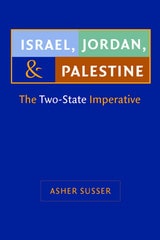
Israel, Jordan, and Palestine
The Two-State ImperativeAsher Susser
Brandeis University Press, 2011
Since 1921, the Zionist movement, the Hashemites, and Palestinian nationalists have been vying for regional control. In this book, Asher Susser analyzes the evolution of the one- and two-state options and explores why a two-state solution has failed to materialize. He provides an in-depth analysis of Jordan’s positions and presents an updated discussion of the two-state imperative through the initiatives of Israel and the Palestinian Authority. Susser argues that Israelis, Palestinians, and Jordanians have cohesive collective identities that violently collide with each other. Because of these entrenched differences, a single-state solution cannot be achieved.
[more]

Resolving Disputes Between Nations
Coercion or Conciliation?Martin Patchen
Duke University Press, 1988
The use of force and coercion to settle disputes between nations is a central problem of our time. Martin Patchen considers the circumstances that lead nations to use coercive means in disputes with other nations and also examines the effectiveness of other means of resolving international disputes. Patchen examines conflict and cooperation as general social processes and builds on previous work to present an overall theoretical framework that encompasses the conflict situation, perceptions of the adversary, decision-making, bargaining, and interaction and influence sequences.
[more]