Results by title
6 books match the query 'Pacifism'
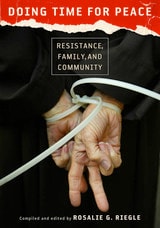
Doing Time for Peace
Resistance, Family, and CommunityRosalie G. Riegle
Vanderbilt University Press, 2013
In their own words, the narrators describe their motivations and their preparations for acts of resistance, the actions themselves, and their trials and subsequent jail time. We hear from those who do their time by caring for their families and managing communities while their partners are imprisoned. Spouses and children talk frankly of the strains on family ties that a life of working for peace in the world can cause.
The voices range from a World War II conscientious objector to those protesting the recent war in Iraq. The book includes sections on resister families, the Berrigans and Jonah House, the Plowshares Communities, the Syracuse Peace Council, and Catholic Worker houses and communities.
The introduction by Dan McKanan situates these activists in the long tradition of resistance to war and witness to peace.
From Warism to Pacifism
A Moral ContinuumAuthored by Duane Cady
Temple University Press, 2010
Duane Cady views warism and pacifism as polar extremes on a continuum that embraces a full spectrum of ethical positions on the morality of war and peace. Realizing that he could not intellectually defend the notions of just-war theory, he found that he was a reluctant pacifist. In this new edition of From Warism to Pacifism, Cady continues to expose the pervasive, subconscious warism that is the dominant ideology in modern Western culture. He explores the changes over the last twenty years—from the end of the Cold War to the ongoing “war on terror,” as well as Barack Obama winning the Nobel Prize for Peace.
Like racism and sexism, the uncritical presumption that war is morally justifiable, even morally required, misguides our attitudes and institutions. In its place, Cady proposes the development of a positive concept of peace. Citing common objections to pacifist values, he describes peace as something more than the mere absence of war and demonstrates that pacifism is a defensible position.
Interpretations of Conflict
Ethics, Pacifism, and the Just-War TraditionRichard B. Miller
University of Chicago Press, 1991
Miller's study of the ethics of war could not be more timely.
Miller brings together the opposed traditions of pacifism and
just-war theory and puts them into a much-needed dialogue
on the ethics of war.
Beginning with the duty of nonviolence as a point of
convergence between the two rival traditions, Miller provides
an opportunity for pacifists and just-war theorists to refine
their views in a dialectical exchange over a set of ethical
and social questions. From the interface of these two long-
standing and seemingly incompatible traditions emerges a
surprisingly fruitful discussion over a common set of values,
problems, and interests: the presumption against harm, the
relation of justice and order, the ethics of civil
disobedience, the problem of self-righteousness in moral
discourse about war, the ethics of nuclear deterrence, and
the need for practical reasoning about the morality of war.
Miller pays critical attention to thinkers such as Augustine
and Thomas Aquinas, as well as to modern thinkers like H.
Richard Niebuhr, Paul Ramsey, Martin Luther King, Jr., James
Douglass, the Berrigans, William O'Brien, Michael Walzer, and
James Childress. He demonstrates how pacifism and just-war
tenets can be joined around both theoretical and practical
issues.
Interpretations of Conflict is a work of massive
scholarship and careful reasoning that should interest
philosophers, theologians, and religious ethicists alike. It
enhances our moral literacy about injury, suffering, and
killing, and offers a compelling dialectical approach to
ethics in a pluralistic society.
Richard B. Miller is assistant professor of religious
studies at Indiana University.
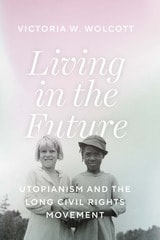
Living in the Future
Utopianism and the Long Civil Rights MovementVictoria W. Wolcott
University of Chicago Press, 2022
Utopian thinking is often dismissed as unrealistic, overly idealized, and flat-out impractical—in short, wholly divorced from the urgent conditions of daily life. This is perhaps especially true when the utopian ideal in question is reforming and repairing the United States’ bitter history of racial injustice. But as Victoria W. Wolcott provocatively argues, utopianism is actually the foundation of a rich and visionary worldview, one that specifically inspired the major figures of the Civil Rights Movement in ways that haven’t yet been fully understood or appreciated.
Wolcott makes clear that the idealism and pragmatism of the Civil Rights Movement were grounded in nothing less than an intensely utopian yearning. Key figures of the time, from Martin Luther King Jr. and Pauli Murray to Father Divine and Howard Thurman, all shared a belief in a radical pacificism that was both specifically utopian and deeply engaged in changing the current conditions of the existing world. Living in the Future recasts the various strains of mid-twentieth-century civil rights activism in a utopian light, revealing the power of dreaming in a profound and concrete fashion, one that can be emulated in other times that are desperate for change, like today.

Roots and Fruits of a Powerful Peace Testimony
Bruce Birchard
QuakerPress, 2004
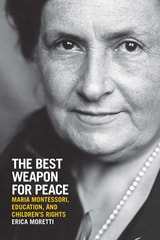
The Best Weapon for Peace
Maria Montessori, Education, and Children's RightsErica Moretti
University of Wisconsin Press, 2022
Using newly discovered primary sources, Moretti examines Montessori’s lifelong pacifist work, including her ultimately unsuccessful push for the creation of the White Cross, a humanitarian organization for war-affected children. Moretti shows that Montessori’s educational theories and practices would come to define chilren’s rights once adopted by influential international organizations, including the United Nations. She uncovers the significance of Montessori’s evolving philosophy of peace and early childhood education within broader conversations about internationalism and humanitarianism.