Results by title
4 books match the query 'Packing-houses'

Down on the Killing Floor
Black and White Workers in Chicago's Packinghouses, 1904-54Rick Halpern
University of Illinois Press, 1997
Rick Halpern examines the links between race relations and unionization in Chicago's meatpacking industry. Drawing on oral histories and archival materials, Halpern explores the experiences of and relationship between black and white workers in a fifty-year period that included labor actions during World War I, Armour's violent reaction to union drives in the late 1930s, and organizations like the Stockyards Labor Council and the United Packinghouse Workers of America.
[more]

Images of Germany in American Literature
Waldemar Zacharasiewicz
University of Iowa Press, 2007
Although German Americans number almost 43 million and are the largest ethnic group in the United States, scholars of American literature have paid little attention to this influential and ethnically diverse cultural group. In a work of unparalleled depth and range, Waldemar Zacharasiewicz explores the cultural and historical background of the varied images of Germany and Germans throughout the past two centuries. Using an interdisciplinary approach known as comparative imagology, which borrows from social psychology and cultural anthropology, Zacharasiewicz samples a broad spectrum of original sources, including literary works, letters, diaries, autobiographical accounts, travelogues, newspaper reports, films, and even cartoons and political caricatures.
Starting with the notion of Germany as the ideal site for academic study and travel in the nineteenth century and concluding with the twentieth-century image of Germany as an aggressive country, this innovative work examines the ever-changing image of Germans and Germany in the writings of Louisa May Alcott, Samuel Clemens, Henry James, William James, George Santayana, W. E. B. Du Bois, John Dewey, H. L. Mencken, Katherine Anne Porter, Kay Boyle, Thomas Wolfe, Upton Sinclair, Gertrude Stein, Kurt Vonnegut, Thomas Pynchon, William Styron, Walker Percy, and John Hawkes, among others.
Starting with the notion of Germany as the ideal site for academic study and travel in the nineteenth century and concluding with the twentieth-century image of Germany as an aggressive country, this innovative work examines the ever-changing image of Germans and Germany in the writings of Louisa May Alcott, Samuel Clemens, Henry James, William James, George Santayana, W. E. B. Du Bois, John Dewey, H. L. Mencken, Katherine Anne Porter, Kay Boyle, Thomas Wolfe, Upton Sinclair, Gertrude Stein, Kurt Vonnegut, Thomas Pynchon, William Styron, Walker Percy, and John Hawkes, among others.
[more]
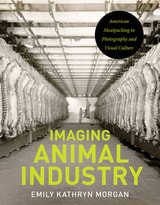
Imaging Animal Industry
American Meatpacking in Photography and Visual CultureEmily Kathryn Morgan
University of Iowa Press, 2024
Imaging Animal Industry focuses on the visual culture of the American meat industry between 1890 and 1960. It describes how, during that period, photographs and other images helped to shape public perceptions of industrial-scale meat production. Although the meat industry today bans most photography at its facilities, in the past this was not always the case: the meat industry not only tolerated but welcomed cameras. Meatpacking companies and industry organizations regarded photographs as useful tools for creating and managing a vision of their activities, their innovations, and their contributions to the march of American economic and industrial progress.
Drawing on archival collections across the American Midwest, this book relates a history of the meatpacking industry’s use of images in the early to mid-twentieth century. In the process, it reveals the key role that images, particularly photographs, have played in assisting with the rise of industrial meat production.
Drawing on archival collections across the American Midwest, this book relates a history of the meatpacking industry’s use of images in the early to mid-twentieth century. In the process, it reveals the key role that images, particularly photographs, have played in assisting with the rise of industrial meat production.
[more]
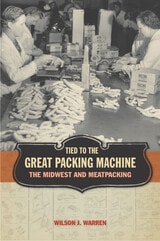
Tied to the Great Packing Machine
The Midwest and MeatpackingWilson J. Warren
University of Iowa Press, 2007
Ambitious in its historical scope and its broad range of topics, Tied to the Great Packing Machine tells the dramatic story of meatpacking’s enormous effects on the economics, culture, and environment of the Midwest over the past century and a half. Wilson Warren situates the history of the industry in both its urban and its rural settings—moving from the huge stockyards of Chicago and Kansas City to today’s smaller meatpacking communities—and thus presents a complete portrayal of meatpacking’s place within the larger agro-industrial landscape.
Writing from the vantage point of twenty-five years of extensive research, Warren analyzes the evolution of the packing industry from its early period, dominated by the big terminal markets, through the development of new marketing and technical innovations that transformed the ways animals were gathered, slaughtered, and processed and the final products were distributed. In addition, he concentrates on such cultural impacts as ethnic and racial variations, labor unions, gender issues, and changes in Americans’ attitudes toward the ethics of animal slaughter and patterns of meat consumption and such environmental problems as site-point pollution and microbe contamination, ending with a stimulating discussion of the future of American meatpacking.
Providing an excellent and well-referenced analysis within a regional and temporal framework that ensures a fresh perspective, Tied to the Great Packing Machine is a dynamic narrative that contributes to a fuller understanding of the historical context and contemporary concerns of an extremely important industry.
[more]