Results by title
9 books match the query 'Pacyga, Dominic A.'
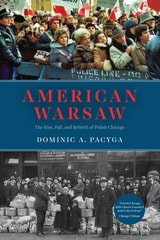
American Warsaw
The Rise, Fall, and Rebirth of Polish ChicagoDominic A. Pacyga
University of Chicago Press, 2019
Every May, a sea of 250,000 people decked out in red and white head to Chicago’s Loop to celebrate the Polish Constitution Day Parade. In the city, you can tune in to not one but four different Polish-language radio stations or jam out to the Polkaholics. You can have lunch at pierogi food trucks or pick up pączkis at the grocery store. And if you’re lucky, you get to take off work for Casimir Pulaski Day. For more than a century, Chicago has been home to one of the largest Polish populations outside of Poland, and the group has had an enormous influence on the city’s culture and politics. Yet, until now, there has not been a comprehensive history of the Chicago Polonia.
With American Warsaw, award-winning historian and Polish American Dominic A. Pacyga chronicles more than a century of immigration, and later emigration back to Poland, showing how the community has continually redefined what it means to be Polish in Chicago. He takes us from the Civil War era until today, focusing on how three major waves of immigrants, refugees, and fortune seekers shaped and then redefined the Polonia. Pacyga also traces the movement of Polish immigrants from the peasantry to the middle class and from urban working-class districts dominated by major industries to suburbia. He documents Polish Chicago’s alignments and divisions: with other Chicago ethnic groups; with the Catholic Church; with unions, politicians, and city hall; and even among its own members. And he explores the ever-shifting sense of Polskość, or “Polishness.”
Today Chicago is slowly being eclipsed by other Polish immigrant centers, but it remains a vibrant—and sometimes contentious—heart of the Polish American experience. American Warsaw is a sweeping story that expertly depicts a people who are deeply connected to their historical home and, at the same time, fiercely proud of their adopted city. As Pacyga writes, “While we were Americans, we also considered ourselves to be Poles. In that strange Chicago ethnic way, there was no real difference between the two.”
Chicago
A BiographyDominic A. Pacyga
University of Chicago Press, 2009
Chicago has been called by many names. Nelson Algren declared it a “City on the Make.” Carl Sandburg dubbed it the “City of Big Shoulders.” Upton Sinclair christened it “The Jungle,” while New Yorkers, naturally, pronounced it “the Second City.”
At last there is a book for all of us, whatever we choose to call Chicago. In this magisterial biography, historian Dominic Pacyga traces the storied past of his hometown, from the explorations of Joliet and Marquette in 1673 to the new wave of urban pioneers today. The city’s great industrialists, reformers, and politicians—and, indeed, the many not-so-great and downright notorious—animate this book, from Al Capone and Jane Addams to Mayor Richard J. Daley and President Barack Obama. But what distinguishes this book from the many others on the subject is its author’s uncommon ability to illuminate the lives of Chicago’s ordinary people. Raised on the city’s South Side and employed for a time in the stockyards, Pacyga gives voice to the city’s steelyard workers and kill floor operators, and maps the neighborhoods distinguished not by Louis Sullivan masterworks, but by bungalows and corner taverns.
Filled with the city’s one-of-a-kind characters and all of its defining moments, Chicago: A Biography is as big and boisterous as its namesake—and as ambitious as the men and women who built it.
Chicago
A BiographyDominic A. Pacyga
University of Chicago Press, 2009
This is an auto-narrated audiobook version of this book.
Chicago has been called by many names. Nelson Algren declared it a “City on the Make.” Carl Sandburg dubbed it the “City of Big Shoulders.” Upton Sinclair christened it “The Jungle,” while New Yorkers, naturally, pronounced it “the Second City.”
At last there is a book for all of us, whatever we choose to call Chicago. In this magisterial biography, historian Dominic Pacyga traces the storied past of his hometown, from the explorations of Joliet and Marquette in 1673 to the new wave of urban pioneers today. The city’s great industrialists, reformers, and politicians—and, indeed, the many not-so-great and downright notorious—animate this book, from Al Capone and Jane Addams to Mayor Richard J. Daley and President Barack Obama. But what distinguishes this book from the many others on the subject is its author’s uncommon ability to illuminate the lives of Chicago’s ordinary people. Raised on the city’s South Side and employed for a time in the stockyards, Pacyga gives voice to the city’s steelyard workers and kill floor operators, and maps the neighborhoods distinguished not by Louis Sullivan masterworks, but by bungalows and corner taverns.
Filled with the city’s one-of-a-kind characters and all of its defining moments, Chicago: A Biography is as big and boisterous as its namesake—and as ambitious as the men and women who built it.
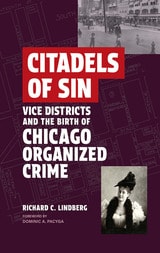
Citadels of Sin
Vice Districts and the Birth of Chicago Organized CrimeRichard C. Lindberg, with a foreword by Dominic A. Pacyga
Southern Illinois University Press, 2026
Revealing Chicago’s underworld before Al Capone
Vice in Chicago did not begin—or end—with Al Capone. In this vividly written narrative, historian Richard C. Lindberg peels back the mythology of Prohibition-era gangsters to reveal a more entrenched, intricate and disturbing system of vice and corruption that took shape decades earlier. Long before the rise of organized crime syndicates, Chicago’s political leaders in league with the criminal classes deliberately created and managed politically-protected segregated vice districts known in Chicago and in other cities as “Levees,” that institutionalized prostitution, graft, and forced sex work in the name of preserving civic order by isolating the vice trade from the citizenry.
Set against the backdrop of the Gilded Age and Progressive Era, Citadels of Sin situates Chicago within a nationwide experiment in regulating prostitution. Reformers, clergy, and municipal officials across the United States believed that confining vice to designated districts would protect respectable neighborhoods and commercial centers. More than fifty such districts emerged nationwide. Instead of curbing crime, however, the Levees became engines of corruption, enriching politicians, police, lawyers, and judges while normalizing exploitation and violence. Lindberg argues that these systems laid the groundwork for modern global human trafficking.
Chicago, with its size and political complexity, supported three major Levees. On the West Side, poverty and endemic corruption devastated local communities. On the North Side, one vice district survived longest, eventually transforming into the fashionable Rush Street nightclub scene. The South Side levee proved most consequential of all, evolving into the organized crime network known as “the Outfit,” whose influence continues to endure.
Lindberg brings the levee era to life through sharp portraits and damning accountability. He exposes how media sensationalism glamorized vice while masking its human cost, and he holds powerful figures—most notably Mayors Carter Harrison Sr. and Jr.—responsible for enabling a system built on bribery, “white slavery,” and coerced sex work. The levees were not accidental byproducts of urban growth; they were carefully managed political machines.
As World War I priorities and urban redevelopment finally dismantled formal vice districts, their activities did not disappear. Instead, they dispersed into neighborhoods, suburbs, and new forms.
By walking readers through the former vice districts as they exist today, Lindberg forges a powerful connection between past and present. In tracing the rise and fall of these districts, he reveals how efforts to impose moral order produced the very exploitation they claimed to prevent—proof that reform, when compromised by politics and greed, can collapse into catastrophe.
Clout City
The Rise and Fall of the Chicago Political MachineDominic A. Pacyga
University of Chicago Press, 2025
Unearths the religious and cultural roots of a powerful political machine that empowered some everyday Chicagoans but ruled all of the city for decades.
In politics, clout is essential. Too often, it determines whether insider access is granted or denied, favors are given or withheld, and payoffs are made or received. But Chicago clout, as we know it today, is even more potent than that—it’s the absolute currency of a social, cultural, and political order that is self-reinforcing and self-dealing. Or, at least, it was.
In Clout City, award-winning historian Dominic A. Pacyga reveals how cultural, ethnic, and religious forces created this distinctive system—and ultimately led to its collapse. Tracing clout’s origins in the Irish Catholic–dominated working-class neighborhood of Bridgeport, shaped by De La Salle Institute and home to the legendary Daley family, Pacyga shows how communal ties can be a force for good and also the deepest wellspring of corruption. He maps Chicago’s unique politics to its remarkable history, from the Great Fire of 1871 through its rise and decline as an industrial center to its emergence as a global city in the early twenty-first century. With deep research and firsthand experience from a lifetime in the city, Pacyga argues that Chicago’s politics is understood best as a mixture of cultural and religious influences and more worldly pursuits, exploring how both Jewish and Catholic communalism played central roles in the creation and sustenance of the Chicago machine.
Chicago’s politics today aren’t as defined by its distinctive brand of clout. But they are shaped by clout’s decline and the ghost of the machine. Pacyga’s tour of the city’s multilayered past is an indispensable guide to its present and future.
Clout City
The Rise and Fall of the Chicago Political MachineDominic A. Pacyga
University of Chicago Press, 2025
This is an auto-narrated audiobook version of this book.
Unearths the religious and cultural roots of a powerful political machine that empowered some everyday Chicagoans but ruled all of the city for decades.
In politics, clout is essential. Too often, it determines whether insider access is granted or denied, favors are given or withheld, and payoffs are made or received. But Chicago clout, as we know it today, is even more potent than that—it’s the absolute currency of a social, cultural, and political order that is self-reinforcing and self-dealing. Or, at least, it was.
In Clout City, award-winning historian Dominic A. Pacyga reveals how cultural, ethnic, and religious forces created this distinctive system—and ultimately led to its collapse. Tracing clout’s origins in the Irish Catholic–dominated working-class neighborhood of Bridgeport, shaped by De La Salle Institute and home to the legendary Daley family, Pacyga shows how communal ties can be a force for good and also the deepest wellspring of corruption. He maps Chicago’s unique politics to its remarkable history, from the Great Fire of 1871 through its rise and decline as an industrial center to its emergence as a global city in the early twenty-first century. With deep research and firsthand experience from a lifetime in the city, Pacyga argues that Chicago’s politics is understood best as a mixture of cultural and religious influences and more worldly pursuits, exploring how both Jewish and Catholic communalism played central roles in the creation and sustenance of the Chicago machine.
Chicago’s politics today aren’t as defined by its distinctive brand of clout. But they are shaped by clout’s decline and the ghost of the machine. Pacyga’s tour of the city’s multilayered past is an indispensable guide to its present and future.
Ethnic Historians and the Mainstream
Shaping America's Immigration StoryAlan M. Kraut and David A. Gerber
Rutgers University Press, 2013
Do historians “write their biographies” with the subjects they choose to address in their research? In this collection, editors Alan M. Kraut and David A. Gerber compiled eleven original essays by historians whose own ethnic backgrounds shaped the choices they have made about their own research and writing as scholars. These authors, historians of American immigration and ethnicity, revisited family and personal experiences and reflect on how their lives helped shape their later scholarly pursuits, at times inspiring specific questions they asked of the nation’s immigrant past. They address issues of diversity, multiculturalism, and assimilation in academia, in the discipline of history, and in society at large. Most have been pioneers not only in their respective fields, but also in representing their ethnic group within American academia. Some of the women in the group were in the vanguard of gender diversity in the discipline of history as well as on the faculties of the institutions where they have taught.
The authors in this collection represent a wide array of backgrounds, spanning Europe, Africa, Asia, the Middle East, and Latin America. What they have in common is their passionate engagement with the making of social and personal identities and with finding a voice to explain their personal stories in public terms.
Contributors: Theresa Alfaro-Velcamp, John Bodnar, María C. García, David A. Gerber, Violet M. Showers Johnson, Alan M. Kraut, Timothy J. Meagher, Deborah Dash Moore, Dominic A. Pacyga, Barbara M. Posadas, Eileen H. Tamura, Virginia Yans, Judy Yung
Polish Immigrants and Industrial Chicago
Workers on the South Side, 1880-1922Dominic A. Pacyga
University of Chicago Press, 2003
Slaughterhouse
Chicago's Union Stock Yard and the World It MadeDominic A. Pacyga
University of Chicago Press, 2015
Slaughterhouse tells the story of the Union Stock Yard, chronicling the rise and fall of an industrial district that, for better or worse, served as the public face of Chicago for decades. Dominic A. Pacyga is a guide like no other—he grew up in the shadow of the stockyards, spent summers in their hog house and cattle yards, and maintains a long-standing connection with the working-class neighborhoods around them. Pacyga takes readers through the packinghouses as only an insider can, covering the rough and toxic life inside the plants and their lasting effects on the world outside. He shows how the yards shaped the surrounding neighborhoods and controlled the livelihoods of thousands of families. He looks at the Union Stock Yard’s political and economic power and its sometimes volatile role in the city’s race and labor relations. And he traces its decades of mechanized innovations, which introduced millions of consumers across the country to an industrialized food system.
Once the pride and signature stench of a city, the neighborhood is now home to Chicago’s most successful green agriculture companies. Slaughterhouse is the engrossing story of the creation and transformation of one of the most important—and deadliest—square miles in American history.