Results by title
2 books match the query 'Padrón, Ricardo'
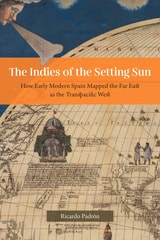
The Indies of the Setting Sun
How Early Modern Spain Mapped the Far East as the Transpacific WestRicardo Padrón
University of Chicago Press, 2020
Padrón reveals the evolution of Spain’s imagining of the New World as a space in continuity with Asia.
Narratives of Europe’s westward expansion often tell of how the Americas came to be known as a distinct landmass, separate from Asia and uniquely positioned as new ground ripe for transatlantic colonialism. But this geographic vision of the Americas was not shared by all Europeans. While some imperialists imagined North and Central America as undiscovered land, the Spanish pushed to define the New World as part of a larger and eminently flexible geography that they called las Indias, and that by right, belonged to the Crown of Castile and León. Las Indias included all of the New World as well as East and Southeast Asia, although Spain’s understanding of the relationship between the two areas changed as the realities of the Pacific Rim came into sharper focus. At first, the Spanish insisted that North and Central America were an extension of the continent of Asia. Eventually, they came to understand East and Southeast Asia as a transpacific extension of their empire in America called las Indias del poniente, or the Indies of the Setting Sun.
The Indies of the Setting Sun charts the Spanish vision of a transpacific imperial expanse, beginning with Balboa’s discovery of the South Sea and ending almost a hundred years later with Spain’s final push for control of the Pacific. Padrón traces a series of attempts—both cartographic and discursive—to map the space from Mexico to Malacca, revealing the geopolitical imaginations at play in the quest for control of the New World and Asia.
[more]
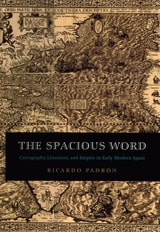
The Spacious Word
Cartography, Literature, and Empire in Early Modern SpainRicardo Padrón
University of Chicago Press, 2004
The Spacious Word explores the history of Iberian expansion into the Americas as seen through maps and cartographic literature, and considers the relationship between early Spanish ideas of the world and the origins of European colonialism. Spanish mapmakers and writers, as Padrón shows, clung to a much older idea of space that was based on the itineraries of travel narratives and medieval navigational techniques.
Padrón contends too that maps and geographic writings heavily influenced the Spanish imperial imagination. During the early modern period, the idea of "America" was still something being invented in the minds of Europeans. Maps of the New World, letters from explorers of indigenous civilizations, and poems dramatizing the conquest of distant lands, then, helped Spain to redefine itself both geographically and imaginatively as an Atlantic and even global empire. In turn, such literature had a profound influence on Spanish ideas of nationhood, most significantly its own.
Elegantly conceived and meticulously researched, The Spacious Word will be of enormous interest to historians of Spain, early modern literature, and cartography.
[more]