Results by title
5 books match the query 'Painting, Chinese'
An Index to Reproductions of Paintings by Twentieth-Century Chinese Artists
Ellen Johnston Laing
University of Michigan Press, 1998
Chinese Paintings in Chinese Publications, 1956–1968
An Annotated Bibliography and Index to the PaintingsEllen Johnston Laing
University of Michigan Press, 1969
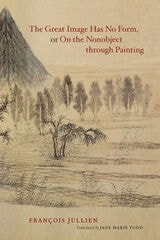
The Great Image Has No Form, or On the Nonobject through Painting
François Jullien
University of Chicago Press, 2009
In premodern China, elite painters used imagery not to mirror the world around them, but to evoke unfathomable experience. Considering their art alongside the philosophical traditions that inform it, The Great Image Has No Form explores the “nonobject”—a notion exemplified by paintings that do not seek to represent observable surroundings.
François Jullien argues that this nonobjectifying approach stems from the painters’ deeply held belief in a continuum of existence, in which art is not distinct from reality. Contrasting this perspective with the Western notion of art as separate from the world it represents, Jullien investigates the theoretical conditions that allow us to apprehend, isolate, and abstract objects. His comparative method lays bare the assumptions of Chinese and European thought, revitalizing the questions of what painting is, where it comes from, and what it does. Provocative and intellectually vigorous, this sweeping inquiry introduces new ways of thinking about the relationship of art to the ideas in which it is rooted.
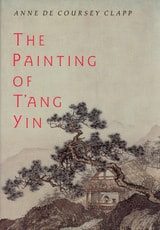
The Painting of T'ang Yin
Anne De Coursey Clapp
University of Chicago Press, 1991
Anne De Coursey Clapp's work also explores larger issues of Ming painting raised by the artist's turbulent career. She describes the social and intellectual values exalted in Ming Suchou, its system of patronage, the contrast between the professional and amateur artist, and the formative influence of twelfth-century Sung dynasty styles on Suchou painters. Clapp shows how T'ang Yin's artistic inventions were made in the course of leading the revival of Sung dynasty styles in Suchou: tracing T'ang Yin's early studies of ancient and contemporary masters, she describes how he reworked an antique style, converting it into a vehicle of expression that reached fruition in a long series of fresh and powerful paintings of landscapes and birds-and-flowers. In the process, she revises the distorted version of middle Ming painting written by later Chinese art theorists to justify their own social and artistic values, noting especially the role of art patrons and their effect on artistic production.
Clapp analyzes the increasing currency of painting as a means of social exchange in ancient China. In particular, she identifies commemorative painting as a major genre of the later dynasties and explores the role it played in the oeuvres of professional masters with its humanistic implications for the Chinese view of the ideal scholarly man. Her broad view of T'ang Yin's career shows him divided between the professional and amateur camps of his time: in landscape and figural subjects he was aligned with the professionals; in flower subjects with the amateurs. Clap argues that the uneven distribution of styles and genres between this master who was subject to the market, and those who were independent of it, suggests that T'ang deliberately tried to expand the range of his paintings in order to appeal to buyers in the lower educational and social strata. Illustrated by some of T'ang Yin's most celebrated paintings and by some which are published for the first time, her work is of tremendous importance to art, literary, and cultural historians of Ming China.
"In this important work, Anne de Coursey Clapp has drawn a clear picture of T'ang Yin's life, patronage relationships, and contribution to the history of Chinese painting. In the person of T'ang Yin, she has chosen an ideal focus around which to examine some of the misleading stereotypes
which have distorted our understanding of Chinese painting since the seventeenth century. Marked by analytical clarity and scrupulous scholarship, her work is a welcome addition to the few works in English on individual Chinese artists."—Louise Yuhas, Occidental College
Two Twelfth-Century Texts on Chinese Painting
Robert J. Maeda, Translator
University of Michigan Press, 1970