Results by title
3 books match the query 'Painting, Italian'
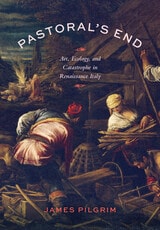
Pastoral’s End
Art, Ecology, and Catastrophe in Renaissance ItalyJames Pilgrim
University of Chicago Press, 2026
How early modern Italian painting addressed the ways humans shape and are shaped by their environments.
In the sixteenth century, Italian artist Jacopo Bassano painted pictures of herdsmen and animals moving through dark and muddy landscapes. But he also participated in the agricultural development of the region in which he lived, producing topographical maps of local mountains and forests, inventing new methods of drainage and irrigation, and studying the latest techniques of crop rotation and fertilization. The relationship between Bassano’s rustic art and his participation in environmental transformation has, however, never been explored.
One of the first studies of Italian Renaissance art to grapple with the connections between visual culture and the environment, Pastoral’s End explores this crucial, formative relationship. James Pilgrim looks at Bassano’s career holistically, demonstrating how his involvement in a world marked by agricultural expansion, industrialization, resource extraction, environmental degradation, social transformation, and radical philosophical development informed his paintings of country life. Introducing new archival and visual evidence of Bassano’s knowledge of hydrology, agronomy, husbandry, and architecture, Pastoral’s End argues that he transformed the more placid rustic imagery of previous Renaissance artists into visions of dangerous ecological instability.
[more]

The Art of the Macchia and the Risorgimento
Representing Culture and Nationalism in Nineteenth-Century ItalyAlbert Boime
University of Chicago Press, 1993
During the 1860s and '70s, more than a decade before the development of French Impressionism, Italy produced a group of avant-garde artists whose fervently nationalist paintings anticipated some of Impressionism's theoretical concerns. These artists were called "Macchiaioli" because they based their technique on a quickly rendered macchia, or sketch.
In the first extended sociopolitical interpretation in English of this important group, Albert Boime places the Macchiaioli in the cultural context of the Risorgimento—the political movement that unified Italy, freed from foreign rule, under a secular, constitutional government. Anglo-American art criticism has generally neglected these painters (probably because of their overt political affiliation and nationalist expression), but Boime shows that these artists, while deeply political, nevertheless created aesthetically superior work.
Boime's study departs from previous research on the Macchiaioli by systematically investigating the group's writings, sources, and patronage in relation to the Risogimento. The book also examines both contemporary and later critical responses, revealing how French art criticism has obscured the achievements of Macchiaioli art. Richly illustrated, The Art of the Macchia and the Risorgimento will appeal to anyone interested in nineteenth-century European art or the history of Italy.
[more]
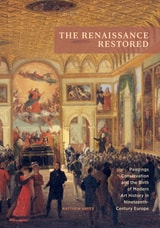
The Renaissance Restored
Paintings Conservation and the Birth of Modern Art History in Nineteenth-Century EuropeMatthew Hayes
J. Paul Getty Trust, The, 2021
This handsomely illustrated volume traces the intersections of art history and paintings restoration in nineteenth-century Europe.
Repairing works of art and writing about them—the practices that became art conservation and art history—share a common ancestry. By the nineteenth century the two fields had become inseparably linked. While the art historical scholarship of this period has been widely studied, its restoration practices have received less scrutiny—until now.
This book charts the intersections between art history and conservation in the treatment of Italian Renaissance paintings in nineteenth-century Europe. Initial chapters discuss the restoration of works by Giotto and Titian, framed by the contemporary scholarship of art historians such as Jacob Burckhardt, G. B. Cavalcaselle, and Joseph Crowe that was redefining the earlier age. Subsequent chapters recount how paintings conservation was integrated into museum settings. The narrative uses period texts, unpublished archival materials, and historical photographs in probing how paintings looked at a time when scholars were writing the foundational texts of art history, and how contemporary restorers were negotiating the appearances of these works. The book proposes a model for a new conservation history, object focused yet enriched by consideration of a wider cultural horizon.
[more]