Results by title
7 books match the query 'Paleoanthropology'

After Eden
The Evolution of Human DominationKirkpatrick Sale
Duke University Press, 2006
In After Eden, Kirkpatrick Sale answers these questions in a radically new way. Integrating research in paleontology, archaeology, and anthropology, he points to the beginning of big-game hunting as the origin of Homo sapiens’ estrangement from the natural world. Sale contends that a new, recognizably modern human culture based on the hunting of large animals developed in Africa some 70,000 years ago in response to a fierce plunge in worldwide temperature triggered by an enormous volcanic explosion in Asia. Tracing the migration of populations and the development of hunting thousands of years forward in time, he shows that hunting became increasingly adversarial in relation to the environment as people fought over scarce prey during Europe’s glacial period between 35,000 and 10,000 years ago. By the end of that era, humans’ idea that they were the superior species on the planet, free to exploit other species toward their own ends, was well established.
After Eden is a sobering tale, but not one without hope. Sale asserts that Homo erectus, the variation of the hominid species that preceded Homo sapiens and survived for nearly two million years, did not attempt to dominate the environment. He contends that vestiges of this more ecologically sound way of life exist today—in some tribal societies, in the central teachings of Hinduism and Buddhism, and in the core principles of the worldwide environmental movement—offering redemptive possibilities for ourselves and for the planet.
Anthropology without Informants
Collected Works in Paleoanthropology by L.G. FreemanL. G. Freeman
University Press of Colorado, 2009
A socio-cultural anthropologist who became a behavioral paleoanthropologist late in his career, Freeman took a unique approach, employing statistical or mathematical techniques in his analysis of archaeological data. All the papers in this collection blend theoretical statements with the archeological facts they are intended to help the reader understand.
Although he taught at the University of Chicago for the span of his 40-year career, Freeman is not well-known among Anglophone scholars, because his primary fieldwork and publishing occurred in Cantabrian, Spain. However, he has been a major player in Paleolithic prehistory, and this volume will introduce his work to more American Archaeologists.
This collection brings the work of an expert scholar, to a broad audience, and will be of interest to archaeologists, their students, and lay readers interested in the Paleolithic era.
Frontiers in Colorado Paleoindian Archaeology
From the Dent Site to the Rocky MountainsRobert H. Brunswig
University Press of Colorado, 2007
The editors introduce the research with scientific context. A review of seventy-five years of Paleoindian archaeology in Colorado highlights the foundation on which new work builds, and a survey of Colorado's ancient climates and ecologies helps readers understand Paleoindian settlement patterns.
Eight essays discuss archaeological evidence from Plains to high Rocky Mountain sites. The book offers the most thorough analysis to date of Dent--the first Clovis site discovered. Essays on mountain sites show how advances in methodology and technology have allowed scholars to reconstruct settlement patterns and changing lifeways in this challenging environment.
Colorado has been home to key moments in human settlement and in the scientific study of our ancient past. Readers interested in the peopling of the New World as well as those passionate about the methods and history of archaeology will find new material and satisfying overviews in this book. Contributors include Rosa Maria Albert, Robert H. Brunswig, Reid A. Bryson, Linda Scott Cummings, James Doerner, Daniel C. Fisher, David L. Fox, Bonnie L. Pitblado, Jeffrey L. Saunders, Todd A. Surovell, R. A. Varney, and Nicole M. Waguespack.
God-Apes and Fossil Men
Paleoanthropology of South AsiaKenneth A. R. Kennedy
University of Michigan Press, 2000
Stones, Bones, and Profiles
Exploring Archaeological Context, Early American Hunter-Gatherers, and BisonMarcel Kornfeld
University Press of Colorado, 2016
Stones, Bones, and Profiles addresses key and cutting-edge research of three pillars of hunter-gatherer archaeology. Stones and bones—flaked stone tools and the bones of the prey animals—are the objects most commonly recovered from hunter-gatherer archaeological sites, and profiles represent the geologic context of the archeological record. Together they constitute the foundations of much of early archaeology, from the appearance of the earliest humans to the advent of the Neolithic.
The volume is divided into three sections: Peopling of North America and Paleoindians, Geoarchaeology, and Bison Bone Bed Studies. The first section dissects established theories about the Paleoindians, including the possibility that human populations were in North America before Clovis and the timing of the opening of the Alberta Corridor. The second section provides new perspectives on the age and contexts of several well-known New World localities such as the Lindenmeier Folsom and the UP Mammoth sites, as well as a synthesis of the geoarchaeology of the Rocky Mountains' Bighorn region that addresses significant new data and summarizes decades of investigation. The final section, Bison Bone Bed Studies, consists of groundbreaking zooarchaeological studies offering new perspectives on bison taxonomy and procurement.
Stones, Bones, and Profiles presents new data on Paleoindian archaeology and reconsiders previous sites and perspectives, culminating in a thought-provoking and challenging contribution to the ongoing study of Paleoindians around the world.
Contributors: Leland Bement, Jack W. Brink, John Carpenter, Brian Carter, Thomas J. Connolly, Linda Scott Cummings, Loren G. Davis, Allen Denoyer, Stuart J. Fiedel, Judson Byrd Finley, Andrea Freeman, C. Vance Haynes Jr., Bryan Hockett, Vance T. Holliday, Dennis L. Jenkins, Thomas A. Jennings, Eileen Johnson, George T. Jones, Oleksandra Krotova, Patrick J. Lewis, Vitaliy Logvynenko, Ian Luthe, Katelyn McDonough, Lance McNees, Fred L. Nials, Patrick W. O’Grady, Mary M. Prasciunas, Karl J. Reinhard, Michael Rondeau, Guadalupe Sanchez, William E. Scoggin, Ashley M. Smallwood, Iryna Snizhko, Thomas W. Stafford Jr., Mark E. Swisher, Frances White, Eske Willerslev, Robert M. Yohe II, Chad Yost
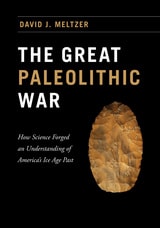
The Great Paleolithic War
How Science Forged an Understanding of America's Ice Age PastDavid J. Meltzer
University of Chicago Press, 2015
In The Great Paleolithic War, David J. Meltzer tells the story of a scientific quest that set off one of the longest-running feuds in the history of American anthropology, one so vicious at times that anthropologists were deliberately frightened away from investigating potential sites. Through his book, we come to understand how and why this controversy developed and stubbornly persisted for as long as it did; and how, in the process, it revolutionized American archaeology.
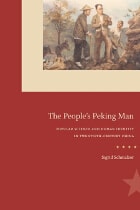
The People's Peking Man
Popular Science and Human Identity in Twentieth-Century ChinaSigrid Schmalzer
University of Chicago Press, 2008
The People’s Peking Man is a skilled social history of twentieth-century Chinese paleoanthropology and a compelling cultural—and at times comparative—history of assumptions and debates about what it means to be human. By focusing on issues that push against the boundaries of science and politics, The People’s Peking Man offers an innovative approach to modern Chinese history and the history of science.