Results by title
2 books match the query 'Palermo, Lynn E.'

Farewell Tangier
Salma El Moumni
Seagull Books, 2026
For Alia, being a teenager in Tangier means constantly facing a gauntlet of unwanted encounters by men in the streets who look her over, grab her, or make comments about her body. At night, in the privacy of her bedroom, Alia begins to take photos of her body in order to understand what those men see when they look at her, becoming her own voyeur. When Alia’s photos somehow end up on the internet, she decides to flee the country, as the photos violate Moroccan law. She seeks refuge in Lyon, France, but is unable to escape the past.
Farewell Tangier is a searing exploration of the male gaze and its potential to shatter a young woman’s life, exploring themes of desire, dissociation, and exile. It is both a feminist critique of the policing of female bodies and an affecting narrative of one young woman’s struggle with her identity.
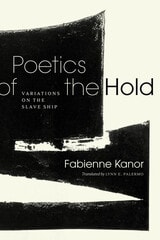
Poetics of the Hold
Variations on the Slave ShipFabienne Kanor
University of Chicago Press, 0
An essential reflection on the haunting legacy of the transatlantic slave trade from award-winning French filmmaker and writer Fabienne Kanor.
A century and a half after the passage of the last known slave ship, the hold—in which captives were imprisoned together under inhuman conditions—still haunts collective memory, particularly that of Afro-descendant artists, thinkers, and writers. With The Poetics of the Hold, scholar, writer, and filmmaker Fabienne Kanor offers a series of meditations on the transatlantic slave trade and on how the experience of the Middle Passage has been represented in modern culture of the United States, Francophone Africa, and the French West Indies.
In this important book, Kanor draws from a multitude of sources—history, literature, art, philosophy, the Négritude tradition, and Caribbean thinkers—to take readers on a journey from colonial archives to public spaces, museums, and other places of commemoration. Throughout, the image of the hold serves as a spectral monument, the traumatic reverberations of which can be felt in both the texts Kanor examines and in her own writing. While archives, logbooks, and sea reports provide information about slave ships, the stories of the slaves themselves too often remain shrouded in silence. This powerful and poetic book seeks to rectify that amnesia and to wrestle with these neglected histories and their afterlives.