Results by title
8 books match the query 'Paley, Vivian Gussin'
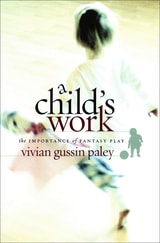
A Child's Work
The Importance of Fantasy PlayVivian Gussin Paley
University of Chicago Press, 2004
A Child's Work goes inside classrooms around the globe to explore the stunningly original language of children in their role-playing and storytelling. Drawing from their own words, Paley examines how this natural mode of learning allows children to construct meaning in their worlds, meaning that carries through into their adult lives. Proof that play is the work of children, this compelling and enchanting book will inspire and instruct teachers and parents as well as point to a fundamental misdirection in today's educational programs and strategies.
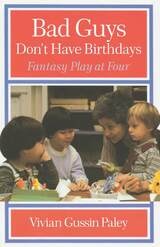
Bad Guys Don't Have Birthdays
Fantasy Play at FourVivian Gussin Paley
University of Chicago Press, 1991
Their play is filled with warnings. They invent chaos in order to show that everything is under control. They portray fear to prove that it can be conquered. No theme is too large or too small for their intense scrutiny. Fantasy play is their ever dependable pathway to knowledge and certainty.
" It . . . takes a special teacher to value the young child's communications sufficiently, enter into a meaningful dialogue with the youngster, and thereby stimulate more productivity without overwhelming the child with her own ideas. Vivian Paley is such a teacher."—Maria W. Piers, in the American Journal of Education
"[Mrs. Paley's books] should be required reading wherever children are growing. Mrs. Paley does not presume to understand preschool children, or to theorize. Her strength lies equally in knowing that she does not know and in trying to learn. When she cannot help children—because she can neither anticipate nor follow their thinking—she strives not to hinder them. She avoids the arrogance of adult to small child; of teacher to student; or writer to reader."—Penelope Leach, author of Your Baby & Child in the New York Times Book Review
"[Paley's] stories and interpretation argue for a new type of early childhood education . . . a form of teaching that builds upon the considerable knowledge children already have and grapple with daily in fantasy play."—Alex Raskin, Los Angeles Times Book Review
"Through the 'intuitive language' of fantasy play, Paley believes, children express their deepest concerns. They act out different roles and invent imaginative scenarios to better understand the real world. Fantasy play helps them cope with uncomfortable feelings. . . . In fantasy, any device may be used to draw safe boundaries."—Ruth J. Moss, Psychology Today
Boys and Girls
Superheroes in the Doll CornerVivian Gussin Paley
University of Chicago Press, 1984
"I will admit my biases up front: having a three-year old daughter of my own made it impossible for this book to be anything but fun to read. I dare anyone who enjoys children not to enjoy this story about stories, this narrative about narratives."—Jerry Powell, Winterthur Portfolio
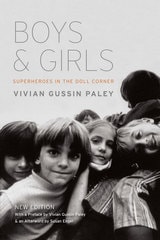
Boys and Girls
Superheroes in the Doll CornerVivian Gussin Paley
University of Chicago Press, 2014
For more than forty years, Boys and Girls has a classic account of the little-known world that young children create together when they play. Vivian Gussin Paley takes readers inside a kindergarten classroom to show them in detail how boys and girls play—and how, by playing and fantasizing in different ways, they work through complicated notions of gender roles and identity. The children’s own conversations, stories, playacting, and scuffles are interwoven with Paley’s observations and accounts of her vain attempts to alter their stereotyped play. In the decades since the book's original publication, play in kindergarten and early years of school has lost ground to structured teaching and even testing, which makes Paley's book, updated for a new era, more important than ever. To teach kids successfully, we must make space for play.
Mollie Is Three
Growing Up in SchoolVivian Gussin Paley
University of Chicago Press, 1986
Mollie Is Three describes a year in the life of a little girl and her preschool classmates in a nursery school classroom run by Vivian Gussin Paley, whose groundbreaking ideas about the best way to teach young children continue to be influential today. We first encounter Mollie on the first day of school, just before her third birthday, and we follow her and her classmates for the next year. Alongside her, we go from confusion and uncertainty in new surroundings to growing understanding and confidence, as patterns emerge and Mollie begins to grasp their significance--and her teacher begins to understand how to track her growth and development.
Rather than offer an account of an idealized, all but imaginary child, Paley presents us with one actual kid, in all their complexity and confusion. The result is a landmark contribution to our understanding of child development and the role early education can play in fostering it.
The Boy on the Beach
Building Community through PlayVivian Gussin Paley
University of Chicago Press, 2010
Four-year-old Eli plays alone at the shore, inventing dramas out of sand and water. He is Builder, Fireman, Protector, and Scout, overcoming waves and conquering monsters. Enter Marianne and doll, Mother and Baby, eager to redefine Eli as a good father and homesteader. Their separate visions intertwine in a search for a common ground on which howling wolves and butterfly sisters can learn to understand and need one another.
What can the richly imagined, impressively adaptable fantasy world of these children tell us about childhood, development, education, and even life itself? For fifty years, teacher and writer Vivian Gussin Paley has been exploring the imagery, language, and lore of young children, asking the questions they ask of themselves.
In The Boy on the Beach she continues to do so, going deeper into the mystery of play as she follows Eli and Marianne through the kindergarten year, finding more answers and more questions. How does their teacher, Mrs. Olson, manage to honor and utilize the genius of play to create an all-inclusive community in which boys and girls like each other and listen to each other’s stories? Why is Paley’s fellow teacher Yu-ching in Taiwan certain that her children pretend to be kittens in order to become necessary to the group? And why do teachers in London see their childrens’ role-playing as the natural end to loneliness in the school community?
Rich with the words of children and teachers themselves, The Boy on the Beach is vintage Paley, a wise and provocative appreciation of the importance of play and enduring curiosity about the nature of childhood and the imagination.
The Classrooms All Young Children Need
Lessons in Teaching from Vivian PaleyPatricia M. Cooper
University of Chicago Press, 2009
Teacher and author Vivian Paley is highly regarded by parents, educators, and other professionals for her original insights into such seemingly everyday issues as play, story, gender, and how young children think. In The Classrooms All Young Children Need, Patricia M. Cooper takes a synoptic view of Paley’s many books and articles, charting the evolution of Paley’s thinking while revealing the seminal characteristics of her teaching philosophy. This careful analysis leads Cooper to identify a pedagogical model organized around two complementary principles: a curriculum that promotes play and imagination, and the idea of classrooms as fair places where young children of every color, ability, and disposition are welcome.
With timely attention paid to debates about the reduction in time for play in the early childhood classroom, the role of race in education, and No Child Left Behind, The Classrooms All Young Children Need will be embraced by anyone tasked with teaching our youngest pupils.
The High-Performing Preschool
Story Acting in Head Start ClassroomsGillian Dowley McNamee
University of Chicago Press, 2015
McNamee outlines how story acting cultivates children’s oral and written language skills. She shows how it creates a crucial opportunity for teachers to guide children inside the interior logic and premises of an idea, and how it fosters the creation of a literary community. Starting with Vygotsky and Paley, McNamee paints a detailed portrait of high-quality preschool teaching, showing how educators can deliver on the promise of Head Start and provide a setting for all young children to become articulate, thoughtful, and literate learners.