Results by title

10 books match the query 'Pan-Africanism'
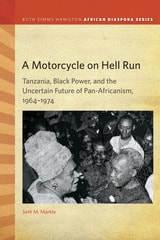
cover of A Motorcycle on Hell Run: Tanzania, Black Power, and the Uncertain Future of Pan-Africanism, 1964–1974

A Motorcycle on Hell Run

Tanzania, Black Power, and the Uncertain Future of Pan-Africanism, 1964–1974

Seth M. Markle

Michigan State University Press, 2017

Between 1964 and 1974 Tanzania came to be regarded as a model nation and a leading frontline state in the struggle for African liberation on the continent and beyond. During this time, a number of African American and Caribbean nationalists, leftists, and pan-Africanists traveled to and settled in Tanzania to join the country that many believed to be leading Africa’s liberation struggle. This historical study examines the political landscape of that crucial moment when African American, Caribbean, and Tanzanian histories overlapped, shedding light on the challenges of creating a new nation and the nature of African American and Caribbean participation in Tanzania’s nationalist project. In examining the pragmatic partnerships and exchanges between socialist Tanzania and activists and organizations associated with the Black Power movements in the United States and the Caribbean, this study argues that the Tanzanian one-party government actively engaged with the diaspora and sought to utilize its political, cultural, labor, and intellectual capital to further its national building agenda, but on its own terms, creating tension within the pan-Africanism movement. An excellent resource for academics and nonacademics alike, this work is the first of its kind, revealing the significance of the radical political and social movements of Tanzania and what it means for us today.
[more]
cover of Black Sporting Resistance: Diaspora, Transnationalism, and Internationalism

Black Sporting Resistance

Diaspora, Transnationalism, and Internationalism

Joseph N. Cooper

Rutgers University Press, 2025
In recent years, there has been increased attention towards activism in sporting spaces. A vast majority of these contributions have focused on intra-nation tensions and impact. Yet, there is a dearth of scholarship that has engaged in a theoretically grounded analysis of how Black sportspersons have exhibited resistance in and through sport across national borders across time, space, and context. In this text, Joseph N. Cooper introduces the Black Sporting Resistance Framework (BSRF) as an analytic lens to examine how resistance actions in and through sport have contributed to the advancement of local and global racial justice efforts. Key concepts such as African (Black) diaspora, transnationalism, internationalism, sporting resistance typology, and sport activism typology are incorporated throughout the book. Black sporting resistance is also analyzed alongside broader social movements such as the Black Liberation Struggle, Black Nationalism, Pan-Africanism, and Black Radicalism. Insights on the ways in which sport can be used to advance social justice in the future are presented.
[more]
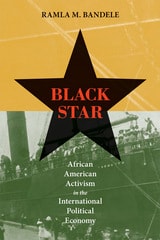
cover of Black Star: African American Activism in the International Political Economy

Black Star

African American Activism in the International Political Economy

Ramla M. Bandele

University of Illinois Press, 2007

This book describes how the first African American mass political organization was able to gain support from throughout the African diaspora to finance the Black Star Line, a black merchant marine that would form the basis of an enclave economy after World War I. Ramla M. Bandele explores the concept of diaspora itself and how it has been applied to the study of émigré and other ethnic networks.

In characterizing the historical and political context of the Black Star Line, Bandele analyzes the international political economy during 1919-25 and considers the black politics of the era, focusing particularly on Marcus Garvey's Universal Negro Improvement Association for its creation of the Black Star Line. She offers an in-depth case study of the Black Star Line as an instance of the African diaspora attempting to link communities and carry out a transnational political and economic project. Arguing that ethnic networks can be legitimate actors in international politics and economics, Bandele also suggests, however, that activists in any given diaspora do not always function as a unit.
[more]
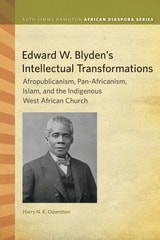
cover of Edward W. Blyden's Intellectual Transformations: Afropublicanism, Pan-Africanism, Islam, and the Indigenous West African Church

Edward W. Blyden's Intellectual Transformations

Afropublicanism, Pan-Africanism, Islam, and the Indigenous West African Church

Harry N. K. Odamtten

Michigan State University Press, 2019
Distinguished by its multidisciplinary dexterity, this book is a masterfully woven reinterpretation of the life, travels, and scholarship of Edward W. Blyden, arguably the most influential Black intellectual of the nineteenth and early twentieth centuries. It traces Blyden’s various moments of intellectual transformation through the multiple lenses of ethnicity, race, religion, and identity in the historical context of Atlantic exchanges, the Back-to-Africa movement, colonialism, and the global Black intellectual movement. In this book Blyden is shown as an African public intellectual who sought to reshape ideas about Africa circulating in the Atlantic world. The author also highlights Blyden’s contributions to different public spheres in Europe, in the Jewish Diaspora, in the Muslim and Christian world of West Africa, and among Blacks in the United States. Additionally, this book places Blyden at the pinnacle of Afropublicanism in order to emphasize his public intellectualism, his rootedness in the African historical experience, and the scholarship he produced about Africa and the African Diaspora. As Blyden is an important contributor to African studies, among other disciplines, this volume makes for critical scholarly reading.
[more]
cover of Emancipation without Equality: Pan-African Activism and the Global Color Line

Emancipation without Equality

Pan-African Activism and the Global Color Line

Thomas E. Smith

University of Massachusetts Press, 2018

At the Pan–African Conference in London in 1900, W. E. B. Du Bois famously prophesied that the problem of the twentieth century would be the global color line, the elevation of “whiteness” that created a racially divided world. While Pan-Africanism recognized the global nature of the color line in this period, Thomas E. Smith argues that it also pushed against it, advocating for what Du Bois called "opportunities and privileges of modern civilization" to open up to people of all colors.

Covering a period roughly bookended by two international forums, the 1884–1885 Berlin Conference and the 1911 Universal Races Congress, Emancipation without Equality chronicles how activists of African descent fought globally for equal treatment and access to rights associated with post-emancipated citizenship. While Euro-American leaders created a standard to guide the course of imperialism at the Berlin Conference, the proceedings of the Universal Races Congress demonstrated that Pan-Africanism had become a visible part of a growing, global, anti-imperialist protest.
[more]
cover of Kwame Nkrumah: The Father of African Nationalism

Kwame Nkrumah

The Father of African Nationalism

Jeffrey S. Ahlman

Ohio University Press, 1998
The first African statesman to achieve world recognition was Kwame Nkrumah (1909-1972), who became president of the new Republic of Ghana in 1960. He campaigned ceaselessly for African solidarity and for the liberation of southern Africa from white settler rule. His greatest achievement was to win the right of black peoples in Africa to have a vote and to determine their own destiny. He turned a dream of liberation into a political reality. He was the leader of Ghana who urged Africa to shed the colonial yoke and who inspired black people everywhere to seek their freedom. This revised edition of Birmingham’s fine and accessible biography chronicles the public accomplishments of this extraordinary leader, who faced some of the century’s most challenging political struggles over colonial transition. African nationalism, and pan-Africanism. It also relates some of the personal trials of a complex individual. As a student in America in the late 1930s, Nkrumah, shy, disorganized, but ambitious and persistent, earned four degrees in ten years. For political training he then went to England. Nkrumah found writing difficult throughout his lifetime, but once back in his African homeland, with its oral heritage, Nkrumah blossomed as a charming conversationalist, a speechmaker, and eventually a visionary and inspiring leader. Nkrumah’s crusades were controversial, however, and in the 1960s he gradually lost his heroic stature both among his own people and among his fellow leaders. He lived his last years in exile. This remarkable life story, which touches on many of the issues facing modern Africa, will open a window of understanding for the general leader as well as for graduate and undergraduate classes. In this new edition, Birmingham also examines Nkrumah’s exile and provides insight into the image of Nkrumah that has emerged in the light of research recently published.
[more]
cover of Kwame Nkrumah: Visions of Liberation

Kwame Nkrumah

Visions of Liberation

Jeffrey S. Ahlman

Ohio University Press, 2021
A new biography of Ghana’s Kwame Nkrumah, one of the most influential political figures in twentieth-century African history. As the first prime minister and president ofthe West African state of Ghana, Kwame Nkrumah helped shape the global narrative of African decolonization. After leading Ghana to independence in 1957, Nkrumah articulated a political vision that aimed to free the country and the continent—politically, socially, economically, and culturally—from the vestiges of European colonial rule, laying the groundwork for a future in which Africans had a voice as equals on the international stage. Nkrumah spent his childhood in the maturing Gold Coast colonial state. During the interwar and wartime periods he was studying in the United States. He emerged in the postwar era as one of the foremost activists behind the 1945 Manchester Pan-African Congress and the demand for an immediate end to colonial rule. Jeffrey Ahlman’s biography plots Nkrumah’s life across several intersecting networks: colonial, postcolonial, diasporic, national, Cold War, and pan-African. In these contexts, Ahlman portrays Nkrumah not only as an influential political leader and thinker but also as a charismatic, dynamic, and complicated individual seeking to make sense of a world in transition.
[more]
cover of Living with Nkrumahism: Nation, State, and Pan-Africanism in Ghana

Living with Nkrumahism

Nation, State, and Pan-Africanism in Ghana

Jeffrey S. Ahlman

Ohio University Press, 2017

In the 1950s, Ghana, under the leadership of Kwame Nkrumah and the Convention People’s Party, drew the world’s attention as anticolonial activists, intellectuals, and politicians looked to it as a model for Africa’s postcolonial future. Nkrumah was a visionary, a statesman, and one of the key makers of contemporary Africa. In Living with Nkrumahism, Jeffrey S. Ahlman reexamines the infrastructure that organized and consolidated Nkrumah’s philosophy into a political program. Ahlman draws on newly available source material to portray an organizational and cultural history of Nkrumahism. Taking us inside bureaucracies, offices, salary structures, and working routines, he painstakingly reconstructs the political and social milieu of the time and portrays a range of Ghanaians’ relationships to their country’s unique position in the decolonization process. Through fine attunement to the nuances of statecraft, he demonstrates how political and philosophical ideas shape lived experience. Living with Nkrumahism stands at the crossroads of the rapidly growing fields of African decolonization, postcolonial history, and Cold War studies. It provides a much-needed scholarly model through which to reflect on the changing nature of citizenship and political and social participation in Africa and the broader postcolonial world.
[more]
cover of Pan-African Resonance: Music, Migration, and Everyday Practice in London and Accra

Pan-African Resonance

Music, Migration, and Everyday Practice in London and Accra

Alison Okuda

Ohio University Press, 2026

As African and Caribbean nations gained independence from Britain in the 1950s and 1960s, many young musicians, students, and professionals crossed the Atlantic in search of new opportunities and built vibrant communities. Pan-African Resonance: Music, Migration, and Everyday Practice in London and Accra traces these journeys from Ghana, Trinidad and Tobago, Jamaica, Saint Lucia, Barbados, and Guyana, exploring how migrants practiced pan-Africanism through music across continents and generations. Drawing on musical recordings, newspapers, oral histories, and government documents from six countries, Alison Okuda demonstrates that pan-African solidarity thrived through the everyday creation and enjoyment of popular music. The book unfolds in two parts. Starting in the 1950s, it examines how Ghanaian highlife and Trinidadian calypso brought together musicians and young members of the independence generation, first in London and later in Accra. Even amid cultural tensions, Ghanaian and Caribbean communities expressed aspirations for freedom and unity in nightclubs, recording studios, private homes, and public streets. Before Ghana’s 1966 coup d’état, Ghanaians and diasporic Africans collaborated to shape an independent African-Atlantic world. Although the coup disrupted formal Pan-Africanist organizing, in the second part of the book Okuda shows that in the 1970s a new generation sustained dynamic networks of solidarity through highlife, reggae, and other popular styles—heard in recordings, radio broadcasts, live performances, and community events. Influenced by generational change and musical fluidity, African diasporic unity has remained central to popular music, migration, and politics in Ghana and the wider African-Atlantic world into the twenty-first century. Offering a rich interdisciplinary approach, Pan-African Resonance will appeal to readers interested in popular culture, transnational history, diaspora studies, and modern African history.
[more]
cover of The African Union's Africa: New Pan-African Initiatives in Global Governance

The African Union's Africa

New Pan-African Initiatives in Global Governance

Rita Kiki Edozie

Michigan State University Press, 2014

The African Union’s Africa: New Pan-African Initiatives in Global Governance examines the initiatives of the Pan-African global governance institution the African Union (AU) as the organization and its precursor commemorate their Jubilee as international actors. Taking a unique approach, the book seeks to explain the AU through a theoretical framework referred to as “the African Union phenomenon,” capturing the international organization’s efforts to transform the national politics of Africa as well as to globalize the practice of African politics. The authors examine Africa’s self-determined international norms and values such as Pan-Africanism, African Solutions to African Problems, Hybrid Democracy, Pax Africana, and the African Economic Community to demonstrate that Africa—the world’s least developed region—is composed of crucial values, institutions, agents, actors, and forces that are, through the AU, contributing to the advancement of contemporary global development. The book reveals how in the areas of cultural identity, democracy, security, and economic development Africans are infusing new politics, economics, and cultures into globalization representing the collective will and imprint of African agency, decisions, ideas, identities, practices, and contexts. Via a Pan-African vision, the AU is having both regional and global impact, generating exciting possibilities and complicated challenges.
[more]