Results by title
6 books match the query 'Pandemics'
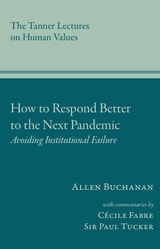
How to Respond Better to the Next Pandemic
Remedying Institutional FailuresAllen Buchanan, with contributions by Cécile Fabre and Sir Paul Tucker
University of Utah Press, 2024
There is no shortage of criticisms of U.S. COVID-19 policy. This book argues that officials at the highest levels lied to the public or deliberately suppressed relevant information, shamelessly over-sold the efficacy of masks and vaccines, and enacted lock-down policies of unproven value that caused massive economic, educational, and psycho-social damage.
In How to Respond Better to the Next Pandemic Allen Buchanan argues that, contrary to widespread opinion, the primary cause of flawed COVID-19 policy was not defective leadership, but rather institutional failure. Decisions were made through processes that lacked the most basic safeguards against the large-institution “yes-man” and group-think phenomena and included virtually no provisions for holding decision makers accountable. More fundamentally, policy makers did not fulfill the crucial duty to provide plausible public justifications for their decisions. They disguised the fact that scientific opinion was divided on the appropriateness of the policies they endorsed and labeled those who disagreed with them as anti-scientific. In some cases, they responded to criticism, not by engaging it on the issues, but by branding their critics as quacks.
In How to Respond Better to the Next Pandemic Allen Buchanan argues that, contrary to widespread opinion, the primary cause of flawed COVID-19 policy was not defective leadership, but rather institutional failure. Decisions were made through processes that lacked the most basic safeguards against the large-institution “yes-man” and group-think phenomena and included virtually no provisions for holding decision makers accountable. More fundamentally, policy makers did not fulfill the crucial duty to provide plausible public justifications for their decisions. They disguised the fact that scientific opinion was divided on the appropriateness of the policies they endorsed and labeled those who disagreed with them as anti-scientific. In some cases, they responded to criticism, not by engaging it on the issues, but by branding their critics as quacks.
[more]

Public Catastrophes, Private Losses
Sarah Tobias
Rutgers University Press, 2025
From COVID to climate-change-induced wildfires and hurricanes, we live in an era when catastrophes have become the new normal. But even though these events affect us all, some members of society are more vulnerable to harm than others.
This essay collection explores how the definition of catastrophe might be expanded to include many forms of large-scale structural violence on communities, species, and ecosystems. Using feminist methodologies, the contributors to Public Catastrophes, Private Losses trace the connections between seemingly unrelated forms of violence such as structural racism, environmental degradation, and public health crises. In contrast to a news media that focuses on mass fatalities and immediate consequences, these essays call our attention to how catastrophes can also involve slow violence with long-term effects.
The authors also consider how these catastrophes are profoundly shaped by government action or inaction, offering a powerful critique of how government neglect has cost lives and demonstrating how vulnerable populations can be better protected. The essays in this collection examine how public catastrophes imprint themselves on lives, as individuals and communities narrate, process, and grapple with legacies of loss. The book is thus a feminist intervention that challenges the binary between public and private, personal and political.
[more]
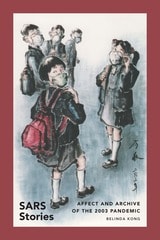
SARS Stories
Affect and Archive of the 2003 PandemicBelinda Kong
Duke University Press, 2024
In SARS Stories, Belinda Kong delves into the cultural archive of the 2003 SARS pandemic, examining Chinese-language creative works and social practices at the epicenters of the outbreak in China and Hong Kong. As the COVID-19 pandemic has highlighted issues of anti-Asian racism and sinophobia, Kong traces how Chinese people navigated the SARS pandemic and created meaning amid crisis through cultures of epidemic expression. From sentimental romances and Cantopop songs to raunchy sex comedies and crowdsourced ghost tales, unexpected and minor genres and creators of Chinese popular culture highlight the resilience and humanity of those living through the pandemic. Rather than narrating pandemic life in terms of crisis and catastrophe, Kong argues that these works highlight Chinese practices of community, care, and love amid disease. She also highlights the persistence of orientalism in anglophone accounts of SARS index patients and global reporting on COVID-era China. Kong shows how the Chinese experiences of living with SARS can reshape global feelings toward pandemic social life and foster greater fellowship in the face of pandemics.
[more]
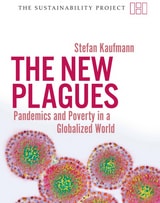
The New Plagues
Pandemics and Poverty in a Globalized WorldStefan Kaufmann
Haus Publishing, 2009
The threat from infectious diseases has increased with globalization. Throughout the history of mankind, epidemics have eradicated whole regions, started the migration of peoples and decided wars. They continue to leave their mark on societies, as well as influencing politics and economies. The New Plagues: Pandemics and Poverty in a Globalized World explores the strategies of microbes in conjunction with the economic impact of epidemics. In particular, it looks at the conflict between rich and poor with regard to outbreaks, and introduces possible strategies for containment.
[more]
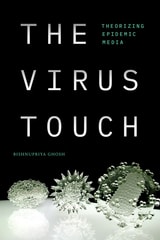
The Virus Touch
Theorizing Epidemic MediaBishnupriya Ghosh
Duke University Press, 2023
In The Virus Touch Bishnupriya Ghosh argues that media are central to understanding emergent relations between viruses, humans, and nonhuman life. Writing in the shadow of the HIV/AIDS and COVID-19 global pandemics, Ghosh theorizes “epidemic media” to show how epidemics are mediated in images, numbers, and movements through the processes of reading test results and tracking infection and mortality rates. Scientific, artistic, and activist epidemic media that make multispecies relations sensible and manageable eschew anthropocentric survival strategies and instead recast global public health crises as biological, social, and ecological catastrophes, pushing us toward a multispecies politics of health. Ghosh trains her analytic gaze on these mediations as expressed in the collection and analysis of blood samples as a form of viral media; the geospatialization of data that track viral hosts like wild primates; and the use of multisensory images to trace fluctuations in viral mutations. Studying how epidemic media inscribe, store, and transmit multispecies relations attunes us to the anthropogenic drivers of pathogenicity like deforestation or illegal wildlife trading and the vulnerabilities accruing from diseases that arise from socioeconomic inequities and biopolitical neglect.
[more]
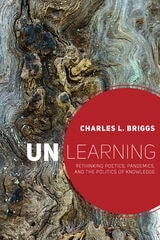
Unlearning
Rethinking Poetics, Pandemics, and the Politics of KnowledgeCharles L. Briggs
Utah State University Press, 2021
A provocative theoretical synthesis by renowned folklorist and anthropologist Charles L. Briggs, Unlearning questions intellectual foundations and charts new paths forward. Briggs argues, through an expansive look back at his own influential works as well as critical readings of the field, that scholars can disrupt existing social and discourse theories across disciplines when they collaborate with theorists whose insights are not constrained by the bounds of scholarship.
Eschewing narrow Eurocentric modes of explanation and research foci, Briggs brings together colonialism, health, media, and psychoanalysis to rethink classic work on poetics and performance that revolutionized linguistic anthropology, folkloristics, media studies, communication, and other fields. Beginning with a candid memoir that credits the mentors whose disconcerting insights prompted him to upend existing scholarly approaches, Briggs combines his childhood experiences in New Mexico with his work in graduate school, his ethnography in Venezuela working with Indigenous peoples, and his contemporary work—which is heavily weighted in medical folklore.
Unlearning offers students, emerging scholars, and veteran researchers alike a guide for turning ethnographic objects into provocations for transforming time-worn theories and objects of analysis into sources of scholarly creativity, deep personal engagement, and efforts to confront unconscionable racial inequities. It will be of significant interest to folklorists, anthropologists, and social theorists and will stimulate conversations across these disciplines.
[more]