Results by title

3 books match the query 'Pantheism'
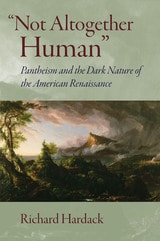
cover of "Not Altogether Human": Pantheism and the Dark Nature of the American Renaissance

"Not Altogether Human"

Pantheism and the Dark Nature of the American Renaissance

Richard Hardack

University of Massachusetts Press, 2012

Many leading American thinkers in the nineteenth century, who accepted the premises of Emersonian transcendentalism, valued the basic concept of pantheism: that God inheres in nature and in all things, and that a person could achieve a sense of belonging she or he lacked in society by seeking a oneness with all of nature. As Richard Hardack shows, however, writers such as Ralph Waldo Emerson, Nathaniel Hawthorne, and Herman Melville conceived of nature as everything “Other”—other than the white male Protestant culture of which they were a part. This conception of nature, then, became racialized, and the divine became associated with African American and Native American identities, as well as with femininity.

In "Not Altogether Human," Hardack reevaluates transcendentalism in the context of nineteenth-century concerns about individual and national racial identity. Elucidating the influence of pantheism, Hardack draws on an array of canonical and unfamiliar materials to remap the boundaries of what has long been viewed as white male transcendental discourse.

This book significantly revises notions of what transcendentalism and pantheism mean and how they relate to each other. Hardack's close analysis of pantheism and its influence on major works and lesser known writing of the nineteenth century opens up a new perspective on American culture during this key moment in the country's history.
[more]
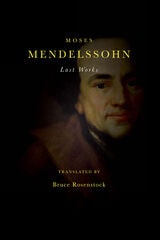
cover of Last Works

Last Works

Moses Mendelssohn. Translated by Bruce Rosenstock

University of Illinois Press, 2012

Moses Mendelssohn (1729–1786) was the central figure in the emancipation of European Jewry. His intellect, judgment, and tact won the admiration and friendship of contemporaries as illustrious as Johann Gottfried Herder, Gotthold Ephraim Lessing, and Immanuel Kant. His enormously influential Jerusalem (1783) made the case for religious tolerance, a cause he worked for all his life.
 
Last Works includes, for the first time complete and in a single volume, the English translation of Morning Hours: Lectures on the Existence of God (1785) and To the Friends of Lessing (1786). Bruce Rosenstock has also provided an historical introduction and an extensive philosophical commentary to both texts.
 
At the center of Mendelssohn's last works is his friendship with Lessing. Mendelssohn hoped to show that he, a Torah-observant Jew, and Lessing, Germany's leading dramatist, had forged a life-long friendship that held out the promise of a tolerant and enlightened culture in which religious strife would be a thing of the past.
 
Lessing's death in 1781 was a severe blow to Mendelssohn. Mendelssohn wrote his last two works to commemorate Lessing and to carry on the work to which they had dedicated much of their lives. Morning Hours treats a range of major philosophical topics: the nature of truth, the foundations of human knowledge, the basis of our moral and aesthetic powers of judgment, the reality of the external world, and the grounds for a rational faith in a providential deity. It is also a key text for Mendelssohn's readings of Spinoza. In To the Friends of Lessing, Mendelssohn attempts to unmask the individual whom he believes to be the real enemy of the enlightened state: the Schwärmer, the religious fanatic who rejects reason in favor of belief in suprarational revelation.
[more]
cover of Not Altogether Human: Pantheism and the Dark Nature of the American Renaissance

Not Altogether Human

Pantheism and the Dark Nature of the American Renaissance

Hardack Richard

University of Massachusetts Press, 2012

[more]