Results by title
30 books match the query 'Paradox'
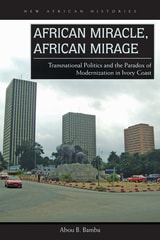
African Miracle, African Mirage
Transnational Politics and the Paradox of Modernization in Ivory CoastAbou B. Bamba
Ohio University Press, 2016
Throughout the 1960s and 1970s, Ivory Coast was touted as an African miracle, a poster child for modernization and the ways that Western aid and multinational corporations would develop the continent. At the same time, Marxist scholars—most notably Samir Amin—described the capitalist activity in Ivory Coast as empty, unsustainable, and incapable of bringing real change to the lives of ordinary people. To some extent, Amin’s criticisms were validated when, in the 1980s, the Ivorian economy collapsed.
In African Miracle, African Mirage, Abou B. Bamba incorporates economics, political science, and history to craft a bold, transnational study of the development practices and intersecting colonial cultures that continue to shape Ivory Coast today. He considers French, American, and Ivorian development discourses in examining the roles of hydroelectric projects and the sugar, coffee, and cocoa industries in the country’s boom and bust. In so doing, he brings the agency of Ivorians themselves to the fore in a way not often seen in histories of development. Ultimately, he concludes that the “maldevelopment” evident by the mid-1970s had less to do with the Ivory Coast’s “insufficiently modern” citizens than with the conflicting missions of French and American interests within the context of an ever-globalizing world.

Demons in Eden
The Paradox of Plant DiversityJonathan Silvertown
University of Chicago Press, 2005
Demons in Eden considers these questions using the latest scientific discoveries from the plant world. Readers join Silvertown as he explores the astonishing diversity of plant life in regions as spectacular as the verdant climes of Japan, the lush grounds of the Royal Botanical Gardens at Kew, the shallow wetlands and teeming freshwaters of Florida, the tropical rainforests of southeast Mexico, and the Canary Islands archipelago, whose evolutionary novelties—and exotic plant life—have earned it the sobriquet "the Galapagos of botany." Along the way, Silvertown looks closely at the evolution of plant diversity in these locales and explains why such variety persists in light of ecological patterns and evolutionary processes. In novel and useful ways, he also investigates the current state of plant diversity on the planet to show the ever-challenging threats posed by invasive species and humans.
Bringing the secret life of plants into more colorful and vivid focus than ever before, Demons in Eden is an empathic and impassioned exploration of modern plant ecology that unlocks evolutionary mysteries of the natural world.

Edward P. Dozier
The Paradox of the American Indian AnthropologistMarilyn Norcini
University of Arizona Press, 2007
Based on archival research, ethnographic fieldwork at Santa Clara Pueblo, and extensive interviews, this intellectual biography traces Dozier’s education from a Bureau of Indian Affairs day school through the University of New Mexico on federal reimbursable loans and graduate school on the GI Bill. Dozier was the first graduate of the new post–World War II doctoral program in anthropology at the University of California at Los Angeles in 1952. Beginning with his multicultural and linguistic heritage, the book interprets pivotal moments in his career, including the impact of Pueblo kinship on his indigenous research at Tewa Village (Hano); his rising academic standing and Indian advocacy at Northwestern University; his achievement of full academic status after he conducted non-indigenous fieldwork with the Kalinga in the Philippines; and his leadership in establishing American Indian Studies at the University of Arizona. Norcini interprets Dozier’s career within the contexts of the history of American anthropology and Pueblo Indian culture. In the final analysis, Dozier is positioned as a transitional figure who helped transform the historical paradox of an American Indian anthropologist into the contemporary paradigm of indigenous scholarship in the academy.

Into the Vortex
Female Voice and Paradox in FilmBritta Sjogren
University of Illinois Press, 2010
Sjogren focuses on a rash of 1940s Hollywood films in which the female voice bears a marked formal presence to demonstrate the ways that the feminine is expressed and difference is sustained. She argues that these films capitalize on particular particular psychoanalytic, narratological and discursive contradictions to bring out and express difference, rather than to contain or close it down. Exploring the vigorous dynamic engendered by contradiction and paradox, Sjogren charts a way out of the pessimistic, monolithic view of patriarchy and cinema's representation of women's voices.
Just Around The Corner
The Paradox Of The Jobless RecoveryStanley Aronowitz
Temple University Press, 2005

LBJ and Mexican Americans
The Paradox of PowerBy Julie Leininger Pycior
University of Texas Press, 1997
T. R. Fehrenbach Award, 1997
As he worked to build his Great Society, Lyndon Johnson often harkened back to his teaching days in the segregated "Mexican" school at Cotulla, Texas. Recalling the poverty and prejudice that blighted his students' lives, Johnson declared, "It never occurred to me in my fondest dreams that I might have the chance to help the sons and daughters of those students and to help people like them all over this country. But now I do have that chance—and I'll let you in on a secret—I mean to use it."
This book explores the complex and sometimes contradictory relations between LBJ and Mexican Americans. Julie Pycior shows that Johnson's genuine desire to help Mexican Americans—and reap the political dividends—did not prevent him from allying himself with individuals and groups intent on thwarting Mexican Americans' organizing efforts. Not surprisingly, these actions elicited a wide range of response, from grateful loyalty to, in some cases, outright opposition. Mexican Americans' complicated relationship with LBJ influenced both their political development and his career with consequences that reverberated in society at large.
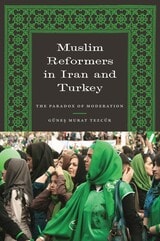
Muslim Reformers in Iran and Turkey
The Paradox of ModerationBy Güneş Murat Tezcür
University of Texas Press, 2010
Moderation theory describes the process through which radical political actors develop commitments to electoral competition, political pluralism, human rights, and rule of law and come to prefer negotiation, reconciliation, and electoral politics over provocation, confrontation, and contentious action. Revisiting this theory through an examination of two of the most prominent moderate Islamic political forces in recent history, Muslim Reformers in Iran and Turkey analyzes the gains made and methods implemented by the Reform Front in the Islamic Republic of Iran and the Justice and Development Party in Turkey.
Both of these groups represent Muslim reformers who came into continual conflict with unelected adversaries who attempted to block their reformist agendas. Based on extensive field research in both locales, Muslim Reformers in Iran and Turkey argues that behavioral moderation as practiced by these groups may actually inhibit democratic progress. Political scientist Güneş Murat Tezcür observes that the ability to implement conciliatory tactics, organize electoral parties, and make political compromises impeded democracy when pursued by the Reform Front and the Justice and Development Party. Challenging conventional wisdom, Tezcür's findings have broad implications for the dynamics of democratic progress.

On Paradox
The Claims of TheoryElizabeth S. Anker
Duke University Press, 2022

Paradox Of Natural Mothering
Chris Bobel
Temple University Press, 2001
Author Chris Bobel profiles some thirty natural mothers, probing into their choices and asking whether they are reforming or conforming to women's traditional role. Bobel's subjects say that they have chosen to follow their nature rather than social imperatives. Embracing such lifestyle alternatives as voluntary simplicity and attachment parenting, they place family above status and personal achievement. Bobel illuminates the paradoxes of natural mothering, the ways in which these women resist the trappings of upward mobility but acquiesce to a kind of biological determinism and conventional gender scripts.

School for Cool
The Academic Jazz Program and the Paradox of Institutionalized CreativityEitan Y. Wilf
University of Chicago Press, 2014
Few art forms epitomize the anti-institutional image more than jazz, but it’s precisely at the academy where jazz is now flourishing. This shift has introduced numerous challenges and contradictions to the music’s practitioners. Solos are transcribed, technique is standardized, and the whole endeavor is plastered with the label “high art”—a far cry from its freewheeling days. Wilf shows how students, educators, and administrators have attempted to meet these challenges with an inventive spirit and a robust drive to preserve—and foster—what they consider to be jazz’s central attributes: its charisma and unexpectedness. He also highlights the unintended consequences of their efforts to do so. Ultimately, he argues, the gap between creative practice and institutionalized schooling, although real, is often the product of our efforts to close it.
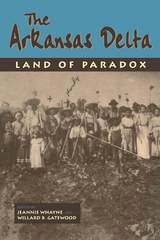
The Arkansas Delta
Land of ParadoxWilliard B. Gatewood Jr.
University of Arkansas Press, 1993

The City and the Hospital
The Paradox of Medically Overserved CommunitiesDaniel Skinner, Jonathan R. Wynn, and Berkeley Franz
University of Chicago Press, 2023
An enduring paradox of urban public health is that many communities around hospitals are economically distressed and, counterintuitively, medically underserved. In The City and the Hospital two sociologists, Jonathan R. Wynn and Berkeley Franz, and a political scientist, Daniel Skinner, track the multiple causes of this problem and offer policy solutions.
Focusing on three urban hospitals—Connecticut’s Hartford Hospital, the flagship of the Hartford Healthcare system; the Cleveland Clinic, which coordinates with other providers for routine care while its main campus provides specialty care; and the University of Colorado Hospital, a rare example of an urban institution that relocated to a new community—the authors analyze the complicated relationship between a hospital and its neighborhoods. On the one hand, hospitals anchor the communities that surround them, often staying in a neighborhood for decades. Hospitals also craft strategies to engage with the surrounding community, many of those focused on buying locally and hiring staff from their surrounding area. On the other hand, hospitals will often only provide care to the neighboring community through emergency departments, reserving advanced medical care and long-term treatment for those who can pay a premium for it. In addition, the authors show, hospitals frequently buy neighborhood real estate and advocate for development programs that drive gentrification and displacement.
To understand how urban healthcare institutions work with their communities, the authors address power, history, race, and urbanity as much as the workings of the medical industry. These varied initiatives and effects mean that understanding urban hospitals requires seeing them in a new light—not only as medical centers but as complicated urban forces.
The Paradox of Agrarian Change
Food Security and the Politics of Social Protection in IndonesiaEdited by John McCarthy, Andrew McWilliam, and Gerben Nooteboom
National University of Singapore Press, 2023
Economic growth in the middle-income countries of Southeast Asia over the past few decades has been widely praised for reducing poverty in both absolute and relative terms. Indonesia is a prime example. But while poverty has declined in Indonesia, patterns of food poverty persist across Indonesia. What explains this troubling paradox? How does it relate to Indonesia’s enthusiastic embrace of the “entitlements revolution,” the use of direct cash transfers as a tool for reducing poverty and building social inclusion?
This book analyzes the nature and social consequences of economic development and agrarian change processes in rural Indonesia in relation to the scope and effectiveness of Indonesia’s social protection programs. The findings are based on a series of extensive ground-up case studies in Indonesian communities in a variety of eco-agrarian settings that seek to understand the drivers of food insecurity and vulnerability at a household level. The results show that while high-value farming, diversification, and migration may offer a means of economic progress for poor households, opportunities for accumulation are limited. This, the authors show, is due to the way class, gender, and power work in remote local contexts, and the fact that much surplus income is used for enhanced consumption and changing lifestyles. There are few signs of the classical structural transformation of the countryside which has historically been considered the most decisive pathway out of rural poverty. The authors conclude that social assistance is unlikely to counter the persistence of rural poverty, food insecurity, and precarity in the absence of other redistributive strategies that shift the structural drivers of inequality.
The Paradox of Authenticity
Folklore Performance in Post-Communist SlovakiaJoseph Grim Feinberg
University of Wisconsin Press, 2018
In Slovakia and elsewhere in Eastern Europe after World War II, Communist governments promoted folklore revivals and staged performances of song and dance as representations of "the people." When the Communists fell from power in Slovakia in 1989, folklore was also discredited in the eyes of many. By the early twenty-first century, however, a new generation launched a movement to revive folklore's reputation and reintroduce it to a broad public.
Weaving together personal narrative, ethnographic analysis, and philosophical reflection, Feinberg examines the aspirations and difficulties of young folk dance devotees as they recognize that authenticity is more easily prized than achieved. He sheds new light on the problems of specialized performance and broad participation, the uneasy relationship between folklore and the public sphere, and the paradoxical pursuit of authenticity in the modern world.

The Paradox of Blackness in African American Vampire Fiction
Jerry Rafiki Jenkins
The Ohio State University Press, 2019
The Paradox of Connection
How Digital Media Is Transforming Journalistic LaborDiana Bossio, Valérie Bélair-Gagnon, Avery Holton, and Logan Molyneux
University of Illinois Press, 2024
Using a framework of online connection and disconnection, The Paradox of Connection examines how journalists’ practices are formed, negotiated, and maintained in dynamic social media environments. The interactions of journalists with the technological, social, and cultural features of online and social media environments have shaped new values and competencies--and the combination of these factors influence online work practices. Merging case studies with analysis, the authors show how the tactics of online connection and disconnection interact with the complex realities of working in today’s media environments. The result is an insightful portrait of fast-changing journalistic practices and their implications for both audiences and professional identities and norms.
The Paradox of Democracy
Free Speech, Open Media, and Perilous PersuasionZac Gershberg and Sean Illing
University of Chicago Press, 2022
At the heart of democracy lies a contradiction that cannot be resolved, one that has affected free societies since their advent: Though freedom of speech and media has always been a necessary condition of democracy, that very freedom is also its greatest threat. When new forms of communication arrive, they often bolster the practices of democratic politics. But the more accessible the media of a society, the more susceptible that society is to demagoguery, distraction, and spectacle. Tracing the history of media disruption and the various responses to it over time, Zac Gershberg and Sean Illing reveal how these changes have challenged democracy—often with unsettling effects.
The Paradox of Democracy captures the deep connection between communication and political culture, from the ancient art of rhetoric and the revolutionary role of newspapers to liberal broadcast media and the toxic misinformation of the digital public sphere. With clear-eyed analysis, Gershberg and Illing show that our contemporary debates over media, populism, and cancel culture are not too different from the democratic cultural experiences of the past. As we grapple with a fast-changing, hyper-digital world, they prove democracy is always perched precipitously on a razor’s edge, now as ever before.

The Paradox of Gender Equality
How American Women's Groups Gained and Lost Their Public VoiceKristin A. Goss
University of Michigan Press, 2013
Drawing on original research, Kristin A. Goss examines how women's civic place has changed over the span of more than 120 years, how public policy has driven these changes, and why these changes matter for women and American democracy. Suffrage, which granted women the right to vote and invited their democratic participation, provided a dual platform for the expansion of women's policy agendas. As measured by women's groups' appearances before the U.S. Congress, women's collective political engagement continued to grow between 1920 and 1960—when many conventional accounts claim it declined—and declined after 1980, when it might have been expected to grow. This waxing and waning was accompanied by major shifts in issue agendas, from broad public interests to narrow feminist interests.
Goss suggests that ascriptive differences are not necessarily barriers to disadvantaged groups' capacity to be heard; that enhanced political inclusion does not necessarily lead to greater collective engagement; and that rights movements do not necessarily constitute the best way to understand the political participation of marginalized groups. She asks what women have gained — and perhaps lost — through expanded incorporation as well as whether single-sex organizations continue to matter in 21st-century America.
The Paradox of Gender Equality
How American Women's Groups Gained and Lost Their Public VoiceKristin A. Goss
University of Michigan Press, 2020
Goss asks what women have gained, and perhaps lost, through expanded incorporation, as well as whether single-sex organizations continue to matter in 21st-century America.
The Paradox of Paradise
Creative Destruction and the Rise of Urban Coastal Tourism in Contemporary Spanish CultureWilliam J. Nichols
Vanderbilt University Press, 2023
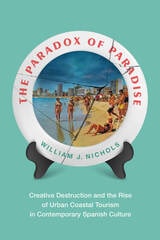
In addition to inserting the coasts into the scope of Iberian urban studies (typically dominated by studies of Madrid and Barcelona), this project breaks new ground by bringing to the fore unexplored cultural artifacts vital to the narrative of development along the coasts in Spain—in particular the ubiquitous tourist postcard, which advances not only the post-Franco economic miracle, but does so by highlighting the transformation of the actual Spanish landscape along its coasts.
The Paradox of Paradise features more than twenty-five striking images of coastal Spain in the throes of its own coming of age. Author William J. Nichols has unlocked a strange, self-conscious archive that tells us as much about our own age of advertising as it does about the hotels and resorts and people on display.

The Paradox of Progress
Economic Change, Individual Enterprise, and Politic Culture in Michigan, 1837-1878Martin J. Hershock
Ohio University Press, 2003
Guiding this transformation was the nineteenth-century Republican party. Drawing heavily from both the pro-market commitments of the early Whig party and the anti-capitalist culture of Jackson's Democratic party, the early Republican party found itself torn between these competing values. Nowhere was this contested process more obvious or more absorbing than in Civil War-era Michigan, the birthplace of the Republican party.
In The Paradox of Progress, a fascinating look at the central factors underlying the history of the GOP, Martin Hershock reveals how in their determination to resolve their ideological dilemma, Republicans of the Civil War era struggled to contrive a formula that wo uld enable them to win popular elections and to model America's acceptance of Gilded Age capitalism.

The Paradox of Progressive Thought
David W. Noble
University of Minnesota Press, 1958
The Paradox of Progressive Thought was first published in 1958. Minnesota Archive Editions uses digital technology to make long-unavailable books once again accessible, and are published unaltered from the original University of Minnesota Press editions.
This book describes and analyzes an important aspect of American intellectual history, the climate of opinion in which nine leaders of progressive thought in America in the late nineteenth and early twentieth centuries were important creators and spokesmen. By closely examining the central ideas of these men, Professor Noble presents an illuminating view of a significant phase of the liberal tradition in America. At the same time, he questions many of the generally accepted views about the philosophical basis of traditional liberalism and demonstrates the paradox of progressive thought.
The social philosophers whose writings and teachings he scrutinizes are Herbert Croly, long-time editor of the New Republic; James Mark Baldwin, psychologist and philosopher; Charles H. Cooley, author of Social Organization; F. H. Johnson, theologian whose name was linked with Darwinism; Henry Demarest Lloyd, reformer and newspaperman who attacked the evils of monopoly in his book Wealth and Commonwealth; Richard T. Ely, economist and early advocate of Christian socialism; Simon N. Patten, whose work The Premises of Political Economy lifted him to fame; Thorstein Veblen, whose Theory of the Leisure Class is a household word today; and Walter Rauschenbusch, the Baptist clergyman who wrote Christianity and the Social Crisis and Christianity and the Social Order. In addition, there is extensive consideration of the thought and influence of Carl L. Becker, the noted historian and analyst of thought and philosophy in action.

The Paradox of Protection
The Making of Indirect Rule in Southern Sierra Leone, 1850–1915Trina Leah Hogg
Michigan State University Press, 2025

The Ruling Passion
British Colonial Allegory and the Paradox of Homosexual DesireChristopher Lane
Duke University Press, 1995
Through attentive readings of sexual and political allegory in the work of Kipling, Forster, James, Beerbohm, Firbank, and others—and deft use of psychoanalytic theory—The Ruling Passion interprets turbulent scenes of masculine identification and pleasure, power and mastery, intimacy and antagonism. By foregrounding the shattering effects of male homosexuality and interracial desire, and by insisting on the centrality of unconscious fantasy and the death drive, The Ruling Passion examines the startling recurrence of colonial failure in narratives of symbolic doubt and ontological crisis. Lane argues compellingly that Britain can progress culturally and politically only when it has relinquished its residual fantasies of global mastery.
The Tension Of Paradox
José Donoso’s the Obscene Bird of Night As Spiritual ExercisesPamela May Finnegan
Ohio University Press, 1992
Pamela Finnegan provides a detailed criticism of a major novel written by one of Chile’s leading literary figures. She analyzes the symbolism and the use of language in The Obscene Bird of Night, showing that the novel’s world becomes an icon characterized by entropy, parody, and materiality. Her study concludes that all linguistic ordering fictionalizes, that the lack of spirituality within the novel’s world is symptomatic of language gone stale, and that blindness to this fact leads to dogma or solipsism, each counter-productive to communication and human endeavor. To revive the linguistic system, she argues, we must revive the creative power of language.

The Virtual Haydn
Paradox of a Twenty-First-Century KeyboardistTom Beghin
University of Chicago Press, 2015
With The Virtual Haydn, Tom Beghin—himself a professional keyboard player—delves deeply into eighteenth-century history and musicology to help us hear a properly complex Haydn. Unusually for a scholarly work, the book is presented in the first person, as Beghin takes us on what is clearly a very personal journey into the past. When a discussion of a group of Viennese sonatas, for example, leads him into an analysis of the contemporary interest in physiognomy, Beghin applies what he learns about the role of facial expressions during his own performance of the music. Elsewhere, he analyzes gesture and gender, changes in keyboard technology, and the role of amateurs in eighteenth-century musical culture.
The resulting book is itself a fascinating, bravura performance, one that partakes of eighteenth-century idiosyncrasy while drawing on a panoply of twenty-first-century knowledge.

Victims as Offenders
The Paradox of Women's Violence in RelationshipsMiller, Susan L.
Rutgers University Press, 2005
Arrests of women for assault increased more than 40 percent over the past decade, while male arrests for this offense have fallen by about one percent. Some studies report that for the first time ever the rate of reported intimate partner abuse among men and women is nearly equal. Susan L. Miller’s timely book explores the important questions raised by these startling statistics.
Are women finally closing the gender gap on violence? Or does this phenomenon reflect a backlash shaped by men who batter? How do abusive men use the criminal justice system to increase control over their wives? Do police, courts, and treatment providers support aggressive arrest policies for women? Are these women “victims” or “offenders”?
In answering these questions, Miller draws on extensive data from a study of police behavior in the field, interviews with criminal justice professionals and social service providers, and participant observation of female offender programs. She offers a critical analysis of the theoretical assumptions framing the study of violence and provides insight into the often contradictory implications of the mandatory and pro-arrest policies enacted in the 1980s and 1990s. Miller argues that these enforcement strategies, designed to protect women, have often victimized women in different ways. Without sensationalizing, Miller unveils a reality that looks very different from what current statistics on domestic violence imply.

Voices in the Wilderness
Public Discourse and the Paradox of Puritan RhetoricPatricia Roberts-Miller
University of Alabama Press, 1999
Both Jürgen Habermas and Wayne Booth—two of the most influential theorists in the domain of public discourse and good citizenry—argue for an inclusive public deliberation that involves people who are willing to listen to one another, to identify points of agreement and disagreement, and to make good faith attempts to validate any disputed claims. The Puritan voice crying in the wilderness, Roberts-Miller shows, does none of these things. To this individual of conscience engaged in a ceaseless battle of right and wrong against greedy philistines, all inclusion, mediation, and reciprocity are seen as evil, corrupting, and unnecessary. Hence, the voice in the wilderness does not in any real sense participate in public deliberation, only in public pronouncement.
Arguing that our culture’s continuing affection for the ethos of the voice crying in the wilderness is one of our more troubling inheritances from the early American ambivalence to public discourse—including the Puritan denigration of rhetoric—Roberts-Miller contends that the monologic discourse of the Puritans in fact contains within it arguments for dialogism. Thus, the history of rhetoric can provide much richer fields for reimagining discourse than heretofore credited. Roberts-Miller concludes by extending her findings into their practical applications for argumentation in the public sphere and in the composition classroom.
Wage Justice
Comparable Worth and the Paradox of Technocratic ReformSara M. Evans and Barbara N. Nelson
University of Chicago Press, 1991
"A perceptive and judicious analysis of comparable worth."—Wendy Kaminer, New York Times Book Review
"Very well-crafted. . . . Wage Justice has admirably launched the scholarly evaluation of pay equity, revealing the unforeseen complexities of this key feminist public policy innovation."—Maurine Weiner Greenwald, Journal of American History
"An insightful glimpse of the policy process."—Marian Lief Palley, American Political Science Review

Women In Utah History
Paradigm Or Paradox?Patricia Lyn Scott & Linda Thatcher
Utah State University Press, 2005
A Comparison of Utah Mormon Polygamous and Monogamous Women Jessie L. Embry and Lois Kelley